
…
Maria Hussakowska
I never met Teresa Tyszkiewiczowa. She was an important figure on the post-war art scene for me, the author of several superb paintings I remembered from the museum in Łódź. I also remembered her portrait, an extraordinarily evocative photograph by Ireneusz Pierzgalski (which he showed at one of the open-air gatherings in the secluded countryside near Poznań). I imagined her – doubtless also on the basis of stories I had heard from people in Łódź – as an intellectual, an artist who trusted her instincts, and at the same time an elegant woman. Among friends she was known as ‘the Countess’, and this was evident even in that photograph. Intrigued by fragmentary recollections, I responded all the more enthusiastically to Atlas Sztuki’s proposal and began reviewing the material being sent to me: more than a hundred reproductions of works, notebooks containing the artist’s notes and a few occasional texts by friends. What should I choose from this wealth of disparate information, what trail should I follow – since I was certainly not going to write the outline of a monograph?
The first important traces in the discourse of post-war art are connected with the artist’s presence at three exhibitions that shaped many artistic biographies. Her participation in the 1st Exhibition of Modern Art in 1947, as in its second edition in 1957 and third in 1959, consolidated her affiliation with the moderns – a group of highly diverse artists for whom even the notion of modernity invoked by the title was not always coherent.
Looking at artists of her generation entangled in modernity and its myths, we find a variety of attitudes united by an emphasis on freedom of the imagination. That freedom, threatened – indeed called into question – by the doctrine of Socialist Realism, was negotiated by artists in different ways and in the name of projects sometimes in open contradiction with one another, from nihilism to a committed, intensified realism.
Invited to the first post-war presentation of the ‘surviving moderns’, Tyszkiewicz wrote to Tadeusz Kantor that she was ‘terribly curious about the exhibition’, but would like to know the composition of the jury, especially the invited members. Looking at reproductions of the submitted works, it is difficult to imagine that her fears about the jury’s response had any foundation. Her paintings, made in full awareness of the Cubist revolution, fully accord with the exhibition’s premises as emphatically defined by Mieczysław Porębski. They demonstrate that ‘today the classics of Cubism teach us the utmost precision of form, aptness of ideas, economy of means and simplicity of formulation’1. In the painting Struggle from 1948, reproduced in the folder, two twisted figures assembled from numerous geometric shapes are placed, in a suggestive dynamic foreshortening, within a spatial construction that remains unclear. The titular struggle unfolds as if on the flat stage of a square, with a strongly outlined configuration of wing-like buildings receding into depth, contrasted with a flatly treated background plane. In these ambiguous, provocative spatial solutions, the lesson of Synthetic Cubism is evident, as is a distinctive reading of Surrealism. The movement of the combatants – figures rather than characters – commands attention through abrupt foreshortenings that compel the eye to follow a line into the painting’s depth, only for it suddenly to break off. One can also find certain anatomical forms in the picture: the outline of a bust, a foot with splayed toes, some bird-like or animal heads that allow even an exuberant imagination to read the struggle in terms of the age-old conflict between the sexes. Without pursuing this interpretative thread, one can certainly accept another trail, strongly present among other artists at that exhibition, who foregrounded figures of ambiguous anatomy.

In various works by the artist – paintings and drawings from the 1940s – we find what seem to be female figures constructed from wire, splayed and trapped in the shallow space of the picture. The struggle of figures akin to one another in dynamic movement is most emphatically presented in a watercolour from that period. Contemporary Polish art-historical discourse has recognised the invocation of the dehumanised human figure as exceptionally important in those activities, which for that generation of artists amounted to an accession to modernity. The traumatic memory behind these images overlapped with programmes formulated by artists and based on divergent world views – from revised Marxism and existentialism to Christian personalism. Tyszkiewiczowa’s wartime reading did not differ from what was read at the time: Proust appears, discussed at length, as do Nietzsche, Wilde and Bergson. The last of these authorises her to state: ‘I simply do not understand how one can be guided by consciousness and reason in art, when I enjoy creation only when I discover and when I understand nothing at all. Every law, once understood, ceases to interest me; but bringing to light a vision hidden in the subconscious is so enabling a stimulus that it cannot be resisted.’ (T. Tyszkiewiczowa, Notatki [Notes] (1940–1983), notebook I). The Confessions of Saint Augustine, with its extensive discussion of the imagination, was important as well. This impressive range of reading would naturally evolve in subsequent years.
In drawings from the early 1950s the line becomes calmer and more rigid, enclosing more clearly defined forms. This doubtless bears some relation to the particular tasks the artist undertook in the Textile Department of the State Higher School of Visual Arts – a highly feminine and highly useful discipline. Working with textiles has its own rules, which the artist would observe diligently. Yet viewed as autonomous creations, the drawings say something important about this phase of her work. Thus the abstract Composition of 1950, in the collection of the museum in Łódź, is a masterpiece. And as tends to be the case with such works, the lines seduce the eye, soaring through space and defining fascinating trajectories; drawn more firmly, they mark out seams, constructing the edges of forms that initiate further spatial explorations. What in this drawing is so precise? Is the precision of the composition a matter of perfectly chosen forms and the relationships between them, which we begin to discern as we focus on what is represented? Can we once again become convinced that nothing here could be changed or removed, and that no further line could be introduced? Everything is held in perfect balance – tensions and harmonies alike.
After a few years, the relationships between forms become increasingly subtle. The language of abstraction becomes ever more fully the artist’s own. The notes she kept over the years – for herself and for utilitarian, teaching purposes – attest to her sound grasp of the thicket of tendencies in contemporary abstract painting. Not content merely to record facts, Tyszkiewiczowa often penetrates the motivations of artists and seeks their answers to the most important questions. She probes and clarifies, situating the artists she studies within ever broader contexts – extending as far as an outline history of philosophy created for her own use.
Among notes dated 29 October 1960, we find the following artistic credo:
‘I neither seek God through art, nor do I wish to express any truths or laws concerning the material world, nor do I need its correlations with science, nor do I look within it for affinities (Paris) with certain organic structures (microscopic ones among them), nor is my purpose self-expression (Spain). Through abstract art I wish to express (and I believe that, when it is art, it fulfils this role well) and bear witness to the existence of truths and of a world beyond matter (I am of course not speaking here of feelings or sensations, which are material in nature). A good painting is one with the greatest capacity to stimulate associations. The tragedy of humanity lies in its eternal and unattainable search for Truth, the Absolute and Love. I believe that many abstract paintings partly fulfil this role, and that is why I feel good in their presence.’ (T. Tyszkiewiczowa, Notatki [Notes] (1940–1983), notebook V)
It should be explained that this good contact – that is, the kind of intimate communion with the sublime that she found indispensable – applied both to viewing other artists’ paintings and to continuing her own painterly experiments, among which abstraction had already predominated for years. Behind the artist stood the tradition and contemporary practice of the language of abstraction; Hans Hartung and Georges Mathieu were certainly among those closest to her.
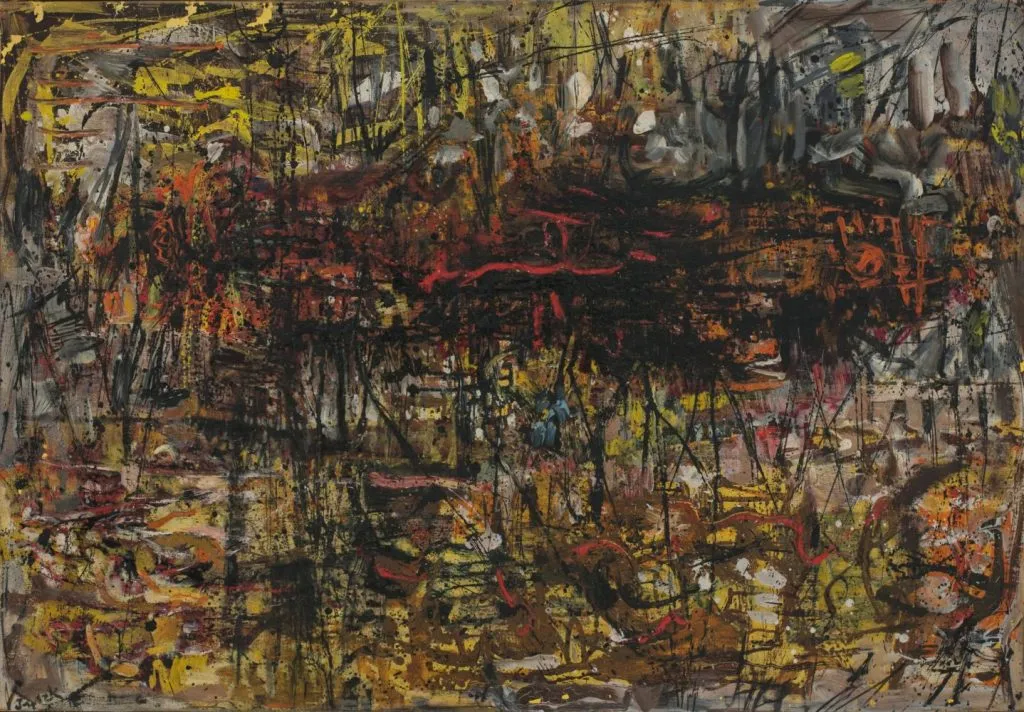
After the gestural paintings, dominated by the presence of a tangled, trembling form in shallow space, the compositions grow quieter: the rectangle of canvas or sheet of paper emanates emptiness. On the surface, just a few lines suggest paths running into the distance, their course abruptly breaking off. The roads may also resemble the outlines of a labyrinth, turning and looping repeatedly, only to lose themselves unexpectedly and merge into the background. Traverses run across some canvases. The line constructing them has a severity not encountered in the earlier works. This is the cycle closest to me – Blind Alleys. Let us begin with a quotation:
‘If we recall that empty space in Zen painting is motionless and at the same time in motion, seems to live and breathe, is formless and empty, and at the same time is the source of all forms. It has no name, and at the same time is the reason why things have names (…). What is not suggested and articulated is more important and more expressive than what is suggested and articulated’2. Herrigel does not in fact appear in the artist’s notebooks, but reflections on Zen naturally do. For her, as for a younger generation of American and European artists, Zen philosophy held great intellectual appeal. Whether emptiness, one of the protagonists of this series, derives from it is difficult to determine conclusively. It is as Julian Barnes observed: a writer does not write ‘about’ their subjects and objects but generally circles ‘around’ them. Some painters proceed in a similar way.
‘The artist is moved by multiple realities. The artist is moved by empty space and points of light. The artist examines the picture. Does light pass through it, or is it reflected? Is it sharp and distinct; does it have boundaries, a form?’3.
These paintings can be viewed in yet another way, and their emptiness read with, for example, the lines of Emily Dickinson’s There is a solitude of space… in mind. Yet if we focus on the lines that interrupt and intrude upon this emptiness – the titular blind alleys – an entire wealth of interpretative trails opens up. The road, after all, is one of the fundamental topoi, not only of modernism. And a road leading nowhere provides a merely somewhat narrower – and exceptionally attractive – field of interpretation. In the sphere of purely visual references to the 1960s and subsequent decades, these paintings certainly evoke reductionism, and not only that of the Minimalist circle. Despite a wholly different scale and medium, they also contain something of Land Art, of drawings left on deserts or stretches of snow along the Canadian–American border.
‘The essential content of my paintings is wonder, continual wonder at the world, its mystery, power, possibilities and drama. But that is perhaps not the most important thing for me, although… I do not know. I think the mystery of the world is most important to me. I live by the contents of my paintings; I remember them through their contents. With passionate regret I remember the contents of certain pictures that I ruined and that had to cease to exist. Yet their unique, singular content lives within me. I do not possess these contents when I begin to paint. How could I shape a form for wonder and love a priori? I must grasp it with wonder and vigilance in every second of my work. As I give birth to them, I follow them with concentration. I bid them live or die, depending [on] the form they have taken. And I must bring them to a single, summative expression, and then leave them alive.’ (T. Tyszkiewiczowa, Notatki [Notes] (1940–1983), notebook V)
Surely no one doubts that communing with Teresa Tyszkiewicz’s paintings – those she left alive – is an extraordinary experience. They are the kind of art objects about which Jeanette Winterson writes extensively in her essays on ecstasy and effrontery4. Commentary on women’s art after feminism always presupposes the presence of that discourse, even when written without an overt or covert intention of introducing the histories of absent women into art-historical discourse. In this particular case one cannot fail to notice that an active, respected artist, strongly present in the artistic life of several decades, was marginalised by the discourse of art history. The paintings – their impeccable form – the original notes kept over many years and the remarkable life experiences all compel renewed, attentive focus on the art of Teresa Tyszkiewicz.
Dr hab. Maria Hussakowska has worked for many years in the Institute of Art History at the Jagiellonian University, in the Department of Modern Art. Since 2005 she has chaired the Programme Council of the Curatorial Museum Studies programme operating within the Institute of Art History at the Jagiellonian University. She is a member of the Polish Section of AICA (International Association of Art Critics) and the author of the books Minimalizm w sztukach wizualnych. Demitologizacja pojęcia awangardy w amerykańskim środowisku artystycznym lat sześćdziesiątych (2003) and Spadkobiercy Duchampa? Negacja sztuki w amerykańskim środowisku artystycznym (1984). With E. M. Tatar she edited the anthologies Display. Strategie wystawiania (2012) and Talking about Exhibition/Rozmawiając o wystawie (2012).
1. M. Porębski, Impresjonizm, kubizm i nowe malarstwo, ‘Nurt’ 1947, no. 2, quoted in: I Wystawa Sztuki Nowoczesnej. Pięćdziesiąt lat później, ed. J. Chrobak and M. Świca (Starmach Gallery exhibition catalogue), Kraków 1998, p. 315.
2. E. Herrigel, The Method of Zen, quoted in: A. Kozyra, Estetyka Zen, Warsaw 2010, pp. 123–124.
3. J. Winterson, O sztuce. Esej o ekstazie i zuchwalstwie, Poznań 2001, p. 142.
4. J. Winterson, O sztuce. Esej o ekstazie i zuchwalstwie, op. cit.