
Krystyna Krygier and Monika Krygier
in conversation with Stefan Szydłowski
Stefan Szydłowski: For Stefan Krygier, was Strzemiński more a Master or a teacher?
Krystyna Krygier: First he was a professor and teacher, later a Master and friend. One cannot look at it so analytically, because everything was entangled in daily life and intertwined. He began to be a Master when they started to agree on certain concepts in art and in thinking about art. As a former student, Stefan quickly began to put their shared ideas into practice and organise exhibitions. Those were times when one studied quickly and entered life quickly. Another factor was that when Stefan began his serious engagement with art, he immediately became involved in theory too. There were also the difficulties arising from the times and Strzemiński’s family situation. Stefan took presents for Nika and money from Strzemiński to Kobro. He worked with Strzemiński on texts.
S. Sz.: I would like to ask about understanding and practising art (‘a product of intellectual inquiry’—B. Kowalska): artist and/or scholar?
K. K.: There is nothing wrong with an artist thinking. Artists should think through what they do before making it public. I believe that here too Stefan was influenced by his profession as an architect; this must be remembered. In his case, a strict division into artist or scholar does not apply. There is a far-reaching similarity between both Strzemińskis and Stefan. Strzemiński began at an engineering school, Kobro studied architecture, and Stefan’s story was similar. The climate of the time exerted a further influence: openness to applied art and the living traditions of the Bauhaus. Strzemiński effectively began and disseminated this. He drummed it into our heads as students: art does not exist simply for its own sake, but also directs activity in other fields. Strzemiński attached great importance to this, as did his students.

S. Sz.: Knowing about Strzemiński’s difficulties, did Stefan Krygier choose architecture as a kind of refuge?
K. K.: First, the matter is very straightforward. After graduating, compulsory work assignments were in force, so one’s workplace was an architectural office and one had to practise the profession. He continued his studies at Warsaw University of Technology, whose diploma in architecture was highly valued at the time. He was invited to stay there for a doctorate, but by then he had become absorbed in painting, and everything proceeded as we know. A person supposedly decides on their own steps, but those decisions are influenced by the kind of road or pavement beneath them, and something of that kind happened here too. Architecture made Stefan completely independent.
S. Sz.: How was it possible for you, while still students, to stand in the front rank of artistic life at the time?
K. K.: Stefan founded the Artists and Scientists Club in Łódź, and we began exhibiting at the YMCA, where Ptycia, a friend of Stefan’s from secondary school, worked. Once we had our own flat, everything became quite simple—we had somewhere to invite Strzemiński and show what we were doing, while avoiding various ‘obstructions’ encountered around the city. Hanka Orzechowska and Danusia Kulanka had social contacts conducive to collaborating with other circles. Julian Przyboś took great care of Strzemiński during his illness. Social relationships developed, yet at the same time we continued to engage intensely and with genuine conviction in art. An artistic group formed outside the union (ZPAP), which, for those of us associated with Strzemiński, was not friendly. Not only success but difficulties bind people together.
S. Sz.: How did the 1948 exhibition From Baroque to Cubism come about?
K. K.: He organised it himself. It is highly significant for understanding art’s historical development. Books about the development of art followed, and a whole direction emerged. Contact was established with Silesia and the St-53 Group. Swinarski brought Stefan there; he drove that collaboration and had already been our friend, so everything developed almost naturally. We valued direct contact with people more highly than looking for ways to enter the ruts of the Union of Polish Artists. That also arose from our avoidance of and opposition to the Union. It fostered our activity. Later, personal and social contacts became more important because artistically we went in different directions. I, for example, was friends with Broll the poet—not Broll the painter. Stefan occupied an entirely different position, because he was an independent artist from the outset. He always had a tendency towards independence in art and in life generally.
S. Sz.: Did turning towards the distant art of Egypt allow Stefan Krygier to stand more securely on his own feet?
K. K.: Where did Egypt come from? First, I think the fact that Stefan was also an architect exerted an influence. Egyptian art was so constructivist and concretely formulated—it was never daubing, but concrete things reduced to a particular solid. It was easy for Stefan to enter it and understand what it was about.
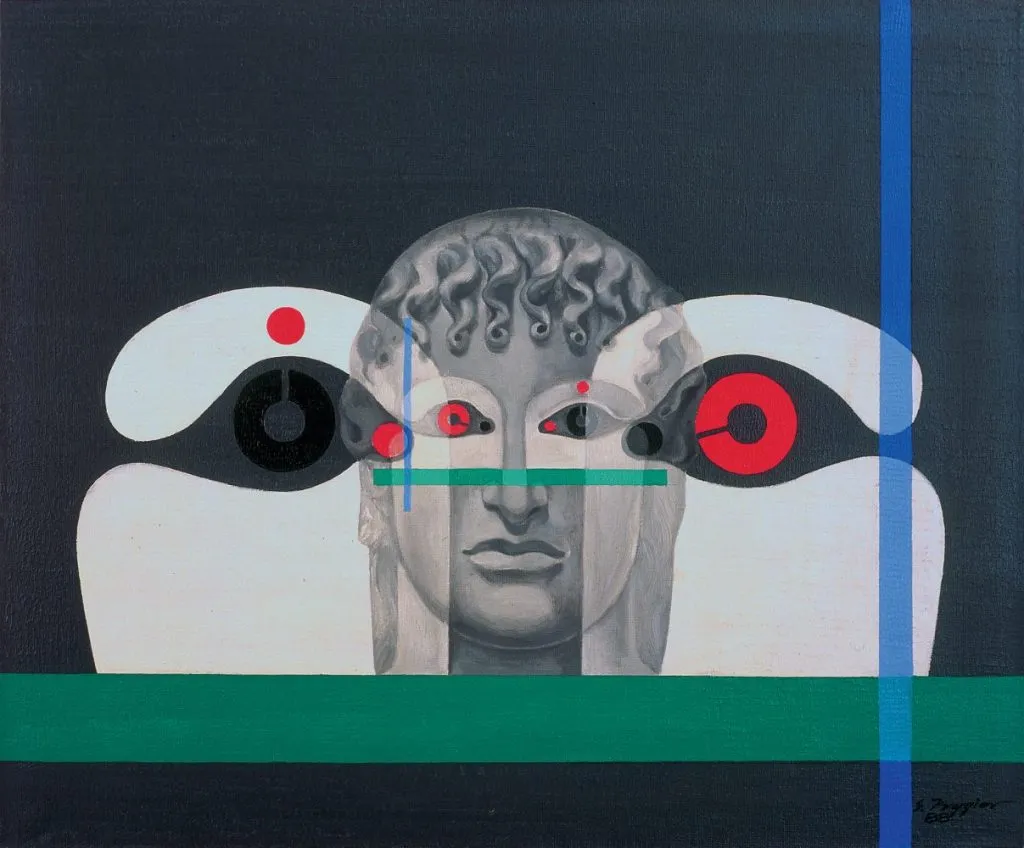
S. Sz.: I think the problems of Egyptian art also offered an escape from contemporary reality.
K. K.: To some extent, yes, but above all it allowed him to concentrate on important questions in art. It shaped his relationship with art, certain rigours and consistency. Within all this there was also Strzemiński’s example. He was exceptionally independent in his thinking about art and never bound to anything so closely that he could not say yes or no. Their characters were even similar. It was a matter of maintaining one’s own views and individuality. Stefan was present in galleries and circles that did not violate or interfere with an artist’s distinctness and separateness, such as Krzywe Koło, Gallery 72 and Osieki.
S. Sz.: After Strzemiński, who became a partner in discussion?
K. K.: Marian Bogusz—Bogusz above all. He did not concern himself only with his own work but also organised artistic life. Thanks to him, contacts remained active and new things emerged. At that time, the Warsaw art community was closer to us; we had prejudices about Kraków, believing Matejko’s spirit still dominated there. There was no significant contact with Tadeusz Kantor then. Julian Przyboś was very important to us, because our relations with him became very close and before our eyes an affection developed between him and Danusia Kulanka. Przyboś wrote in Przegląd Artystyczny that a new phenomenon had been born in art and its name was Stefan Krygier. This was in the 1950s, and at the time that statement harmed more than helped. Everyone turned their backs on us: what was this? No one had known Krygier until then, and suddenly here was such a phenomenon in art. They could not bear it.
Monika Krygier: That, Strzemiński’s death and the refusal to admit him to the Union caused my father to withdraw for a time and take refuge in architecture.
S. Sz.: Jerzy Krawczyk also played a major role in shaping Stefan Krygier’s position.
K. K.: What did Krawczyk mean to Stefan? He was an excellent craftsman, and I think Stefan owed to him his fondness for perfect execution. He absorbed that from Krawczyk and accepted it as essential to the expression of art. If one wishes to say something, one must do it clearly. This is not about realism but about giving concrete form to what is said. Present something concrete, not intentions held by the artist which the viewer is expected somehow to understand out of nowhere. Krawczyk already had extensive experience; through his teacher he drew on the Munich school. His technique was superb, he could pass it on, and it had value. Stefan managed to pick up precisely this because, as we know, he too attached great importance to technique.
M. K.: They did not want to admit my father to the Union. There is a very interesting record of another meeting of the Union of Polish Artists. His later admission to ZPAP was thanks to Krawczyk, who was chair at the time and held considerable influence in the Union. Earlier, however, it was argued that Krygier was slandering the Union. In a sense he was, because of the destruction of the relief designed by Strzemiński1. He did indeed describe the situation, and Julian Przyboś referred to his account. At that moment, Stefan Krygier became public enemy number one in the community. The Łódź milieu that had produced extremely avant-garde figures, led by Strzemiński, was for the most part terribly conservative and anxious about preserving its possessions, various sinecures and similar sources of income. There was an immense gulf between the avant-garde artists and the mass of visual artists. My father was also friends with Artur Sandauer, whom he valued highly; their friendship formed during the open-air workshops in Osieki. He was also close to artists from Wrocław.
K. K.: Those connections also came through architecture. There were artists there who, like us, had studied architecture2. At that time architecture was a kind of refuge, a safeguard within the art world, although it also happened that architecture moved to the centre of politicians’ attention, and substantive issues no longer determined the fate of people and their work. It should be added that architectural commissions brought very concrete money. Stefan enjoyed discussing things with Sandauer and was very fond of Erna Rosenstein too. Whenever he was in Warsaw, he tried to meet them. Erna had a magnificent imagination and her own distinctive ability to leap from subject to subject. In their creative work, however, they were very different. In Warsaw we also had, of course, Przyboś, Hanka Orzechowska, Danka Kulanka and, naturally, Nika Strzemińska. At times we had more friends in Warsaw than here in Łódź.
M. K.: And my father’s decision to abandon architecture, to cut himself off completely?
K. K.: It was not such a complete break. Some connection always remained, indirectly through art, but always. That withdrawal occurred when it became possible, when one could already choose one’s profession. It was always complex—the 1950s were a time of compulsory employment in the profession acquired through one’s studies.
M. K.: And returning to Krawczyk, to the war years…
K. K.: Yes, as I think I have already said, Stefan took his love of painting and fine craftsmanship from Krawczyk. They retained a friendly relationship until the end, although their works were entirely different and their views of art diverged. It mattered that they had been friends since childhood. Krawczyk’s family and aunts were strange and lived in a strange, somewhat Surrealist house—that fascinated Stefan too. What went on in that house was complete Surrealism: a group of elderly people and their customs, and at the same time Krawczyk, who painted those aunts of his.
M. K.: Krawczyk did not enjoy travelling, whereas my father loved it—the further the better. He brought photographs home from his journeys, and Krawczyk sometimes painted pictures from them, pictures my father would never have wanted to paint because he was not interested in painting the water in Venetian canals realistically. The discussions and disagreements with Krawczyk probably contributed a great deal to shaping my father’s position. Perhaps that particular friendship influenced his separateness within Polish art. Even when he established contacts with artistic groups, he somehow stood apart from them.
K. K.: I also want to return to the Exotic café, because it is quite important and cut very deeply into relationships in Łódź. First, it involved Władysław Strzemiński, the work’s creator; second, Stefan Krygier, its maker; and third, Edward Nowicki, an artist who had arrived from Vilnius. All this was alien to the local artists and prompted vicious attacks. Grygiel, Jackowski and a third man—particularly painful to mention because he was an architect who worked with us in the urban-planning office—Guttman, were all furious that something was being executed according to Strzemiński’s design, by a student of Strzemiński and, in effect, an enemy of the other Łódź artists. It is a very ugly chapter in those people’s lives. They then turned on Stefan. I must also say that during the debate about the Exotic café relief—whether to destroy it or not—the client said the work could simply be covered. Stefan Wegner, however, stood up and said: you want to destroy the only sculpture by a man who is dying in hospital! Those were indeed his final days. Despite everything, Strzemiński had defenders who accepted his art, although the decisions were not theirs to make.
M. K.: My father’s way of thinking about art was connected with Strzemiński’s also in the urge to keep searching anew for a new answer.
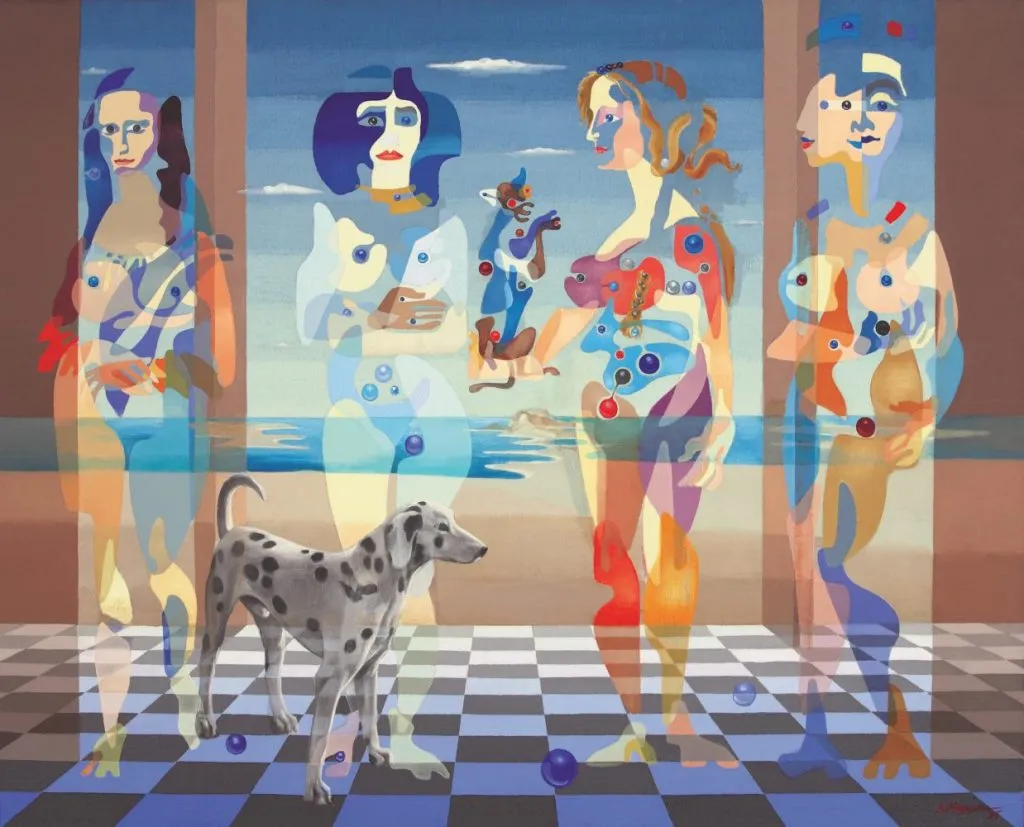
K. K.: Stefan was not schematic. It was not principles such as geometry that determined the shape of his painted works, but forms that at the given moment were the best means of expression and best served the picture’s composition.
M. K.: Strzemiński had the key to composition. In Egypt, there was a migrating axis of symmetry that appeared in different places in paintings, and this was a subject of particular interest to my father. The key to composition differed in the Renaissance and Baroque; in my father’s paintings there was something I would call this migrating axis of symmetry, or migrating compositional key. He continually searched for the place that focused attention.
K. K.: Yes, that is highly significant: a place capable of focusing attention.
S. Sz.: Do you remember how the words—the names of the individual series—came about?
K. K.: They emerged from form—collineations, simultaneism. This is very important. I am glad you have drawn it out, because it is extremely important: ordering one’s own practice post factum, not subsuming it under an assumption but finding a term for one’s works. Although the name itself had existed before, it was not filled with content; the concepts were redefined through artistic practice.
S. Sz.: In your view, did Stefan Krygier work in such a way that one problem arose from another, or did he set himself new tasks defining a new stage in his practice?
K. K.: I do not think there were radical breaks in his position. Everything arose somehow from something else; the seeds were always there. Fundamental questions already occupied him as a student.
S. Sz.: And what was Stefan Krygier’s attitude towards art criticism?
K. K.: He tended to tolerate it as a certain necessity, but felt no particular aversion towards those who criticised him. The best proof is his warm friendship with Krawczyk, who held entirely different views of art.
S. Sz.: Yes, but he was an artist too.
K. K.: He valued Ludwiński and Kowalska, but did not really reserve a place in his heart for critics. He believed everyone had the right to exist and express whatever they liked.
S. Sz.: Did Stefan Krygier have a particular recipient in mind?
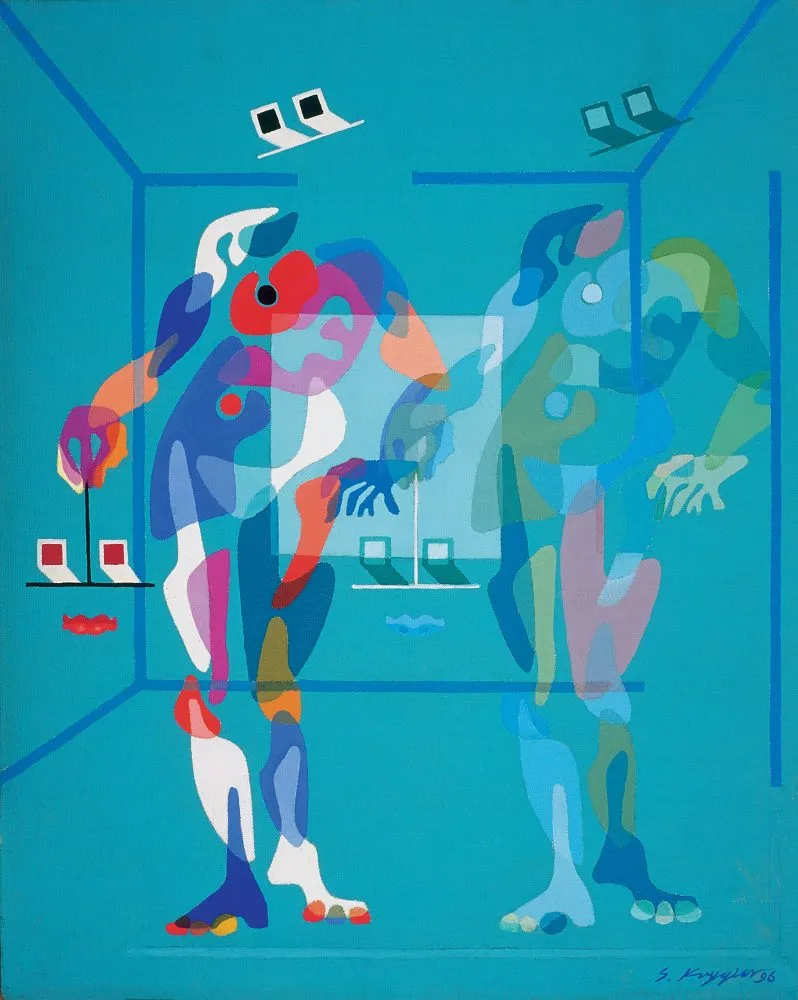
K. K.: He tended to address the largest possible group of viewers, because everyone is connected with space. In the 1960s and 1970s, he worked intensively on the problem of space. Here architecture suggested that space existed to be developed.
S. Sz.: Could you say a few words about your work together?
K. K.: Yes, we worked together as architects and urban planners. It was straightforward insofar as there are certain rules that cannot be broken—for example, the distance between buildings, light in a flat and several other basic principles. We realised several projects together. Once there were industrial areas on one side and residential ones on the other. He designed the industrial areas and I the residential ones. From 1957, Stefan worked at the State Higher School of Fine Arts, but began working at the University of Technology only when the Institute of Architecture was established with Professor Samujłło, who co-created the faculty’s programme. Its purpose was to combine architecture with visual art, which is essential to an architect. He was therefore the ideal person to implement such a programme. As for artistic jealousy, I never experienced it, and neither did Stefan. When I won the competition for Retkinia, a housing estate for 100,000 people, he was occupied with his own architectural concerns, including finding a site and planning the form of our school—he felt connected to it and responsible for its future. There were contacts with the rest of the academic community too. Film-school students attended our lectures, and we often went to theirs. One felt the connections between artistic disciplines.
S. Sz.: Can Krygier’s work provide one path towards understanding the Polish avant-garde?
K. K.: It certainly offers a perspective from which to view the modern artists; we were influenced by Strzemiński and Kobro. One must remember that the twenty years before the war were their life together, while after the war they were separated. Strzemiński’s influence is obvious because he was our teacher, but Stefan also knew Kobro’s statements. Despite the hostility that had developed between them, Strzemiński himself never spoke badly about Kobro as an artist. Kobro too told us: listen to him, because he knows what he is talking about. That was a great deal, considering these were the words of a wife who hated her husband.
S. Sz.: For Krygier, was the question of communication effectively identical with art?
K. K.: There was certainly something in that: searching for important subjects and a suitable mode and language for communicating them. Professional art critics try to find a way of describing what an artist does. Although the dynamics of the artistic process are so great, few concern themselves with ensuring that it is closely connected with the artist’s works. A critic must somehow bring order, not exhaust the subject, because that, as we know, is impossible.
S. Sz.: And Muzeum Sztuki?
K. K.: The museum’s establishment was thanks to the Strzemińskis. The matter was later taken over by former students connected with Strzemiński, people who felt a need for such an institution to exist. That continued, and it must be admitted that there were still substantial connections with Stanisławski; they understood one another. Stefan subscribed to the idea of an artist who does not create to commission or for a career, and he avoided dependence of any kind.
S. Sz.: How did Stefan Krygier view the activities of institutions collecting Polish contemporary art at the time?
K. K.: He greatly valued meetings at various open-air workshops because they offered opportunities to meet and exchange views, and to learn about other artists’ positions. The emergence of new private galleries and the art world’s broader opening were essentially indifferent to him. He valued the peace that allowed him to paint. Art’s institutional aspect did not really interest him. He painted all day until dusk, though he sometimes also painted at night. He had sound equipment in the studio and painted to classical music. He was very fond of Bach and opera. He was highly musical and had an excellent ear. Painting pictures is a very important matter; out of respect for his pictures, he described them in considerable detail in terms of materials. He always attached great importance to technique. At the end of the 1970s, problems arose with the conservation of contemporary paintings because of the low quality of paints, pigments and so forth. A description of the material used could therefore explain a great deal and assist with a work’s possible conservation.
S. Sz.: Were you the first recipient of Stefan Krygier’s work?
K. K.: I always had access to the studio. We often even discussed new paintings; he needed someone to talk to, and despite everything he found it easiest to talk to me. All the more so because he knew I was well disposed—I would not offer a false opinion, remain silent or anything of that kind, which was the main thing.
S. Sz.: Was Stefan Krygier interested in the art scene of the time?
K. K.: He was very interested in contemporary art and wanted to know what was happening in the world. He travelled to Italy, Austria, Germany and the former Yugoslavia whenever the opportunity arose. He followed his own paths, because he identified neither with academic artists nor with fashionable, so-called professionals. He did it all for himself, for inner intellectual satisfaction; it nourished his characteristic separateness.
M. K.: The principal locations were the studio and Masuria. He was very fond of photography and took pictures at home and everywhere he travelled.
K. K.: Thanks to that, I have photographs in which I look like a star. They are truly fantastic pictures; I would never have expected it myself, and no one else would have made them. One must want to see in order to make such a photograph. There are also pictures of Kobro and Strzemiński and photographs from the studio; thanks to them, they remain alive. We know it existed, that it really happened! Nika and Monika appear together in those photographs; there are quite a few because she sometimes looked after Monika.
M. K.: We have not mentioned the theatre. Kazimierz Dejmek, Iwona Zaborowska, Bogdan Bauer and Bąk formed a distinctive circle here. It all began in the halls of residence for art-school students.
K. K.: Those stories connected with the theatre are entirely unknown. I am very keen to describe them because I lived there for several years, but now I find it difficult to sit at a table and the material is immense.
Łódź, spring–summer 2011
- ‘The ZPAP committee comprising Tadeusz Grygiel, Romuald Jackowski, Jerzy Mazurczyk and Ignacy Guttman ordered the relief to be destroyed… as incompatible with the spirit of Socialist Realism. The protests and arguments of its makers that the sculpture depicted African folk art were to no avail. The investor’s proposal to cover it with a curtain because assessment criteria might change was likewise rejected. Nor did the argument that Strzemiński was dying in hospital and this was his last realised work help.’ Krystyna Krygier, Strzemiński’s Last Work. Letter to the editor concerning the relief in the Exotic café in Łódź.
- This refers to Wanda Gołkowska, Jan Chwałczyk and Maria Michałowska.