Blind Pursuit, Blind World. Why Are the ‘Russians’ Fighting? What Rules the ‘Russian World’?
The poster from 1920 by Alexei Radakov (Alexei Alexandrovich Radakov) is one of the most frequently reproduced graphics showing the specific features of Russian art from the Bolshevik Revolution. The desire to appeal to the tradition of folk aesthetics of woodcut (lubok/lubóк), contrasting colour combinations, simplification of the situation. And above all, strength Fate. What's in reality Russian mira(Russian world) Makes you repeat spontaneously and with faith: Wpieriod! Uraa!
If this impersonal, inconceivable and omnipotent push forward does not fail in Russia, the paraphrases and pastiches of Radakov's poster can become an icon of Russian culture of the 1920s as well as the 21st century.
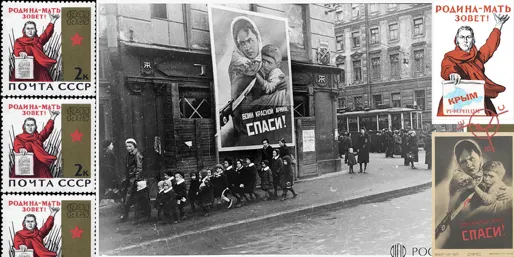
Regardless of whether the "Russians" are ethnically Buryats, Kalmyks, Tuvans, Mordvins, Tatars, thanks first to the Soviet and then the Russian school, all met with a huge number of images over the years, many of which were supported by an extensive liturgy celebrated by pioneers and Komsomolites, then by various youth organisations (Junarmija/Yunarmiya) referring to the tsarist cadet corps. The number of images, constantly repeated, with the same short phrases is crucial. Images carry many times more emotions than texts. Images are affective, they stay somewhere in a deeper layer of memory. They act like food from the microwave, you just need to heat up the atmosphere and suddenly all the long-forgotten contents come back and influence individual decisions.
The Soviet propaganda system did not work in many countries vassalized by Stalin after 1945. Twelve-year-old Romek Polański in Krakow remembered that posters, flags, decorations, messages broadcast from speakers gave the impression that they were childish fun, colorful, bright, loudly reciting the same thing. One can laugh at the reducing simplicity of this system, but it has proven to be very effective in poorly urbanized areas with low population density.
Let's look at a typical photo from street life (Nevsky Avenue, the corner of Litiynogo in Leningrad, probably 1941). What is real is just a layer between the invented pathos of the poster and the photo, which this pathos will duplicate, strengthen, transmit into the future. Building a stereotype into your own memories is a great art. The West patented and developed transistors, i.e. systems capable of amplifying an electrical signal. The Russians did the same with the structure of memory, which after a while spontaneously, cascaded in generations increased the strength of the original impulse.
For someone who remembers many similar frames, the absurd slogan of the fight against "fascists" in 2022 does not necessarily sound idiotic.