
Wąski Dunaj No. 5
Zbigniew Makowski in conversation with Agnieszka Kuczyńska and Krzysztof Cichoń
Zbigniew Makowski: In one of Witkacy’s plays, a light bulb hangs above the stage, and when it comes on the action shifts onto the metaphysical plane. The bulb then lights up with increasing frequency, until finally it begins to blink. Nothing else changes as the scene unfolds. Metaphysical reality imperceptibly overtakes physical reality. The ‘miszkulancja’—as Ważyk would have put it—of banal reality with metaphysical reality cannot be disentangled. They are inextricably intertwined. One more thing on the subject: the artist in me knows better; the artist in me is someone greater than I am (that is Jungianism), so it is hardly surprising that he knows better and is not overly fond of explaining himself.

***
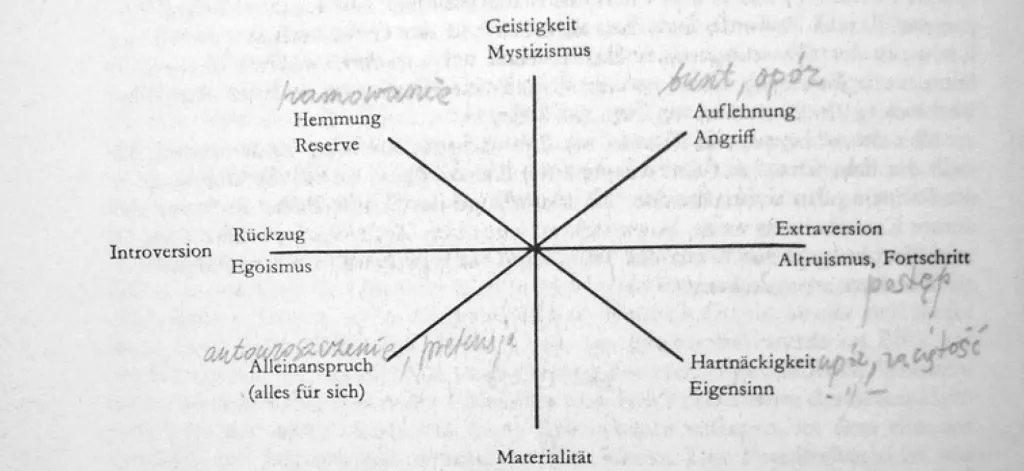
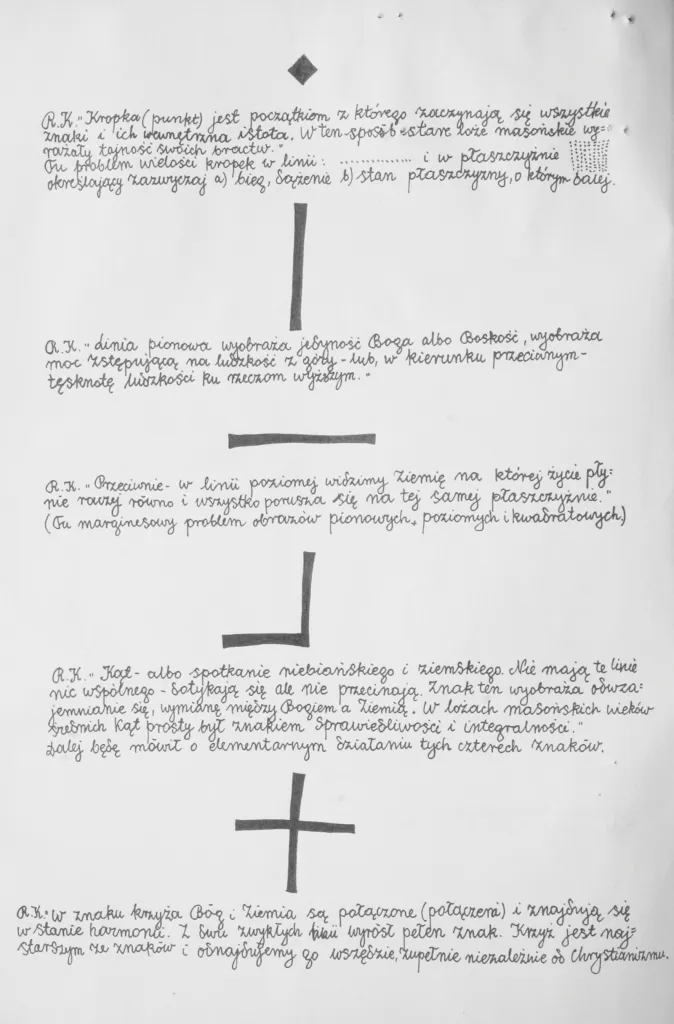
Z.M.: When I arrived in Paris in 1962, I began searching bookshops for dictionaries of symbols. It was not at all easy, and the books I found were rather strange. I came across Rudolf Koch’s The Book of Signs, translated from German and containing pre-war woodcuts reprinted from the German edition. Naturally, I already had some relationship with signs. I knew it was no accident that Elsheimer had placed, in the lower left corner of a painting, a nymph emerging from her bath in an extremely ‘bizarre’ manner; that Munch’s screaming, fleeing man is in the lower right corner; or that Corot’s trees bend in the wind towards the upper left corner of the picture. Optimistic people, or those who want to accomplish something, direct a line upwards when they draw it, while people in depression draw a line downwards. These are orientations we inherit because we walk upon the earth. In our eyes the earth is flat and horizontal, and when we look upwards, we look towards the Gods, towards the Absolute. An animal with eyes on either side of its head sees differently from a human being whose eyes face forwards.
Agnieszka Kuczyńska: Does knowing about these psychologically conditioned orientations not constrain you in some way?
Z.M.: Not in any way. I identify with myself—silly as that sounds—and then I have no inhibitions.
A.K.: Do you not sometimes engage in deliberate mystification? For example, did the fact that the Swiss psychiatrists Dr Bader and Dr Passini subjected your paintings to analysis not provoke you into painting something especially for them, suggesting a false trail?
Z.M.: Some opponents of Freemasonry believe that a Freemason is an artificial Jew. Many of my colleagues have seen works of mine containing a great many dots. In psychiatry this is called schizopherenes pointillé. I first saw it in Benozzo Gozzoli’s painting Musical Angels when I was a small boy. The halos there are made from dots. I thought it was impressive. Not that I liked it more than anything else, but I liked its quality of novelty. Better or worse, it was nevertheless new. Does it constrain me? No, it does not. Nor do I have a problem with being given a choice between a woman and a fish. Naturaliter I prefer a woman to a fish.



Krzysztof Cichoń: Why this particular surreal range between a woman and a fish?
Z.M.: It comes from sirens and water nymphs; from Magritte’s anti-mermaid, with the legs of a maiden and a hideous fish’s upper body; and finally from Breton’s Soluble Fish. Breton met one of his wives—Jacqueline Lamba—under unusual circumstances. Towards the Cité there is Place Blanche. I once lost my way there and did not care whether I turned right or left. I looked up: Blanche Métro. Place Blanche—this was where Breton saw Lamba in a café, swimming in something like a huge aquarium. He waited until she had finished work and approached her, very successfully, as we know. And there is also the weatherfish, which is a double-breathing fish, while I invented triple-breathing fish…
A.K.: Triple-breathing?
Z.M.: Thirty apiece. But I do not regard preferring a woman to a fish as a limitation on freedom. It is, as Marx would have said, recognised necessity. We walk on the earth and there is no escape from it. Nulla est fuga. If we levitate, it is only very rarely. Saint Joseph of Cupertino levitated; he is the patron saint of those unprepared for examinations.
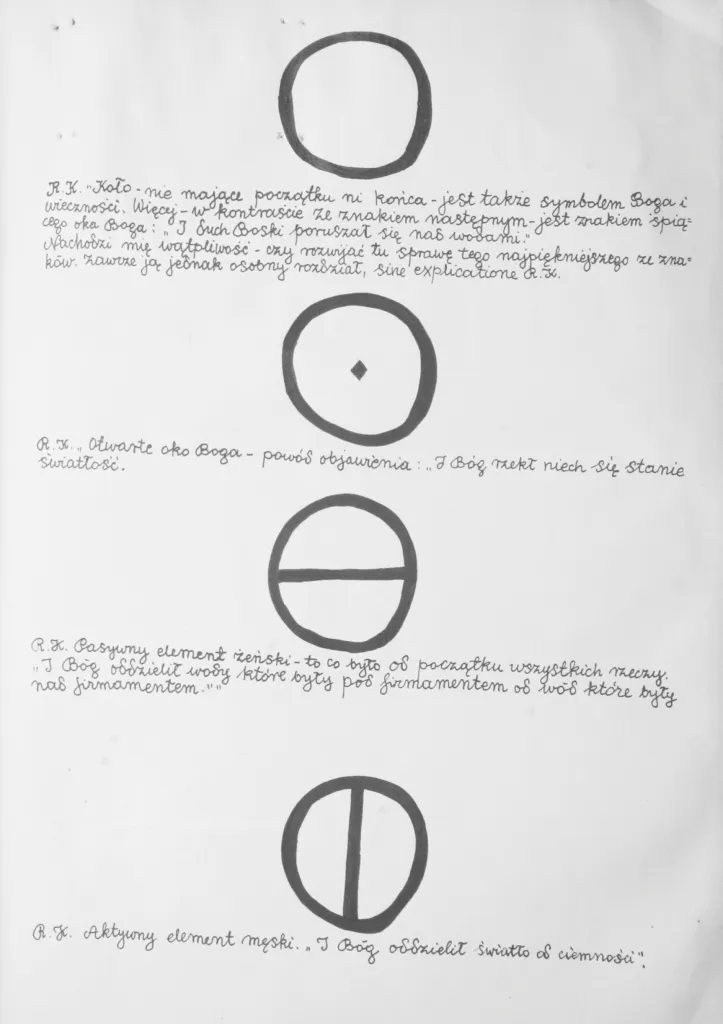
A.K.: I am not so sure. Talking with you constantly reminds me of levitation. A thread disappears as imperceptibly as the ground beneath Saint Joseph of Cupertino’s feet. Returning to the beginning of our conversation and Koch’s book: since encountering it, have the simplest visual elements—a point, a line—been signs above all for you?
Z.M.: There is an anecdote. Yeats attended a gathering of hashish users in Paris. One of them, intoxicated, ran up and showed him a piece of paper bearing a circle with a dot in the middle, crying: ‘God, God, Dieu’. Yeats decided that, for a hashish user, this version of the primum movens was just right. Everything created is around Him. Everything flows from Him. That is the dot, the point. For an artist, that point is the artist himself.
A.K.: At least since Romanticism.
Z.M.: When Breton was told that he was the tail of the German Romantics, he replied: ‘But this tail is still prehensile.’ Breton knew what he owed them—Novalis above all, and Hölderlin.
A.K.: They are also among your favourite authors.
Z.M.: Yes, of course. In French literature I read only a few prose writers: Montaigne; among the poets, really only Rimbaud, though Baudelaire too—I know Le Spleen de Paris by heart… When I was in Paris, Surrealism was no longer the most visible current. The Informalists and Malraux set the tone.


K.C.: In the 1930s, Breton said that either art would be internal or it would not exist at all. What does ‘internal’ mean?
Z.M.: Seneca already addresses this in the Letters: ‘it makes no difference whether the artist has a model outside himself and directs his eyes towards it, or has the model within himself…’. Breton was trained as a psychiatrist.
A.K: Precisely.
Z.M.: Oh yes. Of course he was a psychiatrist. Max Ernst also studied that field, which was new at the time. I read many texts by psychiatrists, and they were more perceptive than art theorists because they touched upon the essence of things.
A.K.: I understand that this shaped your understanding of the symbol to some extent?
Z.M.: To some extent, yes. When I was a boy, I could take a bucket of water and swing it horizontally without spilling the water. When I swung it vertically, it still did not spill, which was astonishing to a small boy. Later I asked an adult an awkward question. I said: when I hold my hands in front of me—one here and the other there—there is space between them. When I put my hands behind my back, what happens to that space? ‘You little rascal, you will be a philosopher.’ Is that a psychiatric point of view? Literally speaking, psychiatry is the study of the poisons within the human soul. Mental health consists in knowing who and where one is. If a person does not understand himself, he repeats what his mother says. Ninety per cent of painters in Paris lacked independence, and still do. They are led like nursery-school children. The children grasp a rope and their teacher leads them, and off they go like a bunch of grapes.
K.C.: Every academy is such a rope. At what point does a person rebel? Might it have been that, because you came from a more restrictive academy, you rebelled more strongly?
Z.M.: I rebelled very strongly.
K.C.: Perhaps there was so much freedom in Paris that there was nothing to rebel against?
Z.M.: Flaubert said: ‘Freedom, and everything I need—I already have it.’ If I painted in an impossible style, nobody would buy it. It was like this: Marian Bogusz once came to see me because he was arranging a new exhibition. I happened to be making some figurative drawings. Marian was impetuous, so I put them aside in case he attacked me. He was domineering: ‘Oh, you will give me that!’ he said, pointing. ‘Wait, I still have to finish it.’ ‘How soon will you be ready?’ ‘In two hours.’ He left with the work still wet. It was non-figurative—black, white, empty, full. It is called drei Schwarzmondkugeln, because there are three days when the moon disappears. In Germanic mythology there is a Lindwurm, a lime-tree worm, which swallows the moon for three days. When I draw a circle like that, almost empty, it is a moon swallowed rather badly. The number of strategies one employed to avoid being caught doing what one was really doing was terrifyingly large.


K.C.: That is why I would like to return to the question of the simplest signs. We have already said that a dot can be God for a hashish user, while for an artist the artist himself may be God and the sole point of reference. When you searched for dictionaries of symbols in Paris, did you know Kandinsky’s reflections on the point and the line? Were they accessible then? Did people discuss them?
Z.M.: They were accessible. Whatever else one may say about the Stalinist period, there was no repression in the academy library. None. One might perhaps have feared those who walked around looking at what other people were viewing, but hardly anyone like that ever came. When I used the library at the Academy of Fine Arts, the regular visitors were Jan Lebenstein, Ksawery Piwocki, Professor Płużański and several graphic designers who copied reproductions. It was a genuinely large library with plenty of good material.
K.C.: Could you borrow books to take home, or did you have to remain there?
Z.M.: You had to remain there. When I wanted to borrow an Utrillo album, Mrs Tarkowska said she would not lend it because some people cut things out, and the staff could not possibly check volumes hundreds of pages long. So I said I would paint there. I painted a fairly large picture after Utrillo. It was in my fourth or fifth year. Tomorowicz said: ‘Very good, only one thing is wrong—the little wall in the foreground. You copied an English reproduction in which the wall is yellowish. It has to be as it really was. A broad brush, Mr Zbigniew.’ ‘Please.’ He took some white and painted the entire wall in my picture pure white. We were dumbstruck. That really was how Utrillo painted white. Although he was an alcoholic, he was a magnificent artist and knew that white is by nature as white as milk, so he added no other colours to it. It was purely conceptual.
A.K.: During your studies, how did you reconcile your private preferences with being taught by a Colourist?
Z.M.: By a slightly restrained, untraditional Colourist. Tomorowicz began with the Formists. Then came Jednoróg, his friendship with Tytus Czyżewski, and a slight pull towards geometric tendencies. He was friends with Bruno Jasieński, although that was a complicated matter. Kazio disliked every ideological parti pris and was highly sceptical about incorporating anything extra-aesthetic into a painting.
A.K.: You always name Kazimierz Tomorowicz as your teacher, but you began your studies in another studio.
Z.M.: For the first six months I studied under Janusz Podoski. I was seducing his girlfriend—he wanted to throw me out of my first plein-air workshop in 1951.
K.C.: When one looked at paintings from Tomorowicz’s studio, was it obvious that they were ‘Tomorowiczes’?
Z.M.: Yes. One could tell easily. Very simple. Paintings from Nacht’s studio were brownish, those from Eibisch’s were madder red, while paintings from Tomorowicz’s studio were greyish and cool. Eibisch could not stand blues. He painted in rusty reds. Nacht loved browns, while Tomorowicz made a pushing-away gesture with his hand, precisely to cool things down. On the whole, what distinguished me from my colleagues was that I took poetry seriously.
A.K.: Did your fellow students read much?
Z.M.: No. Music, yes, but not poetry.
A.K.: Who was in Tomorowicz’s studio at the time?
Z.M.: Oh, masses of people. Tutti morti. Most left Poland.
A.K.: Did any particular fellow student impress you during your studies? Whom do you remember best?
Z.M.: The girls.
K.C.: If there were girls, there must also have been gatherings—a social life?
Z.M.: It all fell apart, because those were times in which people did not trust one another sufficiently. One never knew who had been dyed and who had not: who pretended to be red, who really was red, who pretended to be Catholic while being red, and who pretended to be red while being Catholic. Social life therefore existed only within one’s immediate circle, in one’s own studio.
K.C.: Since social life was so feeble, let us turn to work. Was there an entrance examination for the academy at the time?
Z.M.: There was. I showed quite a few drawings. The examination was in drawing, and I did reasonably well. In composition—I imitated Matisse—not everyone liked it. There was also an examination in Marxism, or knowledge of contemporary Poland, in which I recited like something out of Orwell; there was no other way. It had to be treated as inevitable. And there was art history, in which I demolished everyone around me. In 1951, during my examination with Piwocki, I said: ‘Professor, you were a pupil of Alois Riegl.’ It was 1951, remember, and he looked at me anxiously. I already knew a great deal.
A.K: When did you begin taking a serious interest in art?
Z.M.: Before the Uprising.
A.K.: You wrote a text about being asked as an eleven-year-old boy what you wanted to become.
Z.M.: Ah yes. My father’s uncle asked me. I said I wanted to be an astronomer. ‘Do you like mathematics? No? Then you will not be an astronomer.’ I was more interested in ontology, in some rudiments of philosophy. I drew the starry sky and made maps of the heavens. But for me astronomy was an introduction to concepts of an ontological nature.
A.K.: And painting turned out to be your way towards ontology—or, as you said earlier, the essence of things?
Z.M.: Because it makes freedom possible…


***
K.C.: As the Warsaw Academy, did you meet those from Kraków? Were they different in some way?
Z.M.: They were! We travelled there for a Matejko symposium, and I went to the Academy of Fine Arts because I wanted to meet someone from Kraków. Five in the afternoon, and nobody was there. The porter asked: ‘Are you looking for someone?’ ‘Yes, so-and-so.’ ‘He is not here.’ ‘But there should be evening drawing now.’ ‘There should be, and there is.’ ‘But nobody is here,’ I said. ‘Somehow they do not come.’
K.C.: And in Warsaw people did come?
Z.M.: Very diligently.
A.K.: Besides the Matejko symposium, were there any other opportunities to meet?
Z.M.: I do not know. Few, very few. Those were times that did not encourage candour.
A.K.: Did you never hesitate, even for a moment, about applying to Kraków?
Z.M.: Maja is here, so I will not say! Only women drew me to Kraków. That is privé.
I went there once or twice. One woman declared that I was seducing a minor. I asked how much longer she would be a minor. She replied: ‘One more week.’
***
K.C.: A few years after graduating, you travelled to France on a scholarship. Did you know what you wanted to see and whom you wanted to meet? How does someone arriving from Poland arrange to meet Breton?
Z.M.: One does not arrange to meet Breton. One arranges to meet Aleksander Henisz, who is a friend of Édouard Jaguer, who is a pupil of Breton. Simple.
A.K.: Did your conversations with Breton have the character of an audience?
Z.M.: No, they took place in the gallery, en passant.
K.C.: Did you discuss politics?
Z.M.: No, Mickiewicz and Mickiewicz’s prophetic quality. When I switched to English at the Ranelagh because my spoken French is not very good, he drawled: ‘Don’t speak English. I don’t like Americans.’ In Kraków, Bogucki played Breton’s address to Polish artists from a tape recorder. In any case, for years afterwards Bogucki was not allowed to travel abroad…
A.K.: Was there anything in Paris that filled you with delight?
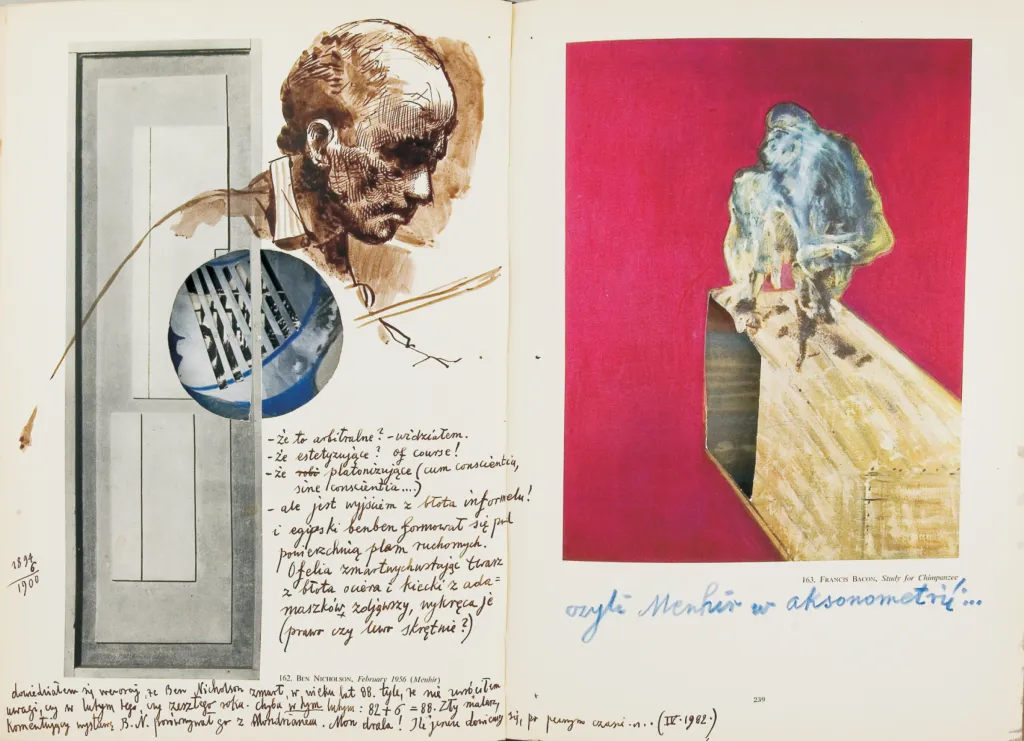
Z.M.: Tibetan art! And the fact that figurative art continued to exist. Most of all, I was delighted by Bellmer’s doll, which was lifelike. It was lifelike. She was twelve years old. I became convinced that figurative art in this surreal form disregards doctrines. Cubisms, Fauvisms and the like are all trifles. In the face of the Gods, in the face of the great truth grasped by Breton, whether someone is a Cubist, Fauvist or Formalist is entirely irrelevant. One must play a completely different game. The categories of games practised in Paris since the epiphany of Surrealism no longer have any significance.

A.K.: And what impression did Art Informel make on you? It was the dominant current at the time, after all.
Z.M.: Pulp, mush, molasses!
A.K.: What were your most powerful artistic experiences in Paris?
Z.M.: In order: Bellmer, Brâncuși, Brauner, and Baudelaire in Courbet’s great painting.
K.C.: Was there anyone whose existence you had not known about before leaving?
Z.M.: No, I was very much au courant. Paris is not conducive to creative work—it is a merry-go-round.
K.C.: I wanted to ask about the Czechs.
Z.M.: I met Toyen (Marie Čermínová), a very talented painter.
A.K.: Who else did you meet in Paris?
Z.M.: I met Joyce Mansour, Breton’s final companion. She was taller than me. Apparently she had been Egypt’s champion in the hundred metres. She had long, dark-purple talons. Breton came up to her shoulder.
A.K.: When I look at the works you made towards the end of your studies, I find it difficult to see any indication that Surrealism would become important to you.
Z.M.: Because I was hiding. I described it like this: when I bought a book about Arnold Böcklin from a stall on Marszałkowska Street in 1949 or 1950, I looked around to make sure none of my colleagues saw me and subjected me to utter ridicule.
A.K.: But Böcklin could have been embarrassing because he was nineteenth-century and could readily be associated not so much with Surrealism as with Symbolism and, worse still, Academicism.
Z.M.: Böcklin was Stimmung, Inhalt, content—and content was considered worthy of the greatest condemnation.
A.K.: It was also a particular kind of content.
Z.M.: Yes, it was also about Schopenhauer, Symbolism and even allegory. The word Symbolism is indeed more appropriate here. I encountered the concept of Surrealism during the German occupation, because I read whatever I could.
A.K.: What version of Surrealism was it?
Z.M.: Poor reproductions that Helena Blumówna had probably brought to Poland.
A.K.: Whose paintings were they?
Z.M.: Mainly Salvador Dalí, whom I regarded as a kitsch artist.
A.K.: Do you no longer think he was kitsch?
Z.M.: No. When he was young, he was not kitsch. Later he became so. I do not know what happened to him. He fell into facile theatricality. Here lies the fundamental distinction between what Coleridge calls phantasy and imagination. Fantastic painters and those who employ imagination are entirely different kinds. Fantastic painters inhabit a realm in which anything is permitted. There is a Dictionary of Visual Artists known as Janota’s dictionary. The title of the work I supplied for reproduction, Royaume sans limites—Kingdom without Borders, simply means hell, complete lawlessness.
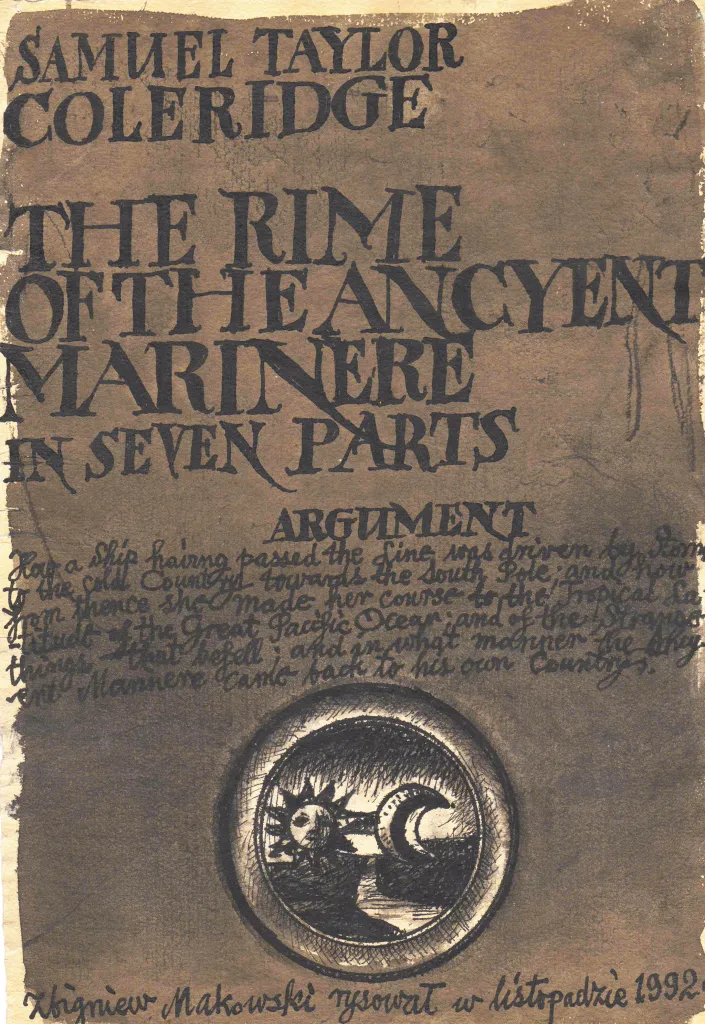
A.K.: How do we know that a kingdom without borders is hell?
Z.M.: One knows. Do I know how? Anything is permitted in fantastic art. It is not modular. Formally speaking, it is non-modular. When a normal, mentally healthy person makes something, they put as much work into it as is necessary to complete it; an ill person, by contrast, may attach utterly absurd importance to seemingly insignificant matters—that defines the art of the mentally ill. Rather like the story about Wyspiański. While working on the polychromes in St Mary’s Church, Wyspiański said to Matejko: ‘Master, when I paint so precisely up there, nobody can see it from below.’ ‘But God can see!’ Matejko replied. Fantastic art does not heed categories of economy. One can close a box inside a box and then inside another box, because the overriding aim lies beyond common sense. In 1943, during drawing lessons, some of my classmates imitated the Kossaks, while others made almost abstract pictures; I made pictures that were essentially Surrealist.
A.K.: Meaning what sort?
Z.M.: Frightening things in Ensor’s manner. A little corpse would peer out from behind a wardrobe. The times were dreadful. Content certainly played a large role in those pictures. I once went to the cinema with my father to see a Chaplin film. There is a scene in which a man walks along, and suddenly only his legs can be seen protruding from behind a curtain. Something strikes him on the head. Everyone laughed, while I thought: this is terrifying. For a child, it was genuine terror. I could not understand why they were all laughing so much.
A.K.: But what does that have to do with Salvador Dalí?
Z.M.: It means that a kingdom without borders is a kingdom in which everything is permitted. Hegel said that everything that enters anyone’s head is evidence of human freedom. But stupid ideas disappear very quickly. Some are good, others bad. Complete arbitrariness will not do. Certain things are binding.
A.K.: What rules applied in Surrealism?
Z.M.: In the broadest terms, I once wrote that the only rule I brought back from Paris was Breton’s sentence: Il faut changer le jeu, non pas les pièces du jeu. A game must have rules. Without rules, it is not a game but a recreational activity—a funfair where one can ride this way and that. Rules exist in Surrealism. In old age—étan dans le vin, like all Frenchmen—Breton said in the preface to Nadja that the subjective and the objective battle one another. If an old man claims that the subjective generally fares badly in this battle, it means he believes in the existence of objective norms and rules.


A.K.: Is that not a strange confession from the pope of Surrealism? How does it relate to psychic automatism?
Z.M.: Those are entirely different things. Who said Surrealism was a whole, that it was coherent? It never was.
A.K.: And how did you view the Surrealists’ practical ambitions—il faut changer la vie, il faut changer le monde.
Z.M.: A true story. During an opening at the Ranelagh, where my work hung below or above Breton’s, he said: ‘Votre travail est merveilleux.’ I replied quietly: ‘Doit être.’ It was cool, though. He understood. He looked like Marian Bogusz—large, rather stout, with the force of a tank and extraordinary self-affirmation. ‘Doit être’—and he smiled. Several films were shown that evening, at the opening. One was a none-too-intelligent Czech film, La sentinelle oubliée, by Miloš Makovec. It was about the war ending while the protagonist was left behind at his post with a rifle. They forgot to relieve him from the trenches. He walked and walked and walked, until at one point a civilian aeroplane flew overhead and he began shooting at it because he thought it was German. A cry then rang out in the auditorium—and everyone recognised Breton’s voice: ‘Merde!’ I thought: ‘Good Lord! This is bad.’ I would have stopped the film at that moment, but it continued. The protagonist emerged from the trenches carrying his rifle, although the war was over—and again came the voice: ‘Merde alors!’ Breton then left the auditorium with his companion and several other people. It was a scandal. Breton took offence.
A.K.: What exhibition was this?
Z.M.: An exhibition at the Ranelagh gallery in 1962.
A.K.: Who organised it? Phases?
Z.M.: Both Phases and Le Mouvement Surréaliste. The Surrealists had difficulties because Breton was under a death sentence. In 1962 the French withdrew from Algeria. The Pieds-Noirs had sentenced him to death. I should not really have attended that film screening, because it included a Tunisian film, J’ai huit ans, about paratroopers shooting children in Algiers. The police could have entered, because the film was illegal and contrary to the interests of the French state. Breton found on his doormat a death sentence for betraying the interests of the French state and nation. He was afraid, because the Pieds-Noirs had carried out several death sentences.
A.K.: Did the Surrealists’ vividly red political accents not bother you?
Z.M.: They did.
A.K.: How did you reconcile that with your own views?

Z.M.: Did I have to? Am I coherent? Nobody is coherent.
A.K.: Did it not grate?
Z.M.: Yes, it grated. One takes the balance per saldo. The Surrealists’ socio-political ambitions were those of café know-it-alls. I prefer to comment on Surrealism’s political red with a short fable about Saint George:
In the First Encounter, the Dragon attacked Saint George with its Flaming Wings. The Hero attacked with his lance, but it shattered into a thousand pieces. The Dragon then swung its tail and knocked our Hero’s Gallant Horse from its feet. Both fell, most fortunately, beneath an Orange Tree, but the Saint bruised two ribs very painfully and lay with the Horse almost senseless from the Dragon’s poisonous breath. Yet, most fortunately, the scent of the Orange Tree—both beneath the branches and for seven feet around—keeps out the poisonous venom of dragon’s breath. Saint George, having turned to heaven for rescue and aid, was strengthened; he took one of the fallen Oranges, crushed it and dripped its juice into the horse’s mouth. He then advanced to the decisive encounter: with his Trusty Sword Ascalon he pierced the dragon—aiming beneath its wing—through heart, liver and bone, until purple gore stained scarlet the green grass covering the dragon’s ravine. The poisoned Horse meanwhile lay motionless, but the orange juice took effect and the gallant steed recovered its customary courage.



***
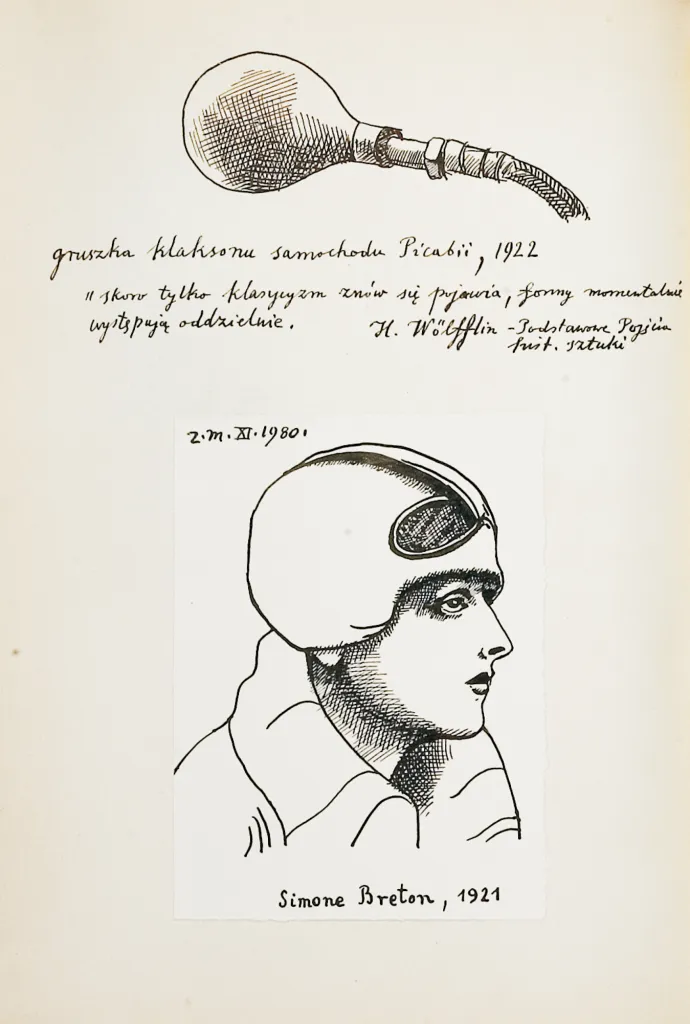
Z.M.: Of the people in this photograph, I met Breton personally, drew Diego Rivera from life and fortunately never met Trotsky. And I wrote: ‘For me, Paris was not worth a Mass, nor en robe rose et verte—that is from Baudelaire—nor a black one.’ And that was that. After the film screening, Breton allowed himself to be placated. The second screening consisted of Norman McLaren’s films, which were very beautiful. In the foyer, Breton came straight towards me. He was leaving with Jaguer and his companion; there was also the Czech artist Toyen, while on the other side were me, Aleksander Henisz and his wife. Breton looked at me and recited in French something that reads in Polish: ‘When in your pilgrimage you come to a city, bless it, saying: may our freedom be with you…’ Mickiewicz, whom I knew by heart! It is from The Books of the Polish Nation and of the Polish Pilgrimage. Breton looked at me; he was sober and looked like a prophet. He was quoting Mickiewicz in Lamennais’s translation.
A.K.: Why?
Z.M.: He saw a place for me in Surrealism. It really made an impression, because he spoke beautifully, like a poet or prophet. Ważyk claims that Breton despised facts. How so? Pierre Alechinsky, whom I met much later, said that Breton had every route he walked with his wives photographed in detail. He did not despise facts. Breton quotes Mickiewicz to me in Lamennais’s translation and says: ‘Seulement la liberté…’ I reply: ‘Ah oui, oui la liberté.’ That was all one could say in response to such a thing in France in 1962. ‘And where are you going?’ he asks Alek Henisz. ‘To Provence.’ ‘Then perhaps we shall meet.’ But we did not.
A.K.: Why not?
Z.M.: Breton was more inclined to expel people than admit them. After he expelled two great artists from the group—Max Ernst and Alberto Giacometti—Jaguer later told me: ‘He thought of you. You are young and talented; you would be useful.’ But I knew the answer was no. Nothing grows in the shadow of a great tree.
A.K.: One question continues to trouble me. Was it those poor reproductions of Salvador Dalí that you saw in the 1940s that made you a clandestine Surrealist?
Z.M.: No. It was something else. Certain things delighted me from childhood. Friedrich de la Motte Fouqué’s Undine made a great impression on me as a boy, as did Dante’s Vita nuova. I remember several books from childhood that possessed this atmosphere between fairy tale and terror.
A.K.: That probably means it was not so much Surrealism itself as sources similar to those from which it arose that determined your interest in the movement.
Z.M.: I have already said that when Breton was once told he was the tail of German Romanticism, he replied: ‘But this tail is still prehensile.’
A.K.: I am not trying to demonstrate that Surrealism was derivative. I mean a certain kind of imagination that occurs regardless of the period.
Z.M.: Very well. Among the many reproductions my father collected, I particularly remember one of Signorelli’s mythological works, captioned Pan als Gott des Naturlebens und als Meister der Musik mit seinen Begleiter. The painting was destroyed in Berlin during the war. It had the atmosphere of a ghostly fairy tale, and that delighted me. I looked with the utmost distaste, however, at paintings by Szermentowski, Kossak and Matejko. Even then I believed that art which merely decorates or records everyday reality did not entertain me. I also disliked looking at Zak, whose work hung in my classroom at school—cheap idylls of a kind. Zak and Stryjeńska.
A.K.: Indeed, that was the period of your childhood—your point of reference.
Z.M.: In the spring of 1939, the teacher told the children to draw an eagle. Everyone drew an eagle as God intended, while I drew one after Stryjeńska, or from the publications of the Maritime and Colonial League. The teacher did not like it. And I lost.
A.K.: And from then on you disliked Stryjeńska.
Z.M.: I disliked Stryjeńska in general, because I regarded her works as stylisations.
A.K.: Wait a moment—you were nine years old and thought they were stylisations?

Z.M.: I thought they were stylisations. When I was eleven, I read Friedrich Nietzsche. I used to read books unsuitable for my age. I was nine or ten when I read Jerzy Żuławski’s On the Silver Globe, and I was enthralled. The war had already begun; the September defeat was over. To me it was a wonderful book. That fairy-tale, escapist current between Signorelli, Undine and Vita nuova was normal literature to me; I read Sienkiewicz during the war out of patriotic duty.
A.K.: Which of the Surrealists do you value most highly? You mentioned Max Ernst. Who comes next?
Z.M.: How should I know? There are several. In Paris, I valued the obsessive linearist Max Walter Svanberg. Early Toyen was good. All the Surrealists suffered from what Breton called the mind set free—placing too much trust in the unrestrained expression of inner content.
A.K.: But that was the basis of what Breton called Surrealism.
Z.M.: He called various things Surrealism.
A.K.: Yet I do not think he ever officially abandoned psychic automatism.
Z.M.: True, but the only book of his that will remain is the one in which he describes inner reality, but also external reality. He needed a miracle. I nevertheless value form in the Surrealists. Józef Waczków translated Nadja: ‘André? André… You will write a novel about me. I assure you. Do not say no.’
A.K.: Not Ważyk?
Z.M.: Ważyk translated part of it. Waczków needlessly entered into a polemic with Ważyk in his translation.
A.K.: Returning to the Surrealists from the textbooks: Masson?
Z.M.: Fantastic. The claim about automatism is untrue. It did not work.
A.K.: Did you ever conduct experiments of that kind?
Z.M.: I did. They are foolish things. Spontaneous generation does not occur in the little box called the subconscious; even if it does, it fades like an unfixed photograph. One cannot take more from the box than one put into it. Adam Ważyk, who was a very lucid man, says that Breton’s poems are a faded Soupault. They had all had it up to here with the France in which they lived. Surrealism understood in this way was a kind of escapism. It failed. Nulla est fuga.
A.K.: Was the popularity of Surrealism in Poland or Czechoslovakia not a form of a different escapism?
Z.M.: More so in the Czech lands. Czech Surrealism was more closely connected with the left.
A.K.: And Polish Surrealism was not?
Z.M.: It was, but only up to a point. The Lviv group of Surrealists—leftists, after all—changed after 1936.
A.K.: What irritates you most about the Surrealists?
Z.M.: A certain childishness and an inability to free themselves from obsessive neurotic symptoms.
A.K.: Do you mean Delvaux?
Z.M.: Magritte and Delvaux. Just as there are minor prophets in the Old Testament, so Surrealism has greater and lesser prophets. The lesser ones are successors to the genre of fanciful fin-de-siècle artists. Although from Klinger’s gloves hatched Alfred Kubin and the great Giorgio de Chirico.
A.K.: Does Magritte irritate you so much? Do his semantic games not amuse you?
Z.M.: Very ugly painting combined with an impressively personal vision of the world.
A.K.: How did you become associated with the Phases group?
Z.M.: It was Krzywe Koło, but also Janusz Bogucki. It was Anka Ptaszkowska, Mariusz Tchorek and Bronek Kierzkowski.
A.K.: What was the first Phases meeting you attended like?
Z.M.: When I first walked into a Phases meeting, someone said of me: ‘He looks exactly like Paul Klee.’
A.K.: Did the Phases group meet regularly? Did you attend those meetings?
Z.M.: Oh yes. Once a week, on Fridays.
A.K.: Where?
Z.M.: At Rouquet’s café in Paris. The ‘Phases people’ gathered there.
A.K.: Where in Paris is this café?
Z.M.: On Boulevard Saint-Germain. Les Deux Magots is just around the corner.
A.K.: Who attended these meetings?
Z.M.: All the ‘Phases people’—Tytus Dzieduszycki, Andrzej Meissner, Horst Egon Kalinowski, Guido Biasi, Radovan Ivšić (Je ne suis pas décadént—je suis kilodent!), Jacques Lacomblez. Toyen did not attend.
A.K.: Did Jaguer attend?
Z.M.: Well, he was the Master.
A.K.: What were such meetings like?
Z.M.: Sometimes they were amusing, as when Jaguer brought banknotes from Brussels on which Magritte’s likeness appeared in place of the Queen’s portrait.
K.C.: What time did these meetings begin?
Z.M.: Usually at eight, around eight. A special table was reserved there for the ‘Phases people’, and about thirty people would meet around it. There is no point listing everyone; in Poland those names mean nothing. And Biasi (from whom I have one little painting), a charming Neapolitan, would order milk at around midnight.
A.K.: And the others?
Z.M.: The others varied, but alcohol was not generally drunk. We took great care that it should not become Bohemian.

A.K.: Bohemianism was in bad taste? Shoddy?
Z.M.: Shoddy.
K.C.: Until what time did such meetings last?
Z.M.: Usually until the last Métro.
***
A.K.: Through whom did Breton know the Poles?
Z.M.: Probably through Kujawski.
A.K.: Was Jerzy Kujawski the first Pole in the Phases movement?
Z.M.: He was a member of the Surrealist group, while Bogusław Szwacz belonged to the Mouvement Surréalistes Revolutionaires.
A.K.: I read that Phases hatched from that very group.
Z.M.: No. Le Mouvement Surréalistes Revolutionaires was a Trotskyist group. Phases arose as a mixture of CoBrA and Jaguer’s friends.
A.K.: You were associated with Phases for a relatively short time.
Z.M.: A few years. After I left France, my works still appeared in five or six exhibitions, but my difficulties in Poland forced contact to cease. Antoni Zydroń later attained a significant position in the group.
K.C.: Was there a consolidated Surrealist milieu in the 1960s?
Z.M.: Several of us tried to form a Surrealist group. I shall name the candidates: Alfred Lenica, Erna Rosenstein, Bogusław Szwacz, Jerzy Kujawski, Kazimierz Mikulski and me. And perhaps another two people. But Lenica told us that every artistic group had to be registered with the appropriate authorities on Rakowiecka Street. That completely discouraged us. One cannot eat from the same bowl as the devil.
K.C.: What year was that?
Z.M.: It was 1966 or 1967. Before the March events, certainly. Once four of us were sitting in the Bristol: Lenica, Szwacz, Kazio Mikulski and me. I said: ‘Colleagues, we all began as violinists.’ They all jumped: ‘You too?’ ‘Not for long, but I studied. I had a teacher; he went to the ghetto.’ Lenica said: ‘And I played under Honegger!’ ‘What do you mean, under Honegger?’ It turned out to have been the famous Honegger’s brother, who came to Poznań as a conductor while Lenica was first violin of the Poznań Opera.
A.K.: Was Surrealism not more visible in post-war Poland than in France?
Z.M.: No, there were only a few people.


A.K.: And the so-called metaphorical current of the 1970s?
Z.M.: Ryszard Stanisławski conceived the first exhibition of the metaphorical-Surrealist current in Poland.
A.K.: Did you consider yourself a Surrealist?
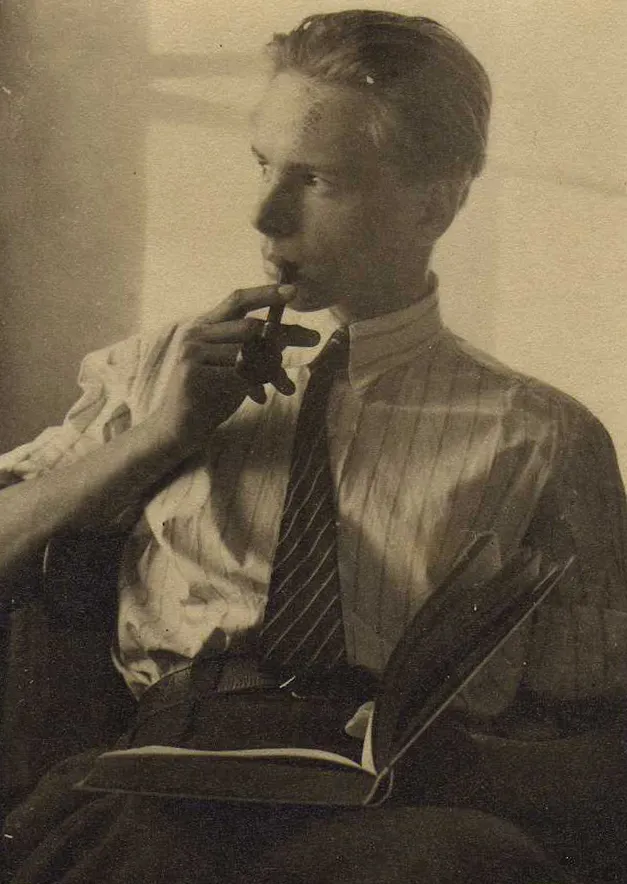
Z.M.: Perhaps in some sense, at eighteen or nineteen. My fiancée’s father lived in Paris for many years. He worked for Jacques Doucet, where he met Breton and Aragon. That impressed me greatly. In 1949 I became somewhat acquainted with the work of G. M. Hopkins, Joyce and Ezra Pound. Then in 1950, when I was still going to the library on Koszykowa Street, if I requested Tadeusz Zieliński, for example, I received a stamp saying ‘in use’. A kind elderly lady told me: ‘Mr Zbigniew, please do not ask for those books, because it upsets me; I cannot give them to you. There is a list of books that are not lent.’ Yet immediately after the war I read all of Witkacy there.
A.K.: And therefore Surrealism? Somehow I still cannot piece it together.
Z.M.: I have an exhibition catalogue: Jubilee Exhibition of Works by Xawery Dunikowski, held at the National Museum under the High Patronage of the President of the Republic, Bolesław Bierut. I wrote on the catalogue: ‘we longed for the irrational as parched earth longs for rain’. Amid the crudity of the Peredvizhniki, we looked out for irrationalism to keep ourselves from going mad.
(an extract from the publication accompanying the exhibition)