
Elementary Education
Maria Poprzęcka*
There is no mercy in Łódź Kaliska’s Alementarz. Its protagonists, Ali and Al (Ala and Ali respectively in Polish), are not nice Polish children. They are not children at all. No one knows who they really are. They are apparently ‘new Poles’. He is an Arab with a Polish passport, no longer young, with an appearance that ought to put airport security guards on alert. She is Chinese, young, like other young Chinese women; everyone knows that all young Chinese women at the bazaar look alike. All the same. You cannot tell them apart. She too is a Polish citizen. Ali and Al do not attend the first year of school. They do not go to school at all. They are probably not learning Polish. Nor are they learning English. They are not learning anything. And they certainly do not have As, the dog from Falski’s primer.
A primer – elementarius – is a textbook for the initial teaching of reading and writing. Could anything be more obvious, more elementary? Polish primers – from the Primer for National Parish Schools, based on the modern analytic-synthetic system and published in 1785 by the Society for Elementary Schools; through the equally enlightened Teaching Writing, Reading and Arithmetic for Elementary Schools of 1819, approved by the contemporary Minister of Religious Denominations and Public Enlightenment, Stanisław Kostka Potocki; then the truly innovative Illustrated Method of Learning to Read and Write, for Use at School, at Home and by the Self-Taught, devised, tested and compiled by Kazimierz Promyk (Konrad Prószyński, first ed. 1879); to Marian Falski’s literally everlasting Primer, which, with modifications, has remained in use from 1910 to the present day – are all sources of pride and glory in the Polish educational tradition. All were created from the noblest motives, were democratic and methodologically modern, even on a European scale. Through them, a civilisational advance regarded as one of the most important of our time took place. What is there to criticise?
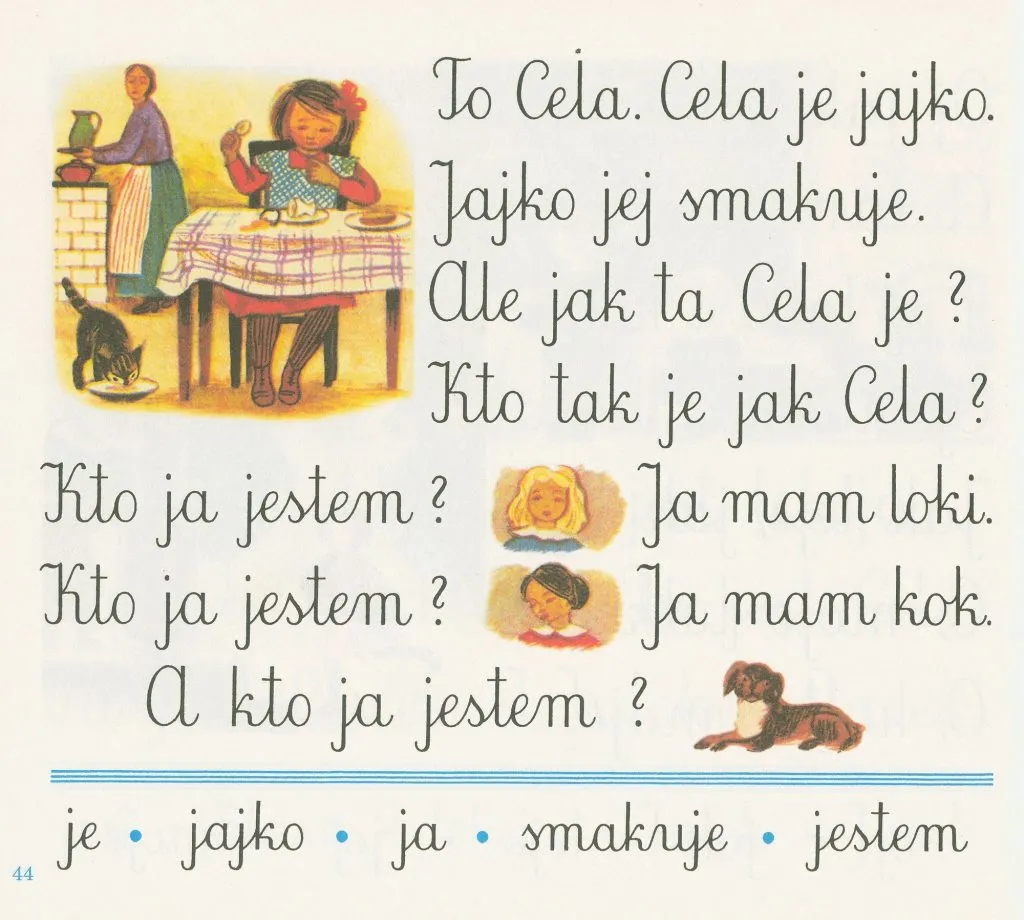
Feminists have already taken issue with the Polish primer, exposing the perfidy of apparently innocent sentences and pictures that press a paternalistic social order into seven-year-old heads. The life roles of the primer’s protagonists are assigned and clearly hierarchical: Ala’s mother darns, Agatka’s mother milks Siwula the cow, Stach’s mother cooks pea soup. Ala’s father, meanwhile, manages a building site. Ola’s father works in machining. Olek’s father is a railway stationmaster. Yet the feminist revision of the primer is nothing beside the total destruction carried out here by Łódź Kaliska.
So far, the letter A has been dealt with, and the artists offer no hope that they will reach Z. They apparently do not even plan B. The entries are not arranged alphabetically. ‘Moreover, in the original they are perversely in English, since it is a contemporary Alementarz for illiterate adults’, as Andrzej Kwietniewski announces. Methodologically speaking, Alementarz is close to the synthetic ‘organic-visual’ method invented by Kazimierz Promyk. According to it, the pupil does not wander among abstractions, but learns sounds together with the corresponding signs – pictures.
In Promyk, a is for angel. We see a picture – an appropriate figure in a long robe, with wings. The lesson proceeds as follows:
‘Let the pupil say what they see in this picture.
‘Let them pronounce the beginning of this word slowly and loudly.
‘Then let them open their mouth as wide as shown in this second picture and speak aloud [here a face is drawn, not very childlike, with its mouth wide open].
‘In this way they will pronounce a.’
Do not expect angels from Łódź Kaliska. There is admittedly the entry angel – a Barbie doll with angel wings attached – but the caption strips us of illusions: ‘Ala received a poor mark for handicrafts – and she tried so hard.’ Besides, A is for Arab, Adultery, Apartheid, Absence, America and Advertising. And the pictures? ‘Each page consists of an illustration and its verbal description, that is, the use of the concept in context.’ This time, the pictures are exceptionally durable and solid. Ali and Al are plastic mannequins inserted into different contexts, photographed, drawn and displayed in installations. But take care! ‘In the descriptive applications of a given concept, we perversely do not quote (ever!) the word-entry’, the authors of Alementarz stipulate. And so it is no lesson in writing or reading, whether in Polish or English. It is a lesson about what primers are. It is ‘the revelation of a deception into which we are drawn from childhood, with a gesture full of smiles’. The large ‘handwritten’ letters refer to childhood, but ‘then the exhibition begins to grow increasingly drastic, speaking about reality in a drastic and ambiguous fashion’.
In this brutal reality, where Ali and Ala ‘are at once Jews and Arabs, Chinese and Poles, Black people, gays and hermaphrodites, patriots and enemies, believers and atheists, whores and thieves, but very rarely ladies and gentlemen’, has anything survived of the old concepts, orders and principles that primers instilled together with the teaching of sounds and letters? Are there no longer God and Fatherland, father and mother, work and bread? They certainly exist, but have been quite thoroughly transformed. Let us compare.
The Primer for National Parish Schools opens with the word ‘father’:
‘The Child’s Learning of Reading and Writing begins in this way:
‘The familiar word, dear to children, father, is written repeatedly on the board.’
The first chapter of the Moral Teaching appended to the primer (by Father Grzegorz Piramowicz, secretary of the Commission of National Education and the Society for Elementary Books) is devoted to the Duties of Children towards their Parents, reinforced by suitable biblical excerpts such as: ‘Listen to thy Father, who begot thee; and do not scorn thy Mother when she grows old.’
‘A father cares for his children and works for them’, the Teaching of Writing, Reading and Arithmetic for Elementary Schools assures in turn.
Our new Alementarz also devotes considerable attention to this word so dear to children:
Holding Schwarzenegger’s torso before her, ‘Ali dreams that her real father will turn out to be someone of standing and with the right genes, rather than the lousy bastard whom her drunk mother pushes into her bed and then takes all the money for herself.’ The entry A is for Adultery, meanwhile, is accompanied by the text: ‘Mother suspects that Ali’s real father is one of the following neighbours: either Jakub from the ground floor, Józef from the fourth floor, or Adam from across the way.’ The sentence ‘this is Ala’s dad’ has lost its obviousness.
The word ‘father’ must be followed by ‘fatherland’.
‘From the same source as love for one’s Parents and attachment to siblings and relations flows the further duty of loving one’s Fatherland’, Father Piramowicz writes in his Teaching, which long remained the most popular exposition of morality in the Polish lands. ‘Poland is our Fatherland, because we live in it’; ‘the sons of one Mother and one Father are brothers to one another – Poles, the sons of one Mother, the Fatherland, are likewise brothers’ – these come in turn from the 1819 Teaching… for Elementary Schools. In Promyk’s primer, permitted by the Russian censors, there are naturally no such declarations, but the commandment ‘Love your native land!’ was smuggled into the very first reading exercise.
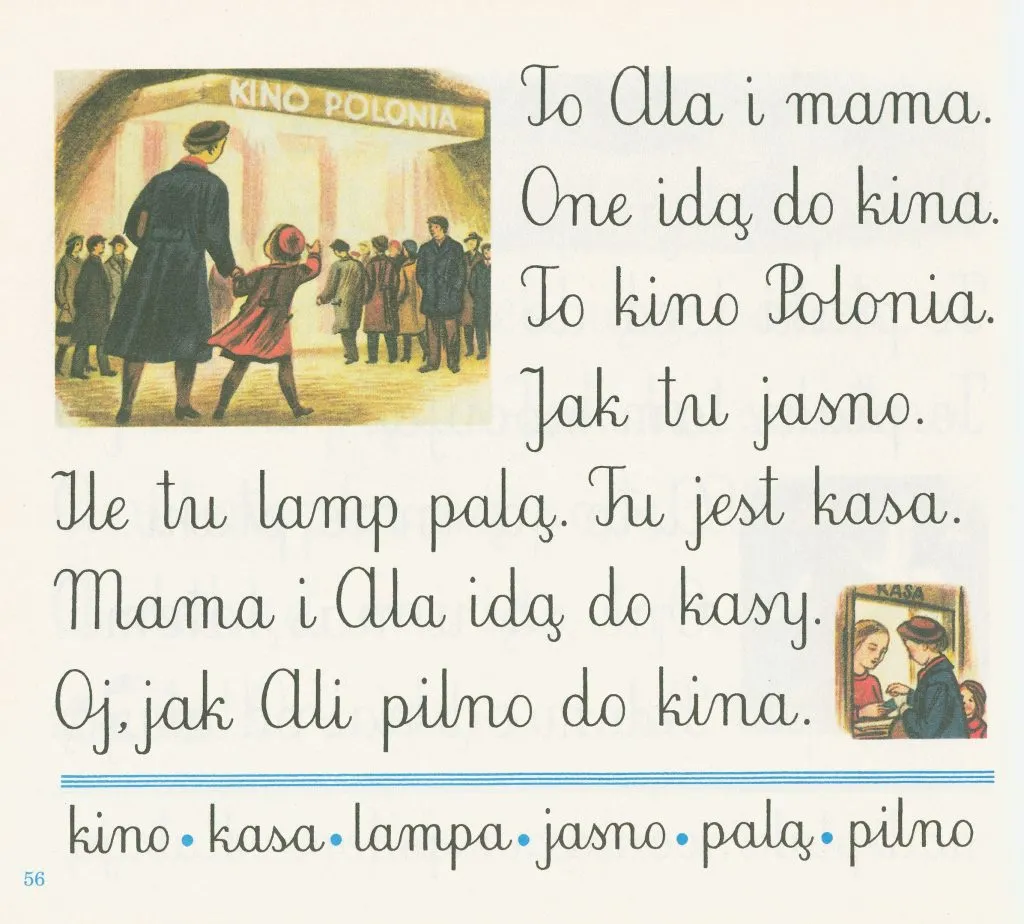
Falski’s Primer naturally returns to patriotic education. Incidentally, by following successive revisions of this most enduring textbook of the Polish school, one could write a history of twentieth-century Poland. Here, let us restrict ourselves to two examples. The 1949 edition emphatically attests to the recent change of political system and the peculiar Bierut-era fusion of nationalism and internationalism that accompanied it. There is a ‘Ceremonial Day’ – the May Day parade (above the reviewing stand, MELS, that is Marx, Engels, Lenin, Stalin), a school assembly, the banner, the capital Warsaw, which ‘will soon be even larger and more beautiful than it was’, while the year’s learning closes with ‘Belweder Palace in Warsaw – the seat of the President of the Republic of Poland’ (not yet the People’s Republic at that time). But there is also a meeting between Polish scouts and Soviet pioneers, and a first encounter with the Russian language: ‘Our Janek – their Vanya. Our Kostek – their Kostya. Our Kasia – their Katya. And they speak similarly to us (…) but when we write mama, mak [poppy] – they will read tata [father], tak [yes].’
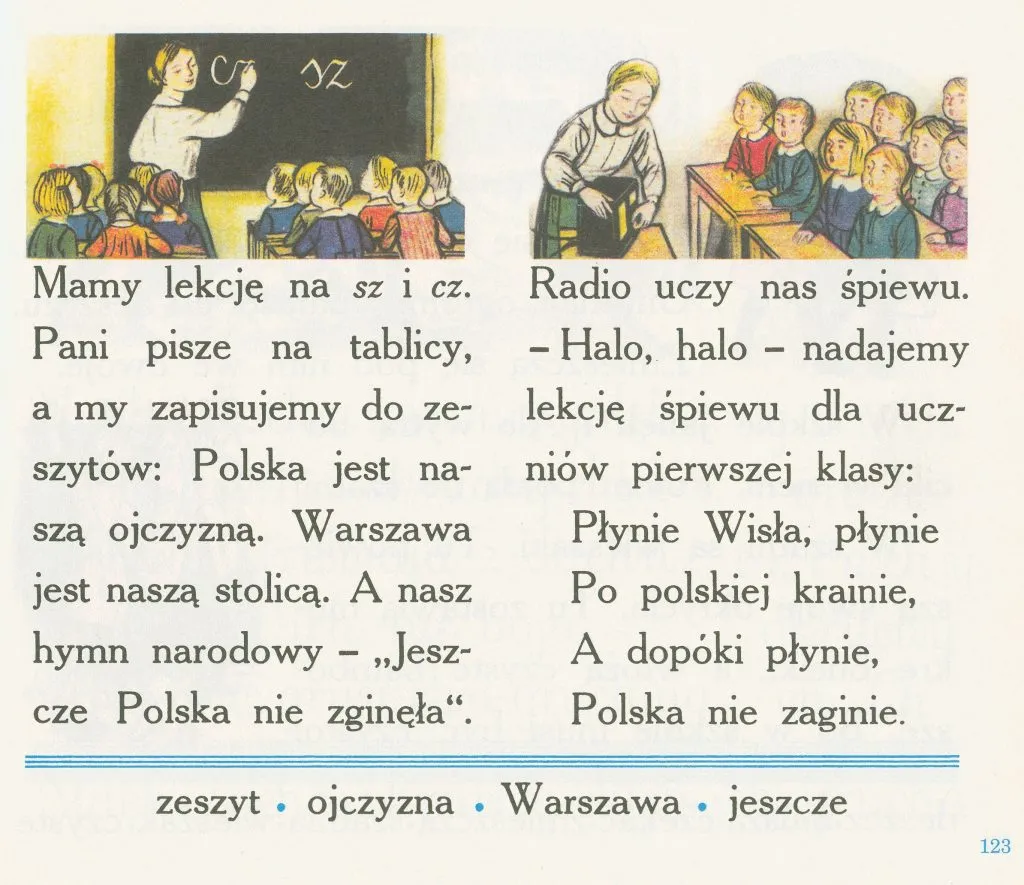
The 1971 edition (the fifteenth and by no means last), meanwhile, may serve the current education authorities as evidence of the marginalisation of patriotic education under the Polish People’s Republic. The fatherland, the capital and even the national anthem appear – shamefully – in connection with the lesson on sz and cz: ‘Polszka is nasza [our] fatherland. Warszawa is nasza capital. And nasz national anthem – “Jeszcze Polska nie zginęła” [Poland Is Not Yet Lost].’
One must give Łódź Kaliska credit for showing genuine concern for the question of attachment to the fatherland and a sense of national identity. Here are Ali and Ala (let us recall: an Arab and a Chinese woman) standing against a wall bearing the national emblem – the eagle – while comic-strip speech bubbles issue from their mouths: ‘Who are you? – A little Pole… etc.’ The installation A is for Arab poses an important problem: He and She in white shirts bearing the eagle (split by the fastening). ‘Bella Donna’ in German plays through a loudspeaker. Beside them, a ‘Pole’ certificate. And the question: ‘In these circumstances, can Ala already give Ali a free fuck?’ There is also, unfortunately, A is for America: both dressed in the American manner (baseball cap, bra patterned with the flag) recite: ‘Who are you?…’ And the comment: ‘Ali and Ala were not granted visas to the USA. Nonetheless, Ali and Ala want to go there, since they have plans that they absolutely must carry out.’
Yet Father Piramowicz had already implored 220 years ago: ‘You whom the Lord God has given the opportunity to receive the learning needed for future happiness, do not imagine that your learning is intended to lead you, once trained, to abandon your estate or your homes; rather, insofar as circumstances permit, remain in that village, that town, and adhere to the homes handed down to you by your Grandfathers and Parents…’
In confronting the old primers with the newest one, Łódź Kaliska’s work, let us limit ourselves to two further, exceedingly important concepts: God and work.
The catechism was an integral part of the Commission of National Education’s Primer. Later nineteenth-century primers likewise contained it (as well as a Latin text for altar boys, the texts of church hymns and so forth). They were not only textbooks for reading, writing and arithmetic, but books containing a summa of the knowledge about the world and God needed by the people. Only in Promyk’s Illustrated Method of Learning to Read and Write does religion lose its autonomous place. This leads to texts such as the first syllabified reading exercise, beside which Dadaist wordplay pales:
‘The measure you use will be measured to you. Love your native land! Have hope that things will be better. Sweep away the rubbish; mint grows among the herbs. Memory, arm, soft, boundary. What is this town called? Money is kept in a pocket, a purse or a pouch. Eat sausage! Radishes are eaten raw, while swedes are boiled. Begin everything with God. A stallion is a horse. Fire requires careful handling. Vodka comes in a tankard…’ – and so we continue to syllabify, mixing God with vodka, a stallion and radishes.
Falski is safely secular. Alementarz, meanwhile, which sets itself the task of ‘showing the complex social and mental phenomena of the adult world’, does not evade truly elementary questions touching on the difficult issue of creationism. In the installation A is for Animal we see plastic, human-made animals and little plants, all with their labels prominently displayed: made in China. And the text: ‘Ala sometimes wonders who really created hell, heaven and everything else?’
And finally, the concept of ‘work’. Need we quote Father Piramowicz? ‘If people did not work, they could not meet their needs; they would be left without food, clothing or shelter…’ The entire second Moral Teaching concerns the duty of Children to be diligent in their Learning, and to accustom themselves to work: ‘God, grant me eternal abhorrence of such harmful idleness…’ and so on and so forth. Naturally, the Polish People’s Republic editions of Falski’s primer likewise devote considerable space to work. Here, instruction comes not through sermons but through example. Workers labour in a factory (the factory is naturally Nowa Huta). The farmer, miller and baker work. The shoemaker works. Even Morusek the dog and Agatka, who watches the geese, work.
‘Thus for everyone’s benefit
And for the common good
Everyone has to work,
My little friend.’
– Tuwim concludes, in a little poem that still echoes in some of our heads.
And what does Alementarz say? A film: He, the motionless face of a sculpture, belching in a female voice professions beginning with A: admiral, advocate, alpinist, ambassador, anthropologist, artist, astronaut, actor, architect. Text: ‘I will take any job.’
This game could continue for a long time – by considering, for example, the question of cleanliness, insistently raised in primers (it must have been very dirty), which reaches its conclusion in the installation A is for Alumnus, where He and She copulate in front of a plastic washbasin, all under the slogan ‘A clean family, a healthy nation’. Yet the entire game leads to a question that is not very amusing: what happened? Did merely ‘the alphabet fall from the stove and strike the floor with a bang’? ‘And I – lost its dot, H – broke its little bridge’? To what extent have primers changed, and to what extent have we ourselves? Was it necessary to read Michel Foucault to sense the oppressive nature of school teaching? To discern the network woven there of mechanisms that discipline, exclude, divide, control and normalise? Or was it enough to release the sickening memory of airless classrooms and crowded, screaming corridors? Of the boredom and coercion of lessons. Of omnipresent hypocrisy.
‘The drama of the individual’s enslavement by society begins at the beginning, and has a sympathetic (smiling) and kindly face’, Marek Janiak writes in the Alementarz project. Yet even that smile is not always benevolent. Let us read in Falski the merciless little tale about a kitten full of educational zeal and the disobedient cockerel carried off by a fox. Or the humiliating story of Antek, who had a hole in his shoe and sock. During the cleanliness inspection, he wiped his dirty foot with his handkerchief. But the teacher ordered the handkerchiefs to be shown as well. ‘Antek takes out his handkerchief. And the handkerchief looks like a floor cloth. What a disgrace.’
‘School, when I remember you,
my eyes fill with tears…’
– wrote the poet whose bronze figure has been seated on a bench on Piotrkowska Street. Perhaps Łódź Fabryczna has a different memory from Łódź Kaliska?
*Prof. Maria Poprzęcka is Director of the Institute of Art History at the University of Warsaw and President of the Association of Art Historians