
Guide to/After Art and Culture
Tomasz Załuski talks to Andrzej Paruzel
Tomasz Załuski: At the time of our conversation, the exhibition you are preparing for Atlas Sztuki is still taking shape. I do know, however, that it will present works by artists whose approach combines their own creative practice with activity devoted to organising artistic culture and shaping artistic life, and even with artistic and social activism. Moreover, these elements do not remain separate or function alongside one another, but interpenetrate and sometimes even combine in a coherent, organic manner. This also applies to you: you conceived and curated the exhibition and selected the artists and works, but you will also be a participant – one of your own works will be shown. You will therefore play a dual role, as artist and curator. This is not the first such situation in your career. In many of your activities of the 1980s and 1990s, artistic and organisational aspects overlap and combine in various ways – you have even been asked whether you are really an artist or rather an organiser of artistic life. I would like our conversation to focus on how these two fields of activity emerged and came together; how you became interested in art’s cultural and social environment and in organisational activity; how these became part of your artistic practice, at times identifying with it and becoming the subject of your works, and at other times developing into a separate, more autonomous and more ‘real’ curatorial, publishing or other activity. It seems to me that the present exhibition grows out of these earlier experiences, and that tracing them will allow us to understand its idea and form more fully. So where did your interest in socio-cultural questions come from? You began studying at the Łódź Film School in the mid-1970s, but I believe this was not your first degree?
Andrzej Paruzel: That is right, it was my second degree. In the first half of the 1970s, I studied at the University of Warsaw’s Faculty of Geography, which had grown out of the former Department of Earth Sciences. In the 1980s, I began signing my artistic texts or manifestations as ‘Master of Earth Sciences’. I completed my studies with a master’s thesis on the demography of France. As a result, I visited France several times between 1973 and 1975, became acquainted with French culture and often went to art galleries. This also helped me to develop my interest in photography and decide to apply to the Łódź Film School later. My geography thesis concerned ethnic minorities in France, including migration – I studied the assimilation of emigrants from North Africa, Portugal, Spain and Poland in social, cultural, linguistic and even culinary terms. I think this was one source of my later interest in sociological and cultural issues in art. As for the artistic context, two elements can be identified that helped shape my dual activity as an artist and an instigator of situations. In the 1970s, art was often judged in terms of attitudes. This was especially true of artists who sought to transcend the classic creator–recipient relationship and bring about situations in which recipients or viewers would participate actively in creative activity. This could be seen in the work of Jerzy Grotowski, whose influence I felt in the early 1970s; as a student and would-be Master of Earth Sciences, I travelled to Wrocław to learn about Grotowski’s practice. It became an important point of reference for my later media works, especially video installations designed so that viewers entering the gallery became participants and co-creators of an artistic situation. The other important element was the activity of the Film Form Workshop. When I began studying at the Film School in 1975, the Workshop as a group had already reached the height of its dynamic development and was entering its final phase, but the individual achievements of members such as Józef Robakowski, Wojciech Bruszewski, Ryszard Waśko and Paweł Kwiek had lost none of their force and remained inspiring. Questions concerning the analysis of the film, photographic and video media, as well as the possibilities of viewers’ perception, were particularly important to me.
T.Z.: And the French points of reference? In France, sociological questions were strongly present in the ideas of Hervé Fischer and the Sociological Art Collective. Did you know their texts and activities, or perhaps encounter them personally, including in Poland? I believe they came here twice – in 1977, they travelled to Warsaw at the invitation of Jan Świdziński to take part in the conference Art as Activity in the Context of Reality.
A.P.: I did not know them personally, but I was familiar with their texts and works. I did know Świdziński’s texts and activities well. I felt close to them – for example, the activities undertaken with Ania and Romuald Kutera and Lech Mrożek in the Kurpie region, within the environment of a local community and its culture. Later, in the early 1980s, Świdziński in turn knew about our activity – that is, mine, my wife Małgorzata Paruzel’s and Piotr Weychert’s – in Koluszki. He even wrote a beautiful text about it. Similar ideas were also discussed in the late 1970s by the Warsaw Seminar group centred around Zbigniew Dłubak, as well as by many other artists. As for France, I knew artists associated with the Paris gallery Lara Vincy and its Conceptual, Fluxus and Nouveau Réalisme circles. In 1977, while still in the second year of my studies, I had a solo exhibition there entitled Video-Photographic Situations, and it was then that I met Raymond Hains, a Nouveau Réaliste with whom I subsequently collaborated for more than thirty years. This acquaintance largely shaped me as an artist in the 1980s.
T.Z.: Let us return to inspirations within Poland. In the first half of the 1970s, what is called media analysis was important to members of the Workshop. Did this idea remain important to you in the second half of the decade, when the Workshop’s existence as a group was drawing to a close? Did you make works devoted to such questions?
A.P.: Yes, that was precisely what the first exhibition in Paris I mentioned was about. Most of the works were photographic, although there were video recordings as well. All of them concerned the analysis of the photographic medium or a comparative analysis of photography and video.
T.Z.: More specifically, what did this analysis involve? Which questions did it address, and what mattered most?
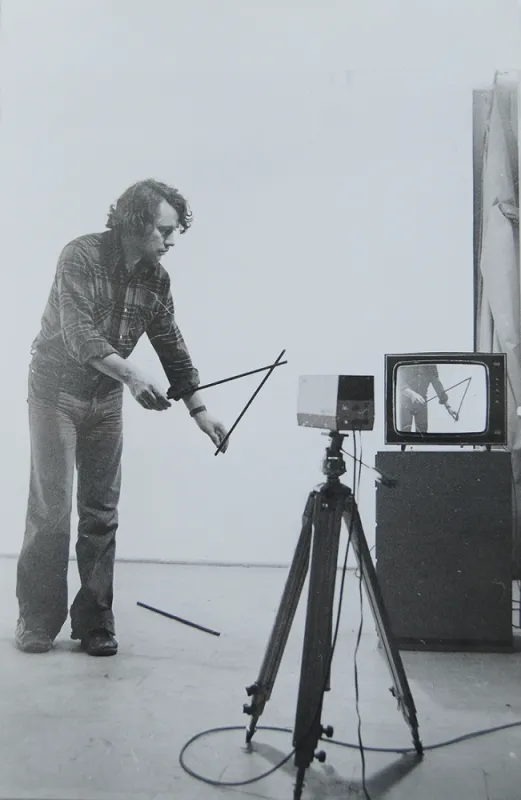
A.P.: Games with the perception of space and perspective, ‘perceptual traps’ created through photography and video. The video works arose from my fascination with the invention of a television camera connected to a monitor transmitting a live feed. What was used in practice in industry, at railway stations or in shops opened up the possibility in art of observing oneself and one’s own actions. I was delighted by this potential and created a series of video installations that made it possible to investigate space and its perception. The camera–monitor arrangement also enabled me to realise Grotowski’s premises: a departure from spectacle towards the participation of viewers, who could act within the gallery space while simultaneously observing their actions transmitted on a monitor. The video installation said: ‘Look, this is you, here and now.’ It therefore created a shock resembling a child’s first sight of their reflection in a mirror. Art later turned away from video and video installation. It seems to me that they were in a sense ‘inconvenient’ for the traditional field of art, just like performance. Another reason was the rapid change in video technology and recording formats: works made on the first video recorders soon could no longer be played on new equipment, causing problems for galleries and museums that presented and archived them. A certain distortion also occurred: the way ‘video’ began to function in mass domestic circulation contradicted the essence of video, meaning the direct recording of an action and its transmission or playback. Treating ‘video’ as the process of playing a film from a cassette impoverished the possibilities of the new medium.
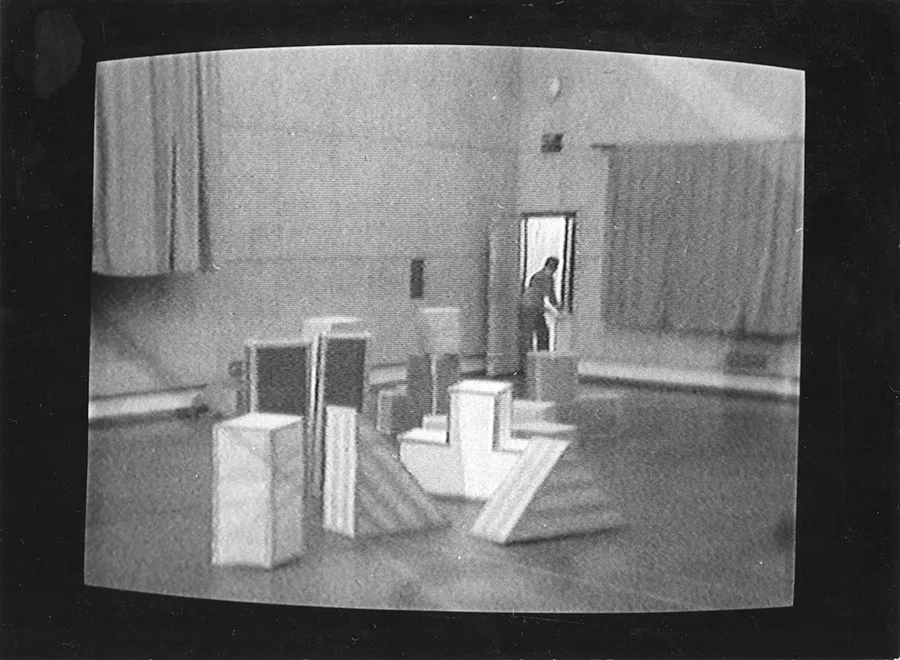
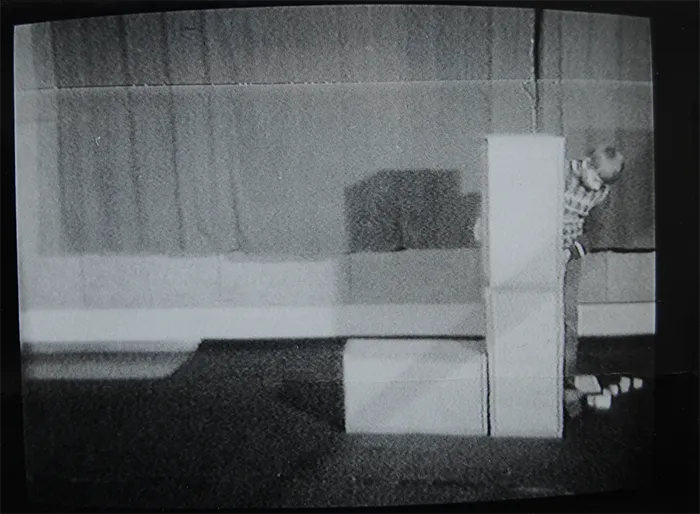
Andrzej Paruzel, Audiovisual Experience at the State Higher School of Music in Warsaw, 1979
T.Z.: Media analysis therefore developed smoothly into activities intended to include the viewer within the artistic situation, making it possible to transcend the division between creator and recipient and giving the viewer an opportunity to act and observe themselves as a kind of performer. Is that right?
A.P.: Yes. The culmination of this approach for me came in the works shown – in the form of documentation – at the international event Works and Words, held at de Appel gallery in Amsterdam in 1979. I realised one of them at the Academy of Music in Warsaw. I arranged the following situation in two studios: one was filled with a cacophony of sounds and contained various spatial forms, while the other remained empty and silent. People of different ages and with different educational backgrounds were invited to participate; their task was to carry the forms into the empty studio and use them to construct a larger spatial, but also acoustic, form. Once an element had been moved into the second room, its individually assigned sound could be heard.
T.Z.: Was the final arrangement predetermined? Were they meant to reconstruct a kind of puzzle?
A.P.: Yes. Instructions specifying what was to be built formed part of the experiment. The entire process was documented by two cameras, so that after the activity had finished each person could see both what they themselves had done and compare their actions with those of the others. The second work shown at de Appel, Statements – Motivations – Confrontations, was photographic. I approached ten people at the Łódź Film School – students, lecturers, fellow artists, representatives of the school’s authorities, technical staff and so forth – with the following proposal: each would have twelve photographic frames at their disposal to describe themselves and me on the Film School premises. I also described each participant photographically. The result was a book containing 480 photographs. Each person had a double-page spread comprising photographs showing how they perceived themselves within the space and community of the Film School, how they saw me there, and how they in turn were perceived by me. Everyone could view the album in its entirety and compare their own way of observing both themselves and me with the way others perceived themselves and me.
T.Z.: Were other Film School students interested in similar subjects at the time?
A.P.: The process of moving from media analysis towards including the viewer in the artistic situation could also be seen among my colleagues, such as Tomasz Konart and Janusz Szczerek. Zespół T, the group that included me, Konart and Szczerek alongside Małgorzata Paruzel, Janusz Kołodrubiec and Piotr Weychert, arose in a sense from this wave of changes. Here, the problem of erasing the boundary between the artist who sends a message and the viewer who receives it emerged with full force. The erasure of this boundary led to a conscious renunciation of exclusive authorship in favour of authorship that was, as it were, shared between the creator and the participant-co-creators. This was connected with all the revaluations that had arisen since the hippie revolt, above all the desire to move away from an attitude emphasising the creator’s individualism. Zespół T focused precisely on studying communication processes within a group of people, and in its activities brought about situations in which subject and object became one.
T.Z.: But before Zespół T, you were briefly a member of the Film Form Workshop – that is, you belonged to the broader configuration of artists who collaborated within the Workshop at the beginning of the second half of the 1970s.
A.P.: Yes; I think I was actually the first member of the younger generation to belong to that broader configuration of the Workshop. It was a time of friendship with Józef Robakowski, Ryszard Waśko and Paweł Kwiek. Significantly, as the Workshop lost its existence as a group, the individual attitudes of its original members became increasingly distinct. Following these individual positions, observing the rivalry between the Workshop’s principal figures and trying to enter into dialogue with them created a very interesting situation and opened opportunities for collaboration. It was a period of intensive cooperation and numerous workshop sessions that we organised together. We also made video works together at the Film School centre in Marysin or using a portable video recorder borrowed from the Olympic Committee. After work, we often met at the Spatif club in Łódź, which at that time was a meeting place for filmmakers and artists.
T.Z.: When exactly was Zespół T founded? What did its name mean?
A.P.: Zespół T was founded in 1979 and existed until martial law was declared, although it was already in a vestigial state for the final six months. The letter T stood for creativity, theory and therapy. The last of these terms referred to contemporary psychology and analytical research into the capacities of the human brain. At the time, we were all tremendously impressed by research into the possibilities of human creative development. An important book was the American psychologist Joy Paul Guilford’s The Nature of Human Intelligence, published in Poland in 1978. We even held a session at a therapeutic centre – a psychiatric hospital in Drewnica near Warsaw. For seven days, we underwent tests intended to determine how we functioned individually and as a group. This accorded with our general interest in interpersonal relations and communication processes within a group.
T.Z.: And what caused Zespół T to disband?
A.P.: For my part, I felt that I lacked some kind of content or cultural value, perhaps even a myth that could emerge from the analysis of media and interpersonal communication. I was looking for a way to address social and cultural reality. This was precisely what the project undertaken in Koluszki with Małgorzata Paruzel and Piotr Weychert gave me. The other important reason for the group’s disbandment was martial law, which caught some of its members abroad.
T.Z.: The project realised in Koluszki already concerned art’s social environment and the conditions under which artistic culture takes shape, while simultaneously attempting to create and animate a participatory situation for the local community. What is the correct title of the undertaking? The Koluszki Project?
A.P.: I use the title Koluszki Realisation.
T.Z.: It concerned undertaking works and activities relating to Katarzyna Kobro’s
and Władysław Strzemiński’s stay in Koluszki between 1926 and 1931. What exactly was the idea behind this undertaking? In which years did you carry it out?
A.P.: We began in late 1980, worked throughout 1981 and finished a year later, by then under martial law. Initially, it was a project conducted as part of Zespół T, although, because of increasingly clear fractures within the group, not by all its members. We wanted to examine the lives, activities and fates of graduates of the School of Industry and Commerce, where Strzemiński had taught. It was the last possible moment to reach these people. We were also fascinated, of course, by the attitudes of Strzemiński and Kobro – we wondered how it had been possible, in a small settlement, to write texts as important as those concerning Unism in painting and the composition of space, while simultaneously participating actively in avant-garde art groups and laying the foundation for the future Muzeum Sztuki in Łódź, namely the a.r. group collection. At the time, it was incomprehensible to me; today, I would probably see it differently – if only because trains ran quickly and punctually before the war…
T.Z.: So was the aim to bring out the contrast between the artists’ ideas and activities and the place where they lived?
A.P.: That too, but the most important issue was their determination. Strzemiński boasted to Przyboś that he did certain things in Koluszki better than they were done at the Bauhaus. I wanted to see this Polish mini-Bauhaus. Some preliminary premises, suppositions and intuitions were confirmed, while others were not. But not because Strzemiński had exaggerated. Rather, it was because life was ‘harsh’. I am referring to the later fates of his pupils from the School of Commerce and Industry. They completed a good school, but the economic situation prevented them from continuing their education. Hence the sense of unfulfilment. One of these pupils tried to continue studying at a printing school in Warsaw, but free train travel for pupils was limited to journeys of up to one hundred kilometres. Koluszki was 107 kilometres from Warsaw…
T.Z.: What exactly did you do in Koluszki?
A.P.: First, we documented the school and the curriculum taught by Strzemiński. Second, we wanted to learn from the former pupils about the relationship between Kobro and Strzemiński during this period. We wanted to find out what it had been like before their relationship broke down. It was a time of close and highly productive collaboration between them, a close intimate relationship, but also one of devotion and fortitude – when snow fell, Kobro brought the disabled Strzemiński to school on a sledge. They were both also very warm and kind in their dealings with the pupils. Finally, the third matter was to undertake specific sociological activity in Koluszki, one that concerned not only history but was also intended to bring new cultural facts into being. Above all, this meant locating documentation of a no-longer-extant pre-war monument and launching an initiative to reconstruct it.
T.Z.: You mean the monument designed by Strzemiński and erected in Koluszki – what did it commemorate?
A.P.: The monument commemorating the tenth anniversary of Poland’s regaining independence was erected in Koluszki in 1930, two years late – as the date reveals – because of insufficient funds. It looked as follows: an eagle rising into flight, highly synthetic in form, was mounted on a red-brick pedestal. The eagle was initially to have been cast in iron, but there was no money for this, so it was ultimately made of plaster and covered with sheet metal. Strzemiński designed the monument, although it seems to me that some of its elements – more precisely, the arrangement of the pedestal with an arch – were taken from one of Kobro’s compositions. They therefore probably collaborated on the design. The monument stood beside the secondary school in Koluszki. After Strzemiński left, the brick pedestal was rendered. Because the monument stood close to the school, it quickly became an important landmark and a meeting place for young people – the arch beside the pedestal was treated as a little bench. Our archive contains many photographs showing the lives of Koluszki’s inhabitants unfolding in this place.
T.Z.: So the monument became a kind of ‘communal piece of street furniture’…?
A.P.: And as a communal piece of furniture, it did not escape various actions by the community. For example, we have a photograph showing a poster pasted to the pedestal that reads: ‘Poles, do not buy from Jews!’ The monument existed for less than a decade and was destroyed during German air raids in the first days of September 1939, whose aim was to eliminate the Koluszki railway junction. Interestingly, during the first six months of our presence and activity in Koluszki, we did not find a single photograph of it. Photographs appeared only after we conducted a survey among Strzemiński’s former pupils and the inhabitants of Koluszki. It transpired that residents had been afraid to reveal images of a monument that included a crowned eagle.
During the war, Koluszki lay on the border between the Reich and the General Government.
A strong organisation of Home Army couriers operated in the area, smuggling people across the border. In 1945, the NKVD deported these Home Army members to the Soviet Union. The fact that Koluszki’s inhabitants were afraid to reveal the photographs in 1981 testifies to their state of mind.
Eventually, however, they decided to show and share them. We achieved what art historians had been unable to accomplish for many years. Our prolonged presence and commitment to the entire undertaking must have inspired the inhabitants’ trust. Once we had the photographs, we decided to reconstruct the monument. With the help of Janusz Zagrodzki and Jerzy Zachara, we used the photographs to make a plaster model; everything was ready for the reconstruction, and then martial law was suddenly declared.
T.Z.: Did you also recreate the crown on the eagle’s head in the plaster model?
A.P.: Yes. At that point, martial law was not the only thing to check the momentum of our activities in Koluszki. My wife gave birth to our daughter two days before martial law was declared, and I had to deal with everything connected with the child’s insurance, food ration cards and so forth. It was a difficult period for many reasons. In order to travel to Koluszki under martial law, I took a job at the local secondary school and construction school, where I taught a subject called knowledge of contemporary culture.
T.Z.: Did you cooperate with the local authorities over reconstructing the monument and returning it to the city? After all, questions of funding, official permission and so forth had to be arranged.
A.P.: Yes, although initially, before martial law, it was to be built with the help of a private individual. At one of the meetings concerning the monument’s reconstruction, someone volunteered to supply the materials and build it. Then martial law was imposed, and I began to question the point of the undertaking. This was in 1982. Suddenly, I received a letter from the Party organisation in Koluszki inviting me to a meeting. I was afraid there would be trouble, but at the meeting its representative told me: ‘We heard that you were active here until martial law and wanted to reconstruct this monument. A military unit is stationed near Koluszki, but we have nowhere to promote soldiers. So build us that monument.’ In those circumstances, however, I did not want to act. I never returned to the question of rebuilding the monument. Several years later, I received a letter from a teacher in Koluszki informing me that a group of inhabitants wanted to erect it and asking me to share the documentation. I gave it to them, and they carried out their plan. Today, the monument stands near the railway station.
T.Z.: Your activities included elements that might also appear in the research of art historians or sociologists – gathering documentation, surveys, interviews, reconstructing the broader context of artistic culture…
A.P.: We also asked how the monument had been received by the community living in Koluszki, and about the reception of the works and exhibitions of Strzemiński’s pupils, who presented bold designs with geometrical patterns. The tangible results of all these activities were appreciated by specialists. Janusz Zagrodzki purchased the documentation for the National Museum in Warsaw; Andrzej Turowski showed our film documenting the entire Koluszki Realisation at several symposia and also wrote a text about our undertaking. I was also in contact with Nika Strzemińska, to whom I passed information about her parents’ stay in Koluszki. We also assembled a collection of designs and works by Strzemiński’s pupils. In 1985, I managed to organise an exhibition at the BWA in Białystok where, alongside paintings by Strzemiński lent to me by Ryszard Stanisławski of the Muzeum Sztuki in Łódź, we presented the entire sociological and cultural context of both artists’ lives and work in Koluszki.
T.Z.: One more thing is worth mentioning. In a 1986 issue of the journal ‘Sztuka’ devoted to Strzemiński and Kobro, you published a text about the entire undertaking, including activities with the local community intended to develop new cultural value. Reading the text today, one notices terms that sound very contemporary: you write of the importance of ‘participation’, ‘drawing people in’, ‘interpersonal relations’, ‘a form of cultural activation’ and ‘replacing the stereotype of culture for society with direct participation in culture’. Many elements of this manifesto of art as socio-cultural animation could be repeated unchanged today and would remain relevant.
Let us change the subject slightly. I would like us to try to establish your place within Łódź’s artistic culture of the late 1970s and 1980s. Which places, situations, events, institutions and people were important or, as it was said at the time, favourable to you? With whom did you cooperate, and with whom did you experience tension and antagonism?
A.P.: For me, the 1980s began with several situations that were the aftermath of my intensive activity in the late 1970s. This applies above all to my participation in the Paris Biennale in 1982. Martial law was already in force, but permission for my trip had been issued a year earlier and was not withdrawn. The journey, and even more so my return, helped me enormously. I subsequently received passports without difficulty.
T.Z.: Precisely because you returned at that time?
A.P.: Because I came back. Later, I received many invitations from friends in France and had numerous opportunities to travel. I also took part in exhibitions organised there – the film about Koluszki was shown in the Présences Polonaises exhibition in 1983. I mention this to show that, by then, I could already feel appreciated and recognised as an artist. To some extent, this shaped my relationship with the Łódź milieu. On the other hand, the birth of my daughter forced me to reorganise my life, while travelling to Koluszki and working there as a teacher prevented me from maintaining a constant presence in Łódź, both at street demonstrations and in artistic life. As is well known, Strych was one of the important places for meetings and activities. I went there and even attended one of the Silent Cinema festivals, while one of my works appeared in an issue of ‘Tango’. At some point, however, I took offence at Adam Rzepecki of Łódź Kaliska, whom, alongside Marek Janiak, I actually valued most highly in the group. I then stopped going to Strych. An important aspect of what happened there was contact with artists arriving from other cities, including Jacek Kryszkowski and Zbigniew Libera, with whom I later collaborated in various ways. These contacts remain important to me today – as demonstrated by the fact that works by these artists will also appear in the exhibition at Atlas Sztuki.
T.Z.: Do you understand Pitch-In Culture narrowly or broadly? Was it primarily Strych, or something more general that occurred not only across the wider Łódź art milieu, but beyond it on a nationwide scale?
A.P.: To be honest, in neither of these versions did Pitch-In Culture represent an important proposition for me. After my experiences of the late 1970s and participation in exhibitions, including abroad, I had already moved elsewhere.
T.Z.: Let us continue. What about the Association of Cultural Artists, active in the late 1970s and almost throughout the 1980s at the Artists’ House?
A.P.: I was the youngest member of the Association’s board; it also included Robakowski, Zagrodzki and Ewa Partum’s brother Konrad Frejdlich, the son of a well-known Łódź doctor and social activist. We worked there together, trying to create an alternative platform for artistic encounters. Many exhibitions and symposia were held there, including international ones. It is worth emphasising that, in the late 1970s, thanks to Robakowski’s initiative, Łódź and Poland as a whole hosted a number of outstanding figures from the international art world, including Valie Export, Peter Weibel, Jiři Valoch and many others. Together with Robakowski, I also co-organised a very important meeting with Joseph Beuys held on the Association’s premises.
T.Z.: Construction in Process in 1981?
A.P.: It was undoubtedly the largest and most important international exhibition held in Poland after 1945. That is indisputable, and Waśko and the team that organised the entire undertaking deserve great credit. From an ideological standpoint, I felt it lacked artists who worked in process rather than merely creating objects. At the time, I was already working in Koluszki and could not perceive or assess the matter differently. On the other hand, after completing the activities there, in a new personal situation and amid the reality of martial law, I also began looking for a way back to creating objects. It was a period of a turn towards expression and the emergence of ‘wild’ painting. I then created a series of small works entitled Planets of Art. They were made while I played with my child, from whatever I had to hand – plasticine, coloured powders, crayons and so forth. Andrzej Turowski wrote an interesting text about these works in 1984. In May 1985, I concluded this object-based series with a large installation prepared in the garden of the Museum of the History of the City of Łódź. It was a wall of dry ice that melted rapidly on a hot evening to the sounds of a German operetta from the interwar period. I wanted to call the installation Berlin Wall, but the censors refused. The work was ultimately entitled The Most Neurotic Point in Europe.
T.Z.: And Galeria Wschodnia?
A.P.: At Galeria Wschodnia in 1987, I showed the installation Shoelaces in Venetian Green, in which I placed monitors alongside powdered paint heaped like building material on a construction site. Galeria Wschodnia was also a place I visited as an employee of Bureau of Guides to/After Art and Culture.
T.Z.: Let us turn, then, to Bureau of Guides to/After Art and Culture. Where did its idea come from, and what did it involve? And why that name – why a ‘bureau’?
A.P.: The Bureau was founded in 1988. Earlier, I had held a fellowship in France and also travelled to Italy, returning with a new perspective on art, practically with a new artistic ‘self’. Renewed contact in Paris with Raymond Hains, who created art through his walks through the city and through culture, was important. In Poland, the Bureau referred in a certain way to Andrzej Partum’s Poetry Bureau, but also to Witkacy’s Portrait Company. The construction ‘to/After Art’ expressed the conviction that art understood narrowly had reached its end and should be replaced by the broader category of ‘Culture’. It could accommodate a ‘Master of Earth Sciences’ and the entire background of socio-cultural questions. The Bureau of Guides was therefore a walk through the city and through culture. I understood that, for such walks and dialogues with culture and history, I had to create an institution – in a sense fictional – extending between the Guide to Art, meaning me, and the Bureau, meaning a place where artistic activities were bureaucratised. The Bureau came into existence at the moment of political transition and a new wave of interest in Poland, or, more broadly, East-Central Europe.
In this context, it began to invoke Łódź’s multicultural history and felt called upon to document its traces, such as remnants of German or Russian inscriptions on walls. All this, however, was carried out in the spirit of ‘Fluxus expression’ or Situationist activities.
T.Z.: What form did the Bureau’s activity take?
A.P.: The Bureau’s daily work included finding the Bureau’s art objects and marking them with a metal plaque. At first, these objects were found in Łódź, but over time the Bureau’s employee – the Master of Earth Sciences – performed these tasks in other cities: Bratislava, Olsztyn and Berlin (in which case the plaques were in the appropriate languages). It was an ongoing occupation, and the Bureau later participated in this way in various open-air workshops, exhibitions and events organised by the Art Hotel. The Bureau’s art objects were ephemeral, absurd visual objects or phenomena. This kind of marking or designation – elevating something to the status of an art object – was frequently encountered in earlier Conceptual practices. The new value I added, as it seemed to me at the time, was to codify this kind of activity through an institution, namely Bureau of Guides to/After Art and Culture, and to place the objects on a map near significant sites important to the city’s history. It was a particular provocation situated between the world of fiction and cultural tradition. A Bureau art object could be an area of variable temperature in a park, but also the ‘parked’, abandoned East German Trabants around the West German consulate in Warsaw’s Saska Kępa district. Sometimes these objects referred to the political situation in Europe. Later, in reunified Berlin, I marked Trabants that served as gardens for growing flowers in alternative free-youth venues in the Mitte district. All these objects and routes were published in the Bureau’s magazine. The periodical published by the Bureau also contained fictional letters to well-known artists and cultural institutions.
Marek Krajewski aptly described the Bureau’s activity. Let me quote a passage from his text: ‘Bureau of Guides to/After Art and Culture (…) began its activity with the birth (rebirth) of capitalism in Poland at the end of the 1980s. This coincidence is not accidental, because the strategy practised by this institution closely resembled the strategy underpinning the new economic system, although their aims were entirely different. This strategy can be described as producing visibility through marking, and its aim is to transform what is invisible (or does not exist) into a distractor whose disclosure causes us to perceive reality differently. Marking consists in isolating something from a homogeneous background that is usually too familiar for us to notice it, and drawing attention to that something – by pointing a finger, standing beside it and staring persistently, granting it the status of a work of art, placing a plaque with information beside it, reproducing it in millions of copies, including it in a tourist brochure or putting it on a street billboard. Marking is Conceptual art because, although its space is the sphere of aesthetics and appearances, it requires an understanding of the rules of the context in which it occurs, while deriving its effectiveness from exceeding our cognitive frameworks and introducing disquiet into the classificatory systems we use every day. (…) Marking therefore always violates the established order, but consequently also possesses the capacity to activate reflection on that order. (…) Marking succeeds if the object is filled with new meanings, if we begin to act towards it differently than before. Success is guaranteed either by the visibility or high status of the person doing the marking (the artist), or by the ubiquity and omnipresence of the marker, the representation of what is being marked (advertising).’
T.Z.: You mentioned the periodical published by the Bureau. What was its print run? How did you publish and distribute it?
A.P.: The premise was that I would publish each issue together with an institution of culture or art – for example, the Museum of Cinematography in Łódź or the Study Theatre, where Jolanta Ciesielska ran the gallery. These institutions gave me an opportunity to present the Bureau’s ideas in a lecture, as well as money for photocopying. The magazine was photocopied and published in this form, in a print run of several dozen copies. Altogether, I managed to publish eleven issues – the first two still had to pass through censorship. I numbered, signed and sold the first ten copies of each issue. This was my idea at the time for earning a living – and, in fact, I managed to live from it for a while. The buyers were mainly affluent Poles who had emigrated from Poland, made their fortunes abroad and were now visiting the country, including Łódź.
T.Z.: The Bureau also meant the briefcase with which you travelled…
A.P.: The briefcase was the Bureau’s only permanent material structure. Thanks to it, the Bureau could move and travel. There were actually many briefcases; in the end, one survived, a kind of miniature suitcase. I carried documentation of activities in it, although it might also contain a sandwich and a bottle of wine. The briefcase was also a sign of the entire situation’s professionalism – when I met someone, I would open it and take out the documentary materials. The Bureau had its own post-office box at Łódź’s main post office. It also had local branches, including one in Toruń.
T.Z.: How did the Bureau find its place within the reality of the time, during the period of transition?
A.P.: Another form of the Bureau’s activity was placing advertisements in Łódź cultural magazines. One concerned training as a guide to Łódź and attracted quite considerable interest – I received several applications. There was also an advertisement from the Bureau’s matrimonial department. This play with provocations fitted perfectly into the feverish search for new possibilities and the shaping of a new political and cultural reality at the time. The Bureau and its activity – above all, the magazine it published – made it possible to create a distinctive narrative, lending narrative continuity to trivial or ephemeral facts and situations, which thereby acquired cultural and political meaning because they related to the decline of a divided Europe. Soon, real coach tours ‘through culture’ began to be organised for visitors from abroad. Some people thought that I also wanted to organise such tours and were surprised when I said it was only fiction. They advised me to do it for real and open an actual travel agency. In a sense, I did begin this kind of more ‘real’ activity, although with a different profile, and it absorbed – ‘devoured’, as it were – the fictional Bureau of Guides to/After Art and Culture. I am referring to the Art Hotel.
T.Z.: The Art Hotel, but also the Art Hotel Publishing House: on the one hand, it was an initiative concerned with organising and curating exhibitions and artistic presentations; on the other, a publishing house that produced catalogues for these exhibition projects and planned to translate and publish important books on art and culture. What provided the impetus for founding the Art Hotel?
A.P.: The Art Hotel was initially a space – in 1990, the City Museum and the regional and municipal authorities in Łódź gave me access to the attic of an administrative building on Plac Wolności. I pursued an activity there for six months, giving it precisely this name: the Art Hotel. I invited six artists to make presentations that could take place there or in the Poznański Palace. The six-month cycle concluded with a large exhibition in which fifteen artists presented their works and activities simultaneously in the Hotel and the Poznański Palace – inside the building and in the garden. The Art Hotel Association and a publishing house of the same name were subsequently founded and co-run with me by Dorota Karaszewska and Ewa Mikina. The Association was the principal organiser of the Paths of European Culture project, a two-year cycle of exhibitions in Brussels, Bratislava, Berlin and Łódź, which I co-created with Ewa Mikina, whose intellectual contribution, especially to the publishing house’s activity, was invaluable.
T.Z.: Both these events – the Art Hotel and Paths of European Culture – featured artists whom you have also invited to participate in the exhibition being prepared for Atlas Sztuki: Jerzy Treliński, Július Koller and Emilio López-Menchero. Once again, it is apparent that contacts and cooperation within earlier undertakings are influencing the form of the present exhibition.
Returning to the Art Hotel Publishing House: in addition to the catalogues for the two exhibition projects we have just discussed, you published Serge Guilbaut’s How New York Stole the Idea of Modern Art and Stewart Home’s The Assault on Culture, both translated into Polish by Ewa Mikina. In practice, the Hotel and publishing house operated until 1993, after which their activity ceased. What caused this?
A.P.: Existential and personal upheavals. But the Art Hotel, in collaboration with Ewa Mikina, also organised the exhibition Turrets, Domes, Attics, Arcades of City-Dwellers in Łódź. Artists could choose a place in the attics of Łódź tenement buildings and prepare their works there. Unfortunately, the event did not produce a catalogue. Around 1995, for various personal reasons, I suspended such intensive artistic activity. I returned to it several years later, when I revived the concept of the Bureau of Guides and created the fictional Lens Travel Agency. It was a cycle of works realised on billboards between 2004 and 2013, presenting my photographs of Parisian homeless people from the 1970s. As Marek Krajewski, whom I would like to invoke once again, wrote, ‘advertisements for the Lens Travel Agency therefore mark contemporary visual culture above all, making visible the rules that govern the production of images and our ways of viewing and using them’. Their aim ‘is not instruction, the revelation of truth or unmasking, but rather opening one more possible path of seeing, moving the action forwards without claiming to write its ending or define its destination’.
The next project in which I became involved had a very ‘real’ character: the Profile Foundation, established in 2008, which I co-founded with Bożena Czubak. At first, we jointly defined the direction of its activity; Bożena later assumed its leadership and continues to run the Foundation today.
T.Z.: It is impossible not to notice that several artists whose works are to be presented in the exhibition at Atlas Sztuki are also artists of the Profile Foundation. The Foundation organises exhibitions of their work and handles its sale. The historical considerations determining the exhibition’s form seem to converge here with your current involvement in the Foundation’s activity. How important is this Profile Foundation context?
A.P.: The Profile Foundation is another challenge, an interesting practice and opportunity for observation. During the first several years of its existence, I was able to observe how visitors to international art fairs in Turin, Vienna and Brussels reacted to works by Jarosław Kozłowski, Krzysztof Wodiczko and Zbigniew Libera. It was an entirely new experience because art fairs attract not a dozen or so visitors, as an art gallery might, but tens of thousands. Through conversations with Kozłowski, I was able to understand the art of the late 1960s and early 1970s more fully, including the work of artists such as Włodzimierz Borowski, Andrzej Matuszewski and Andrzej Dłużniewski. I had the pleasure of collaborating with the latter two artists at the Art Hotel, while Andrzej Dłużniewski was my friend and interlocutor for many years. While preparing exhibitions at Profile, Krzysztof Wodiczko talked to me about his activities outside Poland in the 1980s and 1990s. Helping to realise Zbyszek Libera’s work The Gay, Innocent and Heartless – the first iteration of the project at the Profile Foundation – was an interesting experience. I began collaborating with Bożena Czubak after several spectacular exhibitions that she had prepared, among other places, at Zachęta and the Ujazdowski Castle Centre for Contemporary Art in Warsaw. I was also able to follow successive, tremendously energetic exhibitions of Józef Robakowski’s work that Bożena prepared at the Centre for Contemporary Art in Warsaw and Toruń. There are undoubtedly more points of contact between the scope of the Foundation’s activity and the form of the exhibition I am currently preparing for Atlas Sztuki.
T.Z.: There is only one woman among the exhibition’s participants – Natalia Lach-Lachowicz. Why only her? Were there plans to invite other women artists?
A.P.: Many women artists made presentations as part of the Art Hotel’s activities, including Teresa Murak, Izabella Gustowska and Anne Veronice Janssens. The project’s women curators included Zuzana Bartosova, director of the Slovak National Gallery; Angelika Stepken, co-curator of the exhibition at Kunst-Werke in Berlin; and Marie-Claire Hürner and Carin Fol, curators of the Brussels presentation. I think other women artists will also appear in future iterations of the exhibition now in preparation, since we are considering several international editions.
T.Z.: What else determines the form of this exhibition?
A.P.: Dialogues between artists are tremendously important to art. I want to show such dialogues emerging between the invited artists’ works. And there is one more thing, perhaps slightly selfish or subjective. The artists I have invited are simply people with whom I myself feel at ease.
*Dr Tomasz Załuski is an art historian and philosopher who works in the Department of Media and Audiovisual Culture at the University of Łódź and the Academy of Fine Arts in Łódź. He is the author of the book Artistic Modernism and Repetition (2008), and editor of the volumes Arts in Transmedial Space (2010) and The Effectiveness of Art (2014). He is a member of the editorial boards of the online philosophical journal ‘Hybris’ and the journal ‘Sztuka i Dokumentacja’.