
Regarding ‘Attitudes’
Daniel Muzyczuk
“The bureau is my pen” — this slogan appears in Andrzej Paruzel’s 1988 video The Bureau in Olsztyn. The eponymous Bureau of Guides to/Art and Culture is one of the many one-person art organisations that, from the mid-1960s onwards, formed one of the principal models by which neo-avant-garde artists occupied a place in public space. The particular conditions under which the field of art operated in the Polish People’s Republic, together with the aesthetics of bureaucracy, created fertile ground for all kinds of bureaux, studios and galleries whose names suggested an official mode of operation within a landscape in which permission to become visible was strictly rationed. Neo-avant-garde art could not assume its rightful place in institutions that not only mediate between it and its publics but, in accordance with the institutional definition of art, also make it possible to distinguish art from non-art. Artists’ institutions emerged from this nexus of circumstances and from impulses originating in Western Conceptualism, which, under the influence of social change, was adopting an increasingly well-defined political position. Some artists’ institutions were intent on ridiculing the bureaucracy of the Polish People’s Republic; others used such mimicry to lend themselves gravitas. All, however, testified to highly distinctive struggles for a new concept of art’s autonomy: one understood as a field extending beyond the individual artistic gesture towards the artist’s activity as a whole, encompassed by the term “attitude”, much overused in the 1980s.

This tendency has another aspect that is becoming exceptionally relevant today: artists’ self-organisation, prompted by deficiencies in the institutional infrastructure of the late Polish People’s Republic, when most exhibition institutions proceeded as though the neo-avant-garde breakthrough had never taken place. Engaging with the Twentieth-Century Avant-Garde brought together several examples of the “attitudes” adopted by artists as organisers. It is worth naming at least some of these entities and their authors: Jerzy Treliński’s 80 × 140 Gallery; Ryszard Waśko’s Archive of Contemporary Thought and Artists’ Museum; Józef Robakowski and Małgorzata Potocka’s Exchange Gallery; Natalia LL, Andrzej Lachowicz and Zbigniew Dłubak’s Permafo; Jacek Kryszkowski’s Personal Point for Observing and Shaping the Creative Flora; Andrzej Partum’s Poetry Bureau; Jarosław Kozłowski’s Akumulatory Gallery; the Film Form Workshop; Team T; Hotel Sztuki; and Andrzej Paruzel’s Bureau of Guides to/Art and Culture. Józef Robakowski traces the genealogy of this phenomenon to the activity of the a.r. group, and especially to Władysław Strzemiński and Katarzyna Kobro.1 In addition to creating individual works, these artists were involved in the institutional organisation of the field of art. The formation of the a.r. group’s collection, its teaching and theoretical activity are elements difficult to separate when we examine the “attitude” invoked above. Here we can understand it as an ethos that prompts artists not only to construct a work but also to build the conditions for its reception. Construction in Process, the celebrated international exhibition held in Łódź in 1981 as an artists’ initiative, should likewise be understood as a collective work in this expanded sense.
All these elements — artist-run galleries, independent one-person institutions or simply events driven by artists — were not merely forms of cultural animation; they also constitute the genealogy of the contemporary figure of the “artist as curator”. Once institutions had caught up, absorbed the premises of institutional critique, created conditions for mediating creativity understood in this way and assimilated curatorial discourses, it turned out that we were witnessing a new wave of exhibition-making by artists who, for subversive purposes, effected a significant quid pro quo. Nothing, of course, could be further from the truth: in terms of the struggles for the autonomy of art and the artist inherited from the 1970s and 1980s, the artist’s assumption of the means for distributing both their own work and that of other artists should be understood as one of the fundamental methods of creating an expanded field of art. Is this not, after all, the practical and radical conclusion of Jan Świdziński’s theory of contextual art? If art exists as a process under strictly defined conditions that affect how it operates, might the fundamental condition for the existence of art for which institutions are unprepared not sometimes be the establishment of a new context? “The bureau is my pen”: this quotation indicates that the institution established by Andrzej Paruzel was a means rather than the objective of his activity. An institution founded as a work of art becomes a tool for shaping the artistic environment. The Bureau of Guides to/Art and Culture pursued precisely this kind of activity: designating elements of the urban landscape as works of art and declaring the most banal objects to be the Bureau’s property, until the boundary between art and everyday life dissolved. The Guides were concerned not only with reproducing history but also with creating new narratives in public space and realising Andrzej Partum’s dream of “normal art”, which he characterised as follows: “Perhaps through normal art, art made by people rather than artists, we shall attain knowledge of our own nature; we shall attain what is beautiful in a new understanding.”2 These words resound with the avant-garde’s most radical ideas, which can be summarised by a quotation from Henri Lefebvre’s Critique of Everyday Life: “Do you consider art external and superior to real life, and what the artist creates to exist on a transcendent plane? Or do you think politics and the state stand above everyday life and outside society? The critique of everyday life includes the critique of art by everyday life and the critique of everyday life by art.”3
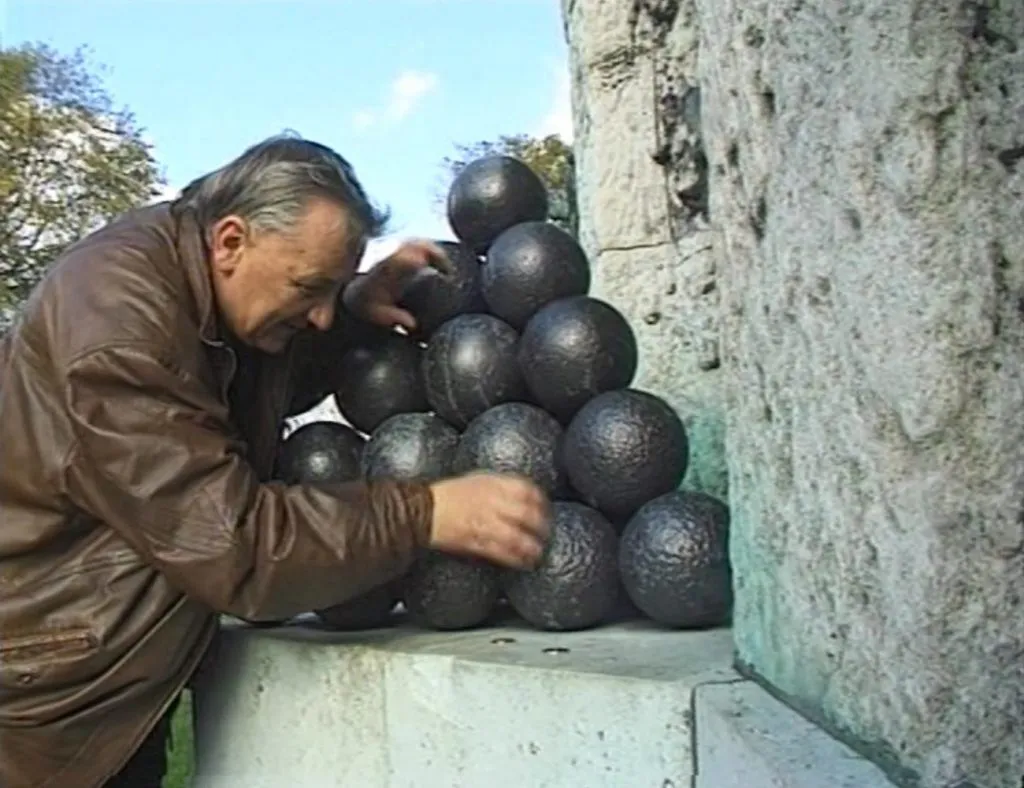

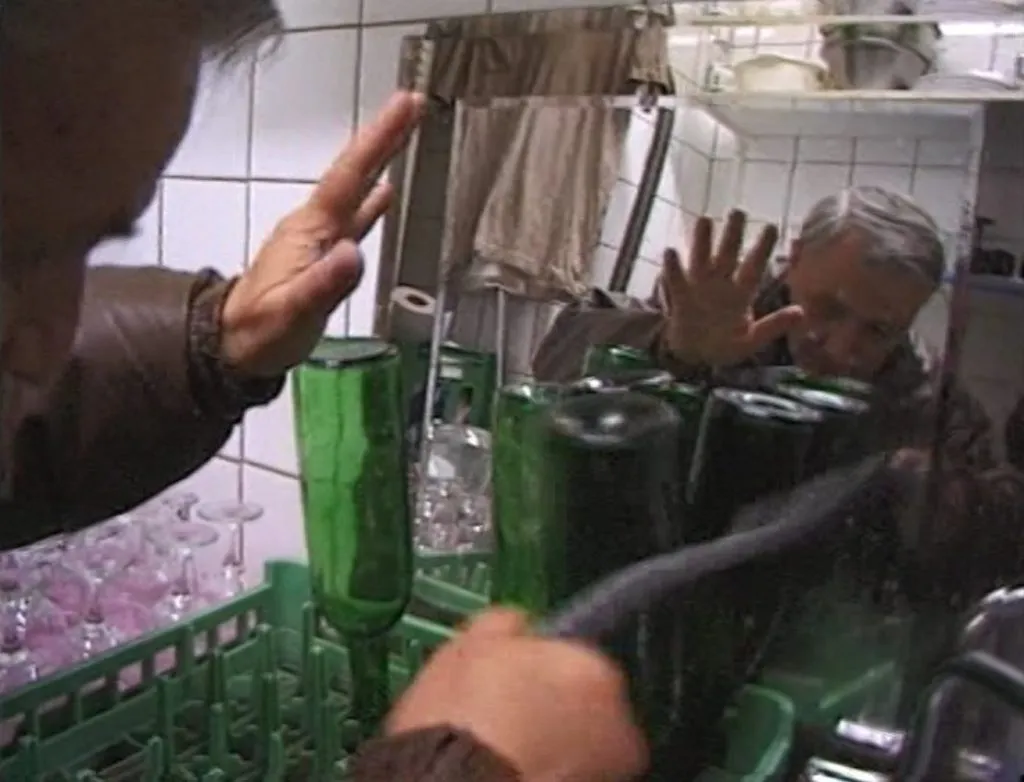
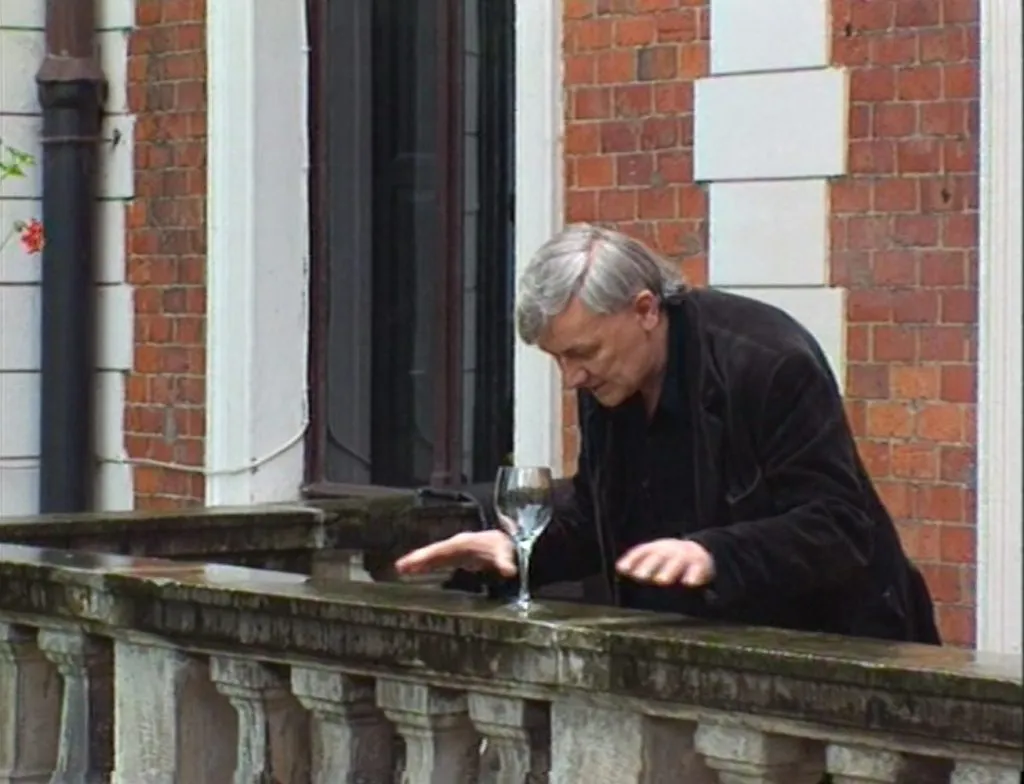
Stills from Partum de facto, directed by Piotr Wejchert, 1997, documentary film, 28 min, produced by Telewizja Polska — Polish Educational Television, Channel 1; courtesy of the author
Through precisely conceived, developed and executed mini-performance actions, Piotr Wejchert’s film aptly conveys the artist’s creative character. By participating in the prearranged “scripts”, modifying them through creative dialogue, Partum accepts and identifies with them. This method of acting within performance produces a surprising result. The sequence of filmed actions becomes a performative provocation within the structure of an everyday narrative in which Partum was a masterful animator, requiring the participant to cross over to the creator’s side.
In this interpretation, the distinction between base and superstructure in art disappears, and studying art becomes a matter of observing changing states. Jacek Kryszkowski had precisely this model of creativity in mind when he described the operation of his Personal Point for Observing and Shaping the Creative Flora: “[…] I respond to the course of events, observing and shaping them through an utterance. The utterance as the effect of observation and as an action — an element actively participating in the situation. […] My utterances do not lead to understanding or description; they are neither topical nor new. They are an act of becoming one with the situation. They are a state that I bring about through my observation and shaping.”4 The logical consequence of the emergence of artists’ conceptual institutions and of Conceptualism’s development towards analysing the very concept of art is the rise of a distinctive version of institutional critique. Institutions turn towards examining the field of art itself. Kryszkowski’s Point and Paruzel’s Bureau are precisely the kinds of entities whose critically motivated activity focuses on expanding the field of art beyond all known constraints. A prefiguration of such artistic-curatorial practices can be seen in Józef Robakowski’s 1975 film Living Gallery. Originally conceived as a film about Muzeum Sztuki in Łódź, the maker’s conflict with the producers turned it into an exhibition-film, thereby discovering a new field for neo-avant-garde art and redefining the artist’s role as an organiser of artistic life. In Piotr Weychert’s film about Jan Świdziński’s meeting with Joseph Kosuth, the originator of the concept of contextual art states: “The most important ideas were articulated in the 1970s. Today those ideas are being put into practice.”5 Andrzej Paruzel constructs a genealogy of attitudes across at least two generations, united by their aspiration to build an appropriate social context for art. Activities from the 1970s became the foundation for the most radical neo-avant-garde strategies of the following decade. Robakowski, Partum, Waśko, Natalia LL, Kozłowski and Świdziński are not only — to quote Zbigniew Libera’s work — “masters”, but also precursors of artists’ curatorial practices.

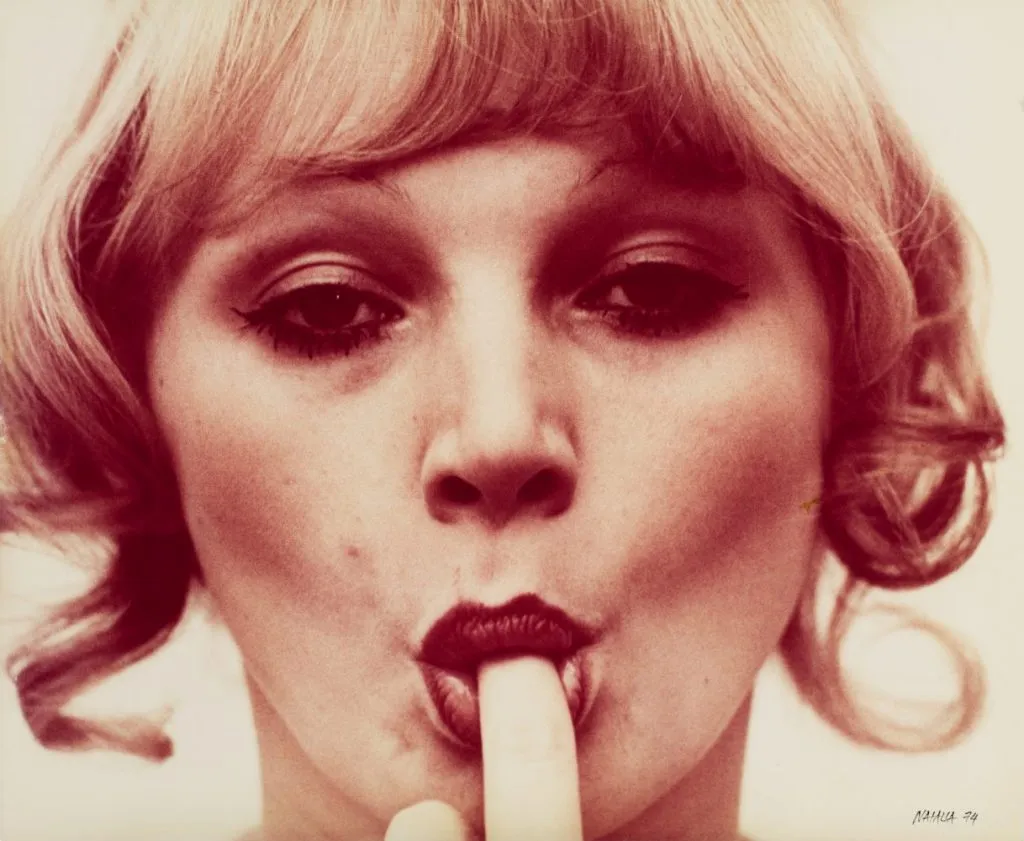


Natalia LL
Conceptual Art, 1974, photographs, 30 × 50 cm, courtesy of the artist / lokal_30 gallery
But how can one narrate an “attitude” through an exhibition? Creativity of this kind plainly cannot be deposited in objects or documentation, which can only ever constitute a symptom or substitute. They can also become an element that distracts attention from what matters most in art. Jacek Kryszkowski addressed this problem in an attempt to define more precisely the meaning of the term zrzuta: “A zrzuta does not furnish results in the form customarily expected. Concrete things in the nature of a trampled cigarette end or an intricate trinket, such as participants in its events sometimes like to fashion, can at most serve as gadgets in ‘conducted dialogues’. Their function is as arbitrary and senseless as the colour of the underpants worn by the perpetrators as they carry out their next zrzuta.”6 For Kryszkowski, works or pieces were elements in which fetishism petrified every subversive meaning and critical potential. Moreover, neither documentation nor an object of any kind can testify to something larger: the totality of phenomena making up the artist’s seemingly integral subject. The exhibition Engaging with the Twentieth-Century Avant-Garde cannot achieve such an aim. It does something else: rather than directly setting out the characteristics of individual artists’ “attitudes” and the connections between them, it draws individual works into a constellation that points to a particular set of qualities arising from an ethos produced by artists’ collective effort to create new conditions for the production and distribution of art.
*Daniel Muzyczuk, curator at Muzeum Sztuki in Łódź. From 2008 to 2011 he was a curator at the Znaki Czasu Centre of Contemporary Art in Toruń. His curatorial projects include: Long Gone by Susan Philipsz; We Went to Croatan (with Robert Rumas); The Factory by Mariusz Waras and Krzysztof Topolski; MORE IS MORE (with Agnieszka Pindera and Joanna Zielińska); The Melancholy of Resistance (with Agnieszka Pindera); Views 2011; and Sounding the Body Electric (with David Crowley). He was curator of the Polish Pavilion at the 55th Venice Biennale in 2013. With Agnieszka Pindera, he won the Igor Zabel Award Competition in 2011. He has taught at the Academy of Fine Arts in Gdańsk. Vice-president of AICA Poland since 2015.
1 See Józef Robakowski, Uwaga! Idą PROGRESYWNI… (szkic intuicyjny) [Attention! The PROGRESSIVES Are Coming… (An Intuitive Sketch)], in Teksty interwencyjne. 1970–1995, Galeria Moje Archiwum, Koszalin 1995, p. 4.
2 Quoted from the film Partum de facto, directed by Piotr Weychert, 1997, documentary film, 28 min, produced by Telewizja Polska — Polish Educational Television, Channel 1.
3 Henri Lefebvre, Critique of Everyday Life: The One-Volume Edition, Verso, London–New York 2014, p. 313.
4 Jacek Kryszkowski, Tylko tam gdzie jestem [Only Where I Am], Tango, no. 1, 1983.
5 Quoted from the film Spotkanie w Rzymie — Kosuth, Świdziński 02.07.2008 [Meeting in Rome — Kosuth, Świdziński, 2 July 2008], directed by Piotr Weychert, 2010, documentary film, 39 min, produced by Media Kontakt, Telewizja Polska and Galeria Labirynt.
6 Jacek Kryszkowski, Pismo redaktorskie [Editorial Letter], in Halo Haloo, 1985, unpaginated.