
Jean-Marc Caracci’s Urban Landscapes
Tomasz Ferenc

In 1838, Louis Daguerre photographed the Boulevard du Temple in Paris from the window of his apartment1. This remarkable image is the first urban landscape and most probably the first photograph to record human beings. Its reproduction appears in most books on the history of photography. Two figures visible in the extraordinary image, customarily understood as a shoeshine and his customer, were recorded on the daguerreotype because they remained still. The other people moving along this urban artery literally disappeared as a result of the long exposure. They are absent from the picture despite having been within the frame. Ten to fifteen minutes sufficed to create this effect. Before us, therefore, is a street in a city emptied by photography, with only two people engaged in an ordinary, everyday transaction. The situation appears thoroughly Surrealist. Photography, intended to provide proof of existence, has annihilated existence. A medium meant to show the world as it is has presented a falsified world. An image intended as realistic became simultaneously entirely incredible and untrue.
Daguerre, probably unknowingly, made one of the most important photographs in the medium’s history. We must admit that a single daguerreotype contains an extensive catalogue of intriguing questions concerning photography’s history and ontology. The image is universally known and constantly reproduced, yet remains mysterious and compels us to ask questions. To what extent was its creator aware of the effect he would achieve? Were the two human figures definitely there by accident, and moreover at such a perfect compositional point? Was it a brilliant plan, or a revelation or manifestation of the photographic medium’s essence extending beyond the artist’s intentions, control, expectations and imagination? Such questions would undoubtedly be unfounded in relation to Jean-Marc Caracci’s work. Yet the Homo Urbanus Europeanus series can be symbolically rooted in Daguerre’s photograph. Alternatively, we may treat the image as a form of visual prehistory, the first appearance of a motif that waited more than 160 years for its complete and consistent development. Initiated and first revealed in 1838, it became one of photography’s topoi before ultimately assuming a new face and quality in this series.

The HUE series was also made in a completely transformed Europe and must be interpreted in different terms. Empty spaces and anonymous human figures appear like actors in a precisely planned performance. The city becomes a stage, the photographer its director. Only the actors remain unaware of the parts they play — citizens of Europe. This dimension appears crucial to an artist creating a photographic story about the inhabitants of European cities. Yet we may also consider the series in terms of a phantasm. Here is a dream captured: a reverie, fantasy and game at once. The isolated human being in a great metropolis is a recurring motif in visual art, literature and film. The final crystallisation of this phantasm comes in stories of the “last man”, the sole survivor wandering in a state of total, inescapable solitude. Such an interpretation is tempting in its own way, but would remain far from the artist’s intentions.
In one interview, Caracci describes the project as his opus magnum2. He has worked on it continuously since 2007, systematically enriching successive exhibitions with photographs made in new cities and further European capitals. The project’s idea was born in Chicago in 2006, where the artist observed and photographed gigantic buildings and people who appeared as small, constantly moving points within the metropolitan scenery. It was then that Caracci began framing his photographs to produce the effect of isolating a single person against an urban landscape.

Caracci rightly observes that cities have become Europeans’ principal living environment, and that we therefore unquestionably ought to care for them. People will be happier in beautiful cities. Photography can remind us of this simple relationship. “Art and photography must show the beauty of life… that is what I try to do, especially in relation to the city,” the artist says in the same interview. Caracci believes in a mission often denied today, one formulated by the creators of humanist photography’s programme. It rested on faith in photography’s agency, understanding it as a universal language shared by all people. Properly used, photography can change attitudes and shape opinion, remind us of imponderables and compel reflection. The photographer also mentions that his next major project, were a budget available for such an undertaking, might become Homo Ruralus Europeanus. The rural person, an increasingly rare species in industrialised Europe, could become the protagonist of another of Caracci’s great photographic narratives.

Jean-Marc Caracci was born in Tunisia, grew up in France and continues to live there. The pictures he makes in different parts of the world demonstrate the ease with which he navigates varied social and cultural contexts. On his website he included a quotation from Claude Lévi-Strauss’s Tristes Tropiques, the French structuralist’s famous sentence: “I hate travelling and explorers.” Looking at the site’s contents, however, one can only read this ironically. His journeys have taken him through Europe, North America, Asia and Africa. To date, he has visited China, the United States, Egypt and Lebanon. He photographed in Poland three times: in 1993, 2006 and 2009. The first trip took him to Kraków, the second to Szczecin and the Koszalin region. The most recent group of photographs was made in Warsaw as part of HUE. All can be viewed on the artist’s website3. Caracci is therefore an inveterate traveller, but his journeys are of a particular kind. The human being occupies the centre of his interest; everything else is merely background and circumstance. Homo Urbanus Europeanus might appear to reverse this proportion: the person becomes an element of the urban landscape and the place begins to dominate. Yet this does not happen. Although Caracci changes perspective and wishes to address something different, the human being remains most important. It is the figure who gives meaning to every photograph in the series.
HUE became a pretext for further journeys, this time around European capitals. When viewing the photographer’s online gallery, it is worth noting the Homo Urbanus in Beirut series — not only because Caracci develops his idea beyond Europe, but also because he chooses to use colour, which appears nowhere else in this cycle.
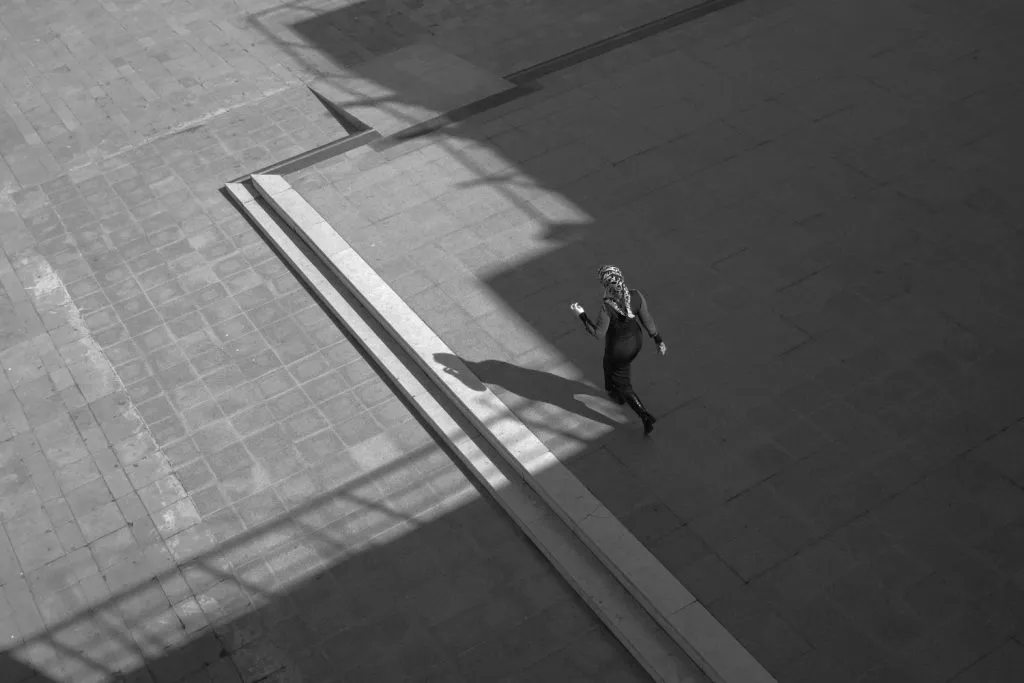
Caracci does not seek landmarks or obvious, readily recognisable places. He generally operates in spaces difficult to identify. A fragment of park in Madrid might be one of Łódź’s parks; a pedestrian crossing in Bratislava could lie on the outskirts of Paris or anywhere else. Recognition without a caption becomes possible in only a few cases: Istanbul, Rome, Riga. Yet even this does not alter the impression that all might belong to a single great city in which the photographer waited patiently for passers-by like a hunter. Italo Calvino presented a similar vision of the metropolis in Invisible Cities: “As you travel, you realise that differences disappear: each city begins to resemble every other city; places exchange their forms, order and distances, while a fine and formless dust settles over the continents”4. The cities in Caracci’s vision resemble one another and become a single vast metropolitan labyrinth.
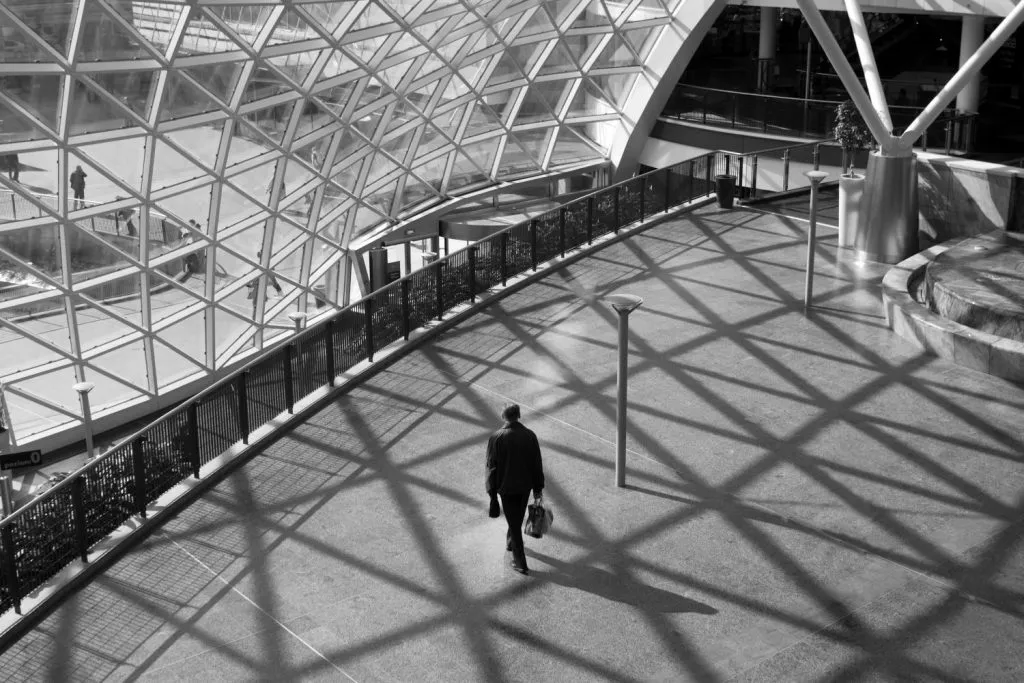
The precision of these photographs recalls Henri Cartier-Bresson’s concept of the decisive moment. Within a perfectly composed frame, the human being is always caught at a strong point, which is why the small figure attracts the viewer’s eye so intensely. We might think of these figures in terms of staffage: a supplement to a work whose principal subject remains the landscape. Traditionally, staffage made an image more attractive, helped establish a sense of scale and guided the viewer’s attention in accordance with the artist’s intentions. In Caracci’s work, human staffage becomes the principal element, focusing attention and shaping reception. The generally solitary figures, caught in motion, might be interpreted as expressions of loneliness in the big city. Yet they are not. The people in these photographs are dynamic and strong, striding confidently along their routes. They rarely stop, but even then they do not look lost. On the contrary, they are on their own ground, in their own cities, and the surrounding space does not overwhelm them. Homo urbanus is a species specialised in urban navigation, moving confidently and skilfully along streets, bridges and boulevards, decisively proceeding in its chosen direction.

What message can we read in Jean-Marc Caracci’s photographic series? What purpose does this journey through European capitals serve? At least several interpretations are surely possible. It is certainly an artistic manifesto of a unifying Europe. Caracci returns to a humanist vision of photography whose simple message is intended to reach everyone. Yet it is simultaneously a story of the beauty of European cities, created through the efforts of successive generations of urban people. It is also a reminder of the need to protect the urban environment, which for most of us has become the only one in which we can function effectively.

*Tomasz Ferenc works in the Department of Sociology of Art at the University of Łódź and lectures at the Łódź Film School. His research focuses on visual culture in the broad sense and on migration. His books include Photography: Dabblers, Amateurs and Artists (2004), The Artist as Foreigner: A Sociological Study of Polish Artists in Emigration (2012) and Dennis: Biographical Story of an American (2014).
1 The exact date of the photograph is unknown; different sources give either 1838 or 1839.
2http://www.public-republic.net/artist-of-the-week-jean-marc-caracci/
3http://jean.marc.caracci.free.fr/index.html.
4 Italo Calvino, Invisible Cities, Polish edition, Kraków, 2005, p. 116.