
An Ordinary Observer
Jean-Marc Caracci in conversation with Agata Mendrychowska
Agata Mendrychowska: The introduction to the CV you sent me says that you are self-taught and began acquiring your skills as a teenager, helping in the darkroom with your brother, who was also interested in photography. Yet your career was not connected with art until 2005. How did you discover that you wanted to be an artist?
Jean-Marc Caracci: Well, I must admit that I do not consider myself an artist. I simply have my own way of looking at the world around me, like an ordinary observer or, in a sense, a biologist studying life within a cell. As you know, the principal subjects of my photographs are people and the street… perhaps because I am trying to understand who I am myself and where exactly my place lies within our urban world. Human beings became the subject of my photography during compulsory military service, when I spent nine months as the regiment’s photographer.
A.M.: Your website shows various photographic series, including one from Poland in 1993, which you photographed soon after the political transformation. In making those pictures, you approached the people you photographed quite closely. Many of the images are portraits. In your largest project, Homo Urbanus Europeanus, presented in the current exhibition at Atlas Sztuki, you instead photograph people from a distance of fifteen to twenty-five metres using a 28 mm lens. What was the idea behind this?
J.M.C.: For more than a decade, photographing people in the street without their consent has been seen as an abuse, something unlawful in almost every country — at least throughout Europe. So in 2007, when I was thinking about this new large series, after losing the job that supported me, I had to keep this obstacle in mind. I had actually just returned from a fifteen-day stay in Chicago, where I was fascinated by the possibility of capturing the city’s residents within their immense urban universe… I mean photographing them like ants among enormous buildings. This kind of distance, which had always been present in my photography, made me realise how interesting and beautiful it is to show these people within their — our — cities, our urban landscapes. Suddenly, if I can capture a single person apart from the crowd, if I can isolate that person against the city, the city no longer appears so alien… because it becomes increasingly ordinary, one might say. It even looks like a place where we can feel at ease, a place where we can breathe, a place we are proud to have created. I like the city, I like walking its streets, and the Homo Urbanus Europeanus series posed a kind of challenge: to show the beauty of a city in which most of us see only ugliness.

A.M.: While preparing the exhibition, I had the impression that you pay attention to several aspects: the person in the picture must be visible, attention must focus on the figure, and the photograph must be consistent with the rest of the series. From the many photographs you presumably take in each city, which images do you choose for your portfolio?
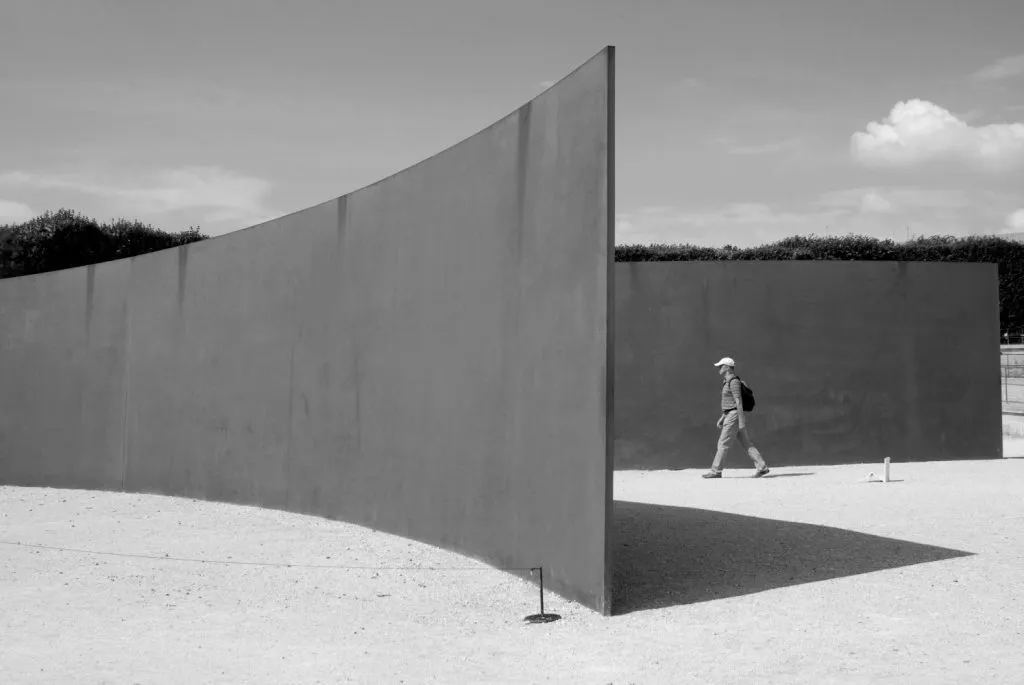
J.M.C.: In this series I wanted to capture scenes in which a single figure — rarely two or more — interacts with the urban surroundings. So, as you said, I sometimes took a dozen or more photographs in the same place, which I had selected for the cleanness of the frame and perfect light, waiting for people to pass alone and photographing each of them… until I had placed a beautiful, dynamic silhouette in the right part of the frame. I selected most such images for the official Homo Urbanus Europeanus portfolio. Yet I also included photographs of a slightly different kind — not as clean, not as balanced, without the right lighting — because of the humour they convey.
A.M.: How do you plan your work, and what does the “cleanness of the frame” you mentioned mean to you?
J.M.C.: When I arrive in a city, I know nothing about it… nothing beyond the tourist area, that is. My work therefore begins with surveying the streets in search of a “clean” urban background — by which I mean a place without cars, bicycles, trees or advertisements, although a good photograph may of course contain a car, tree, bicycle or advertisement. I then record these places in a notebook so that I can return in better light… because the sun is very rarely in the right position when I discover an interesting setting. Afterwards I return to these places again and again… until I manage to take THE photograph. Although I must say that I often leave full of frustration because the light and the figure never came together where I expected.

A.M.: In the Chicago photographs you mentioned, you show the city and its residents in two ways: in colour and in black and white. Why did you decide to use black and white in the next project?
J.M.C.: When you speak of my photographs from Chicago, you are referring to an entirely different way of working. The colour pictures I took there were connected not so much with a creative search as with what is known as illustrative photography. In my creative work I do indeed value black and white more highly… for one simple reason: I love it. It has something to do with my particular sensitivity. I am simply drawn to black-and-white work.
A.M.: And why did you choose Europe as the setting for the project rather than the United States or Asia, where you had already photographed?
J.M.C.: The real question would be: why Europe rather than France alone?… Why survey all of Europe when I could have made a similar series in every major French city?… In truth, when I was thinking about a large project — my first genuinely large project since I began taking photographs — I was looking for a subject that would bind it into a whole. So, very quickly, thinking of the word “unity” led me to “union”, then “Europe” and naturally the “European Union”.
A.M.: Yet not all the photographs come from European Union countries…
J.M.C.: Please note that Homo Urbanus Europeanus is not only a conceptual work but also has a political dimension. I am pro-European, and making this series is also an opportunity to say so. Every European country is or can be included, regardless of whether or not it belongs to the European Union yet… it is a way of saying that we are all Europeans and proud of it. This is in fact why many European Commission Representations and Delegations have acquired the right to organise Homo Urbanus Europeanus exhibitions… and why the series was selected for the exhibition Plzeň 2015: European Capital of Culture, held in March and April 2015.
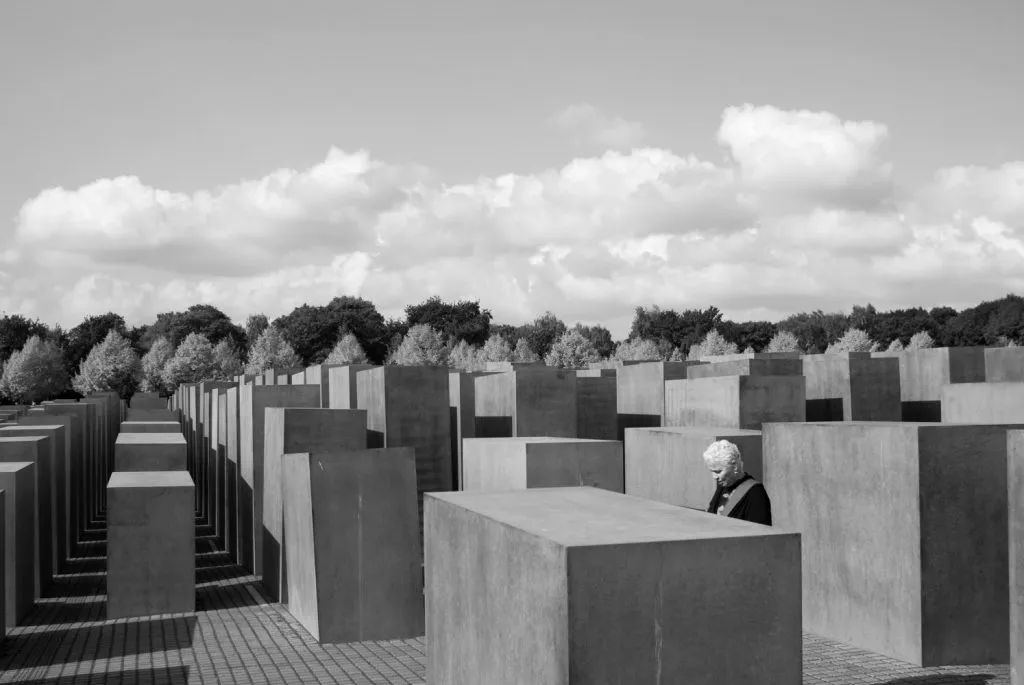
A.M.: Most photographs in Homo Urbanus Europeanus show places that do not look like tourist attractions. Do you avoid such sites when photographing?
J.M.C.: As you can imagine, capturing a solitary figure against a great city is almost impossible in a place visited by tourists. So yes, I definitely avoided crowded tourist sites… although I sometimes treated them as a personal challenge and tried anyway. That is how the photograph near St Peter’s Basilica in the Vatican came about, for example, or the one taken at Złote Tarasy in Warsaw. In reality, however, this technical limitation — the need to avoid tourist sites — was perfectly suited to what I intended: photographing European capitals in a uniform way, without presenting visible cultural or social characteristics. I wanted people looking at my HUE series to say, “I really do recognise Europe”, and never — or almost never — “I recognise Oslo, Belgrade or Tallinn”.
A.M.: Is that why you gave the project a Latin title?
J.M.C.: The title of the series is in Latin simply because I wanted everyone around the world to be able to understand it.
A.M.: “I hate travelling and explorers.” What does this quotation, which you placed as a motto on your website, mean to you?
J.M.C.: As you probably know, the sentence is by Claude Lévi-Strauss… in fact, it is the opening line of his famous book Tristes Tropiques. At first I simply liked the humour of the words, considering how much travelling and discovery Lévi-Strauss experienced in his life. Later I found my own meaning in them. Applied to myself, I could translate them as: I hate tourist trips and I hate tourists. Well, to put it better: I do not understand tourists. Think what it means: boarding a plane, sometimes taking a very long flight, merely to see the Egyptian pyramids, the Eiffel Tower or the Colosseum in person… when you can see all of them on television, online and so forth?… Travelling, to my mind, means encounter: encountering other people, other cultures, other ways of life… everything you cannot really do near the Colosseum, the Eiffel Tower or the pyramids.
A.M.: Did you receive a grant or assistance from cultural institutions to fund all these journeys?
J.M.C.: The only financial support I have received — and will receive — comes from selling limited-edition prints. Yet I made and continue to make HUE independently, on a very low budget. The secret is to book the cheapest journeys by plane or bus and never stay in hotels. That is why the largest part of my work — a Herculean task, one might say — was finding and persuading people in every capital to give me somewhere to sleep. It involved searching online, writing and answering emails, and so on. Ultimately, however, I can say that staying in strangers’ homes is definitely the best way to travel… that is, the best way to meet people and encounter local culture. Even in the future, if I had a larger budget, I think I would still ask people to let me stay with them.
A.M.: This time, during your visit to Poland, you plan to see Kraków as well as Łódź, where the exhibition is being held, and to return to Warsaw. Will you photograph in these cities? Is the project nearing completion now that you are revisiting some places?
J.M.C.: First, note that I photograph capitals exclusively, and I shall consider closing HUE when it includes every European capital. Last summer, in 2014, I photographed four more: Sarajevo, Podgorica, Pristina and Skopje. This summer I should like to photograph Tbilisi, Yerevan and Chișinău… and photograph Bucharest again — as I revisited Belgrade, Zagreb and Ljubljana last summer — because I did not do a good job there in 2009 owing to bad weather and therefore unsuitable light.
A.M.: You are of Italian, Sicilian origin, were born in Tunisia, but have lived in France since childhood. Who is Homo Urbanus Europeanus to you? Is it everyone who lives in a European capital?
J.M.C.: Exactly.
A.M.: Would you like visitors to the exhibition to identify with the figures in the photographs?
J.M.C.: I am not that demanding. I always hope viewers will appreciate my work… that is all. Everyone knows — artists, at least — that once a photograph, painting or sculpture enters a gallery, a film enters a cinema or a book enters a bookshop, it no longer belongs to the artist.
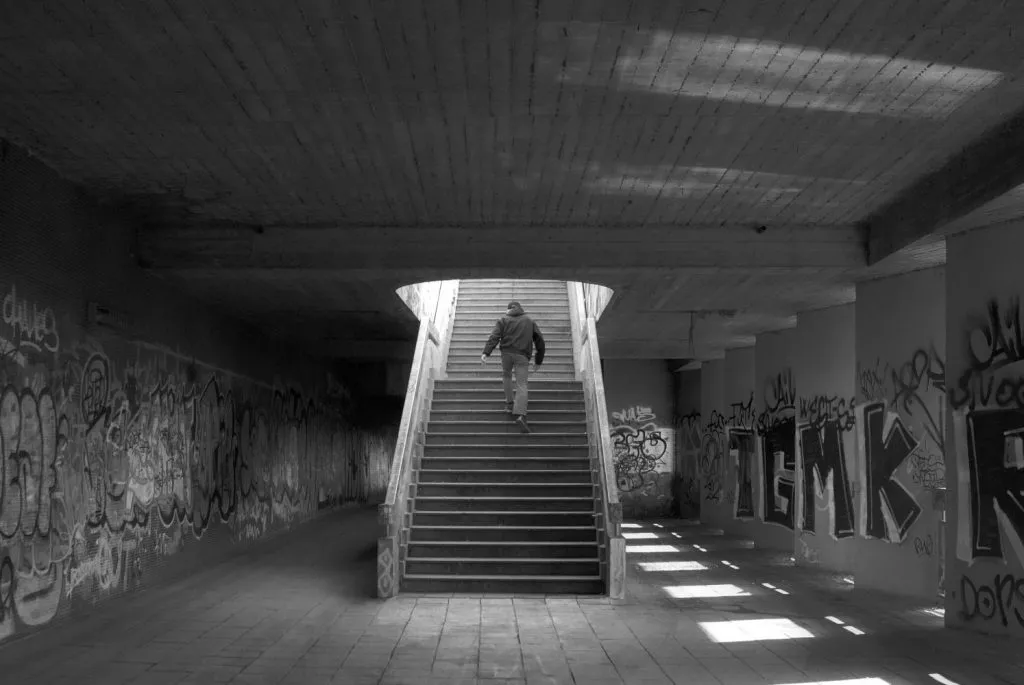
A.M.: I also want to ask about something that interests me when I look at your photographs — those, for example, in which figures cross a distinct boundary between light and shadow. When you take photographs, or later when selecting them, is it important that an image contain a metaphor or subconscious content?
J.M.C.: Thank you for your observations about my series, but I am afraid I did not choose the settings for any metaphorical content. There may of course be subconscious meanings, but my intention was simply to make a clean and compositionally balanced photograph.
A.M.: I am also thinking of your inspirations from painting…
J.M.C.: I do not paint myself; I have no talent for it. I can say, however, that Edward Hopper was a particular inspiration for the HUE series… even subconsciously. As for other art forms, several years ago I wrote a novel… but it has not yet been published. Incidentally, did I mention that I plan to publish a Homo Urbanus Europeanus album? It will contain thirty-five short texts specially written by thirty-five European authors — as many as the countries I have visited for the series. The Polish writer contributing to the album will be Mariusz Szczygieł.
Translated into Polish by Agata Mendrychowska
Jean-Marc Caracci’s online portfolio for the Homo Urbanus Europeanus project is available at: http://homo.urbanus.free.fr/portfolio