
I Have to Provoke Myself
Katarzyna Kozyra in conversation with Jacek Michalak
Jacek Michalak: As a child, did you play with dolls or toy cars?
Katarzyna Kozyra: Both dolls and toy cars. I also dreamt of garages, although now that I think about it more carefully, I am not sure whether I invented those garages later, when I was no longer a little girl.
J.M.: How far back can you remember your childhood?
K.K.: My earliest memory is connected with Christmas and the Christmas tree. I think I was two or three at the time. That first tree was wonderful. I remember that the following Christmas was no longer quite so good: my parents had not prepared things as well, the tree was not as big as the year before and there were fewer presents.
J.M.: You have a sister who is three years younger. What do you remember about her arrival? Do you remember her as a baby?
K.K.: No, I do not. As it happened, I was growing up in Austria, while my sister was living with our grandmother in Warsaw. She entered my life when I was about seven and she was four. I remember that well; of course I was jealous. Until she appeared, I had lived like an only child, and suddenly everything changed. I think my father handled her arrival in my life badly.
J.M.: Your relationship with your sister did not begin very well. What happened later?
K.K.: My sister was my opposite: well behaved, calm and compassionate. After that difficult beginning, our relationship settled into a good one. Today she helps our mother.
J.M.: After your school-leaving exams, you began studying German. Why did you not choose the Academy of Fine Arts?
K.K.: I wanted to study at the Academy. When I finished secondary school, I did not have much faith in myself or my abilities. I thought about applying, but somebody told me I still had a great deal of work to do before the portfolio I submitted for the entrance examination would give me any chance of being admitted. Faced with that, I gave up. German studies were an easy choice for me.
J.M.: Did you get into the Academy at your first attempt?
K.K.: Yes. I prepared really thoroughly for the entrance examination.
J.M.: Why did you choose sculpture?
K.K.: My boyfriend at the time, who was a sculptor, helped me choose my course. He also helped me prepare for the entrance examination. In addition, fewer people wanted to study sculpture than the other disciplines. I took that into account as well.
J.M.: Yet after graduating, you did not pursue sculpture.
K.K.: True, but I should say that I sculpted nudes with great determination and enjoyed it. Sometimes I think I might still sculpt something one day. That would be quite a story: Kozyra sculpts. When speaking about my studies, it is important to say that I graduated in sculpture, but Grzegorz Kowalski taught everything an artist needs. I think everything Grzegorz taught can be applied to painting too, although I have never tested that. His classes taught a feeling for visual form.

J.M.: Paweł Althamer studied alongside you, in Grzegorz Kowalski’s studio and in the same year. Many outstanding artists graduated under Professor Kowalski. Are you still in contact with other colleagues from Professor Grzegorz Kowalski’s studio?
K.K.: Before 2004, I was in reasonably regular contact with them. There were fifteen people in our year. Over the past decade those ties have loosened considerably. I am still in touch with Jacek Markiewicz, Monika Osiecka and Jacek Malinowski.
J.M.: What is your relationship with Professor Grzegorz Kowalski?
K.K.: We are friends. Our acquaintance became a friendship after I completed my diploma. I should point out, though, that Grzegorz Kowalski is a friend to his students.
J.M.: More than twenty years have passed since you graduated from the Warsaw Academy of Fine Arts. How do you remember it after all this time?
K.K.: Dreadfully.
J.M.: Why?
K.K.: Socially, on the one hand, it was wonderful. A group of terrific people formed quickly; we were close, supported one another creatively, and a genuinely interesting community of young, creative people inspiring one another emerged. On the other hand, the institution’s structure was ossified, some lecturers were rigid, and many classes offered very little and were probably unnecessary.
J.M.: Have you never thought about teaching? Would you not like to share your knowledge with young people?
K.K.: I once thought about teaching, and I think I will do it in the future. I hope that when I do, I will be able to help students, but not yet. What I do requires one hundred per cent commitment; that has always been the case with me. When I undertake a project, I enter it completely, dream about it at night and often cannot tear myself away from what I am doing. I cannot imagine being able to help young people while carrying out a project; I remember very well how many problems I had as a student myself. Recently, an acquaintance came with a group of a dozen or so students from Germany. They had so many problems and expected to be shown solutions, yet there are none. Besides, the Academy remains ossified; not all that much has changed since I was a student. So I must wait until art education changes a little. In any case, I have plenty to do and have not yet exhausted the areas that interest me.
J.M.: Has the Academy ever offered you a teaching position?
K.K.: Not really; I have not received any specific offers.
J.M.: Let us change the subject slightly. Is it possible to make a living from art?
K.K.: Sometimes I think it is, and at other times that it is not. I am afraid to say yes, because in answering that question I would be theorising. My case is unusual. What I do would not allow me to survive without other income. Relatively speaking, I have made a small number of works; the process behind my projects is long, and my works develop sequentially.
J.M.: Have you ever destroyed one of your works because you were dissatisfied with it?
K.K.: No, I have not destroyed anything. As I said, I have made relatively few works. There are two or three less successful pieces to my name; they were not completely thought through, but I did not destroy them.
J.M.: Do you believe in what you do today?
K.K.: Yes. Looking back now, I can say that I have been fortunate in life. My life has worked out in such a way that I have done, and continue to do, what interests me. I have never worked, and do not work, under financial pressure.
J.M.: The honourable mention awarded to Men’s Bathhouse at the 48th Venice Biennale in 1999 gave you star status.
K.K.: I see it differently. That award meant that what I do was accepted.
J.M.: I have the impression that you have never particularly cared what others might say about you.
K.K.: I have never had time to think about what others might say. To answer the question directly: yes, that is true. I do what interests me, and that has been the case since my diploma work, Pyramid of Animals. While preparing it, I was so absorbed that I was simply incapable of doing anything else. Besides, when I made my diploma work I was too young, too inexperienced, too honest, too committed and too caught up in the whole thing for any option other than Pyramid of Animals to exist. And when you have no choice, things are simpler. I always throw myself entirely into my projects.
J.M.: After your school-leaving exams you did not believe in your own abilities. Is it different today? Are you satisfied with yourself and what you have achieved?
K.K.: Absolutely. I am satisfied with what I have achieved and with the way I achieved it. I have very little to reproach myself for; I have always tried to be honest and to approach my art and my work honestly. I hope it will remain that way in the future.
J.M.: Each of your successive projects differs from the previous ones. Working sequentially, as you put it, means you are not at risk of routine.
K.K.: Yes, there is absolutely no risk of my falling into a routine. I change subjects and form, and that entails changing collaborators. Working with new people on new subjects is always interesting.
J.M.: Yet there are people around you with whom you have collaborated for a long time.
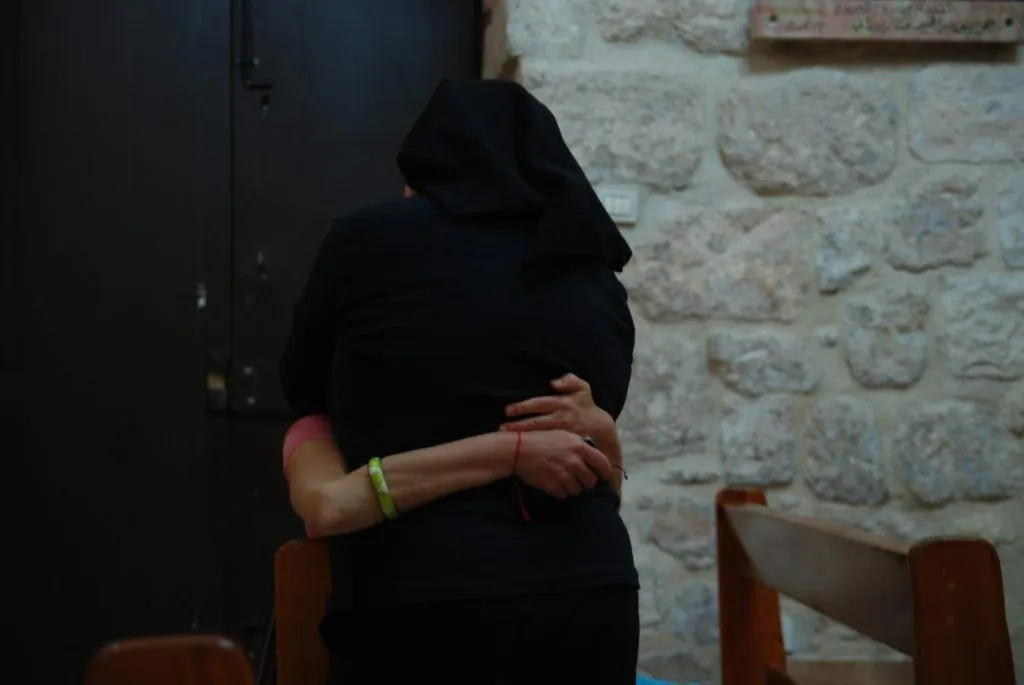
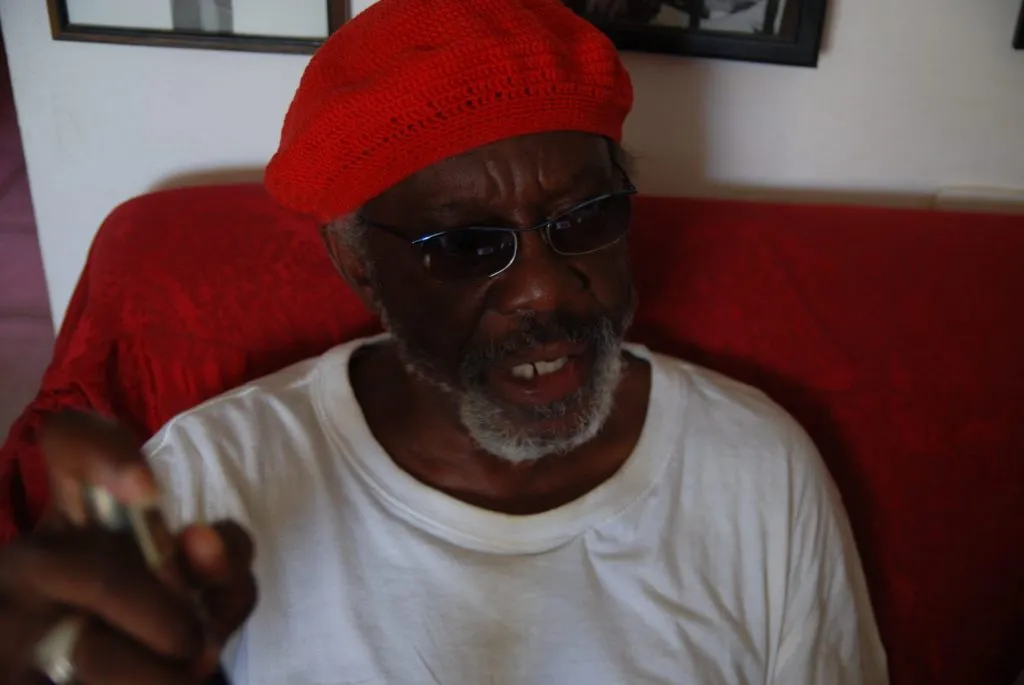
K.K.: Yes, but only two: Miras, who has always edited everything I do, and Klaudia, who designed several of my catalogues. Everyone else changes because my projects change. Just look at my latest work, Looking for Jesus. It is no longer a video but a documentary film in which I interview people and undertake editorial work. During the project I went to Jerusalem four times. Each trip was prepared, admittedly, but only to the extent that it could be. We never knew whom we would meet or when, whether we would manage to speak to those we encountered or whether they would be willing to open themselves to the project. I recorded several hours of interviews with some people, and now I have to extract their essence, reduce them to two or three minutes and do so without ruining them, so that the viewer can understand the conversation properly. Every project of mine is different and makes different demands of me, while in the latest one everything changes constantly. After interviewing someone, getting to know them and their story, I meet another person and discover that this is a different case, and that everything I learnt or found out before does not apply to the next one.
J.M.: Have you never thought about returning to one of your works or to a subject you have explored? As a perfectionist in your work, are you not tempted?
K.K.: No, there is no project I would like to return to. Perfectionism is one thing, but I believe I have exhausted the subjects I pursued. A subject has to inspire me while I work on it. Today I see no possibility of returning to completed projects.
J.M.: So there will be no Men’s Bathhouse 2.
K.K.: I could still visit a mikveh, but I probably would not survive it. Some artists have a single subject and circle around it throughout their lives. That is not my case. I have to provoke myself, hence the new subjects that spur me into action.
J.M.: What do you intend to do after completing Looking for Jesus?
K.K.: I am going to make an autobiographical film: a new project, a new format of my own, a new situation I have never dealt with before. I hope the project will not overwhelm or kill me. I am interested in developing my own original format, which is why I have been circling around this project for so long. I have to set myself new challenges.
J.M.: Why did you establish the Katarzyna Kozyra Foundation?
K.K.: Institutional support makes it easier to carry out my projects. I needed it. My foundation also enables me to realise projects that I did not devise but whose themes are close to me and which I consider important. The foundation is an alternative platform for other artists, and it matters to me that I can support them. Last year, thanks to the foundation, the Commentators project came into being, which makes me happy, particularly given that the space available for art in Poland is not very large.
J.M.: In a conversation with Joanna Ruszczyk, you said that the Katarzyna Kozyra Foundation would make exhibitions about what girls get up to.
K.K.: There are not many interesting men, while women fight one another, and fiercely at that. So they need support.
J.M.: Agreed, but in everyday Polish the term laska means an attractive, shapely, pretty girl; it defines her physical appearance. Saying of a woman, for example, ‘despite her age, she is still quite a looker’ is acceptable. Even ‘that girl is quite a looker’ may be acceptable. Yet if you want the work of your foundation to make women more visible and better heard, and the subjects they address more readily noticed, I wonder whether the word laska will help. Do you not think that describing women in this way has the opposite effect to the one intended?
K.K.: It is not as you suggest. If a woman calls another woman laska, that is fine; it is different when a man says it. The term is not pleasant coming from a man. Other women I know see it similarly.
J.M.: Although I support equality, I still find that difficult. In many situations women have to be better than men.
K.K.: Yes, and they also have to endure being treated as commodities. That only begins to change when you turn fifty, and then it is wonderful. Before that it is hard and infuriating.
J.M.: We are speaking before your exhibition at Atlas Sztuki. The very title of the project, Looking for Jesus, may spur many people into action. I shall mention only the banners proclaiming ‘Down with Nieznalska’ that appeared outside the National Museum in Kraków on the day your retrospective opened there. What do you expect from your latest project? I shall not ask about fears, because I know you have none.
K.K.: First of all, we are speaking almost three months before the presentation. I am still working on the project and simply expect to bring it fully under control. Having gathered all the material, I am working on it in Warsaw. I have several possible ways of editing it and am still considering which is best. That is what I am concentrating on at present: I want to make the best work possible. I live with this work all the time, and that is all. I am conscious of the exhibition’s opening date; I have always had that awareness and it has always motivated me. I am not worried about the work’s reception. It is not directed against anything or anyone.
J.M.: How would you characterise the ‘Jesuses’ you encountered?
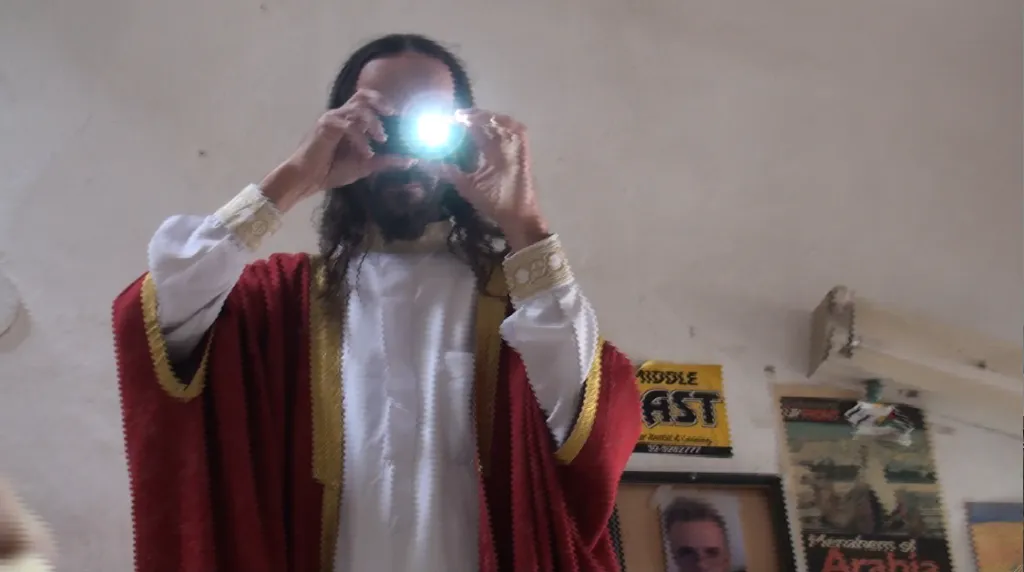
K.K.: There is a group who have come through it: people who genuinely experienced Jerusalem syndrome and can speak about it with a certain distance. The experience gave them so much that they find their own way of life, entirely nonconformist. So many things opened up for them during that state of maximum sensitivity. They describe what it was like when they identified with biblical figures and how they live now. The second group consists of those currently going through the syndrome. Then there is a third group who may not be concerned with Jerusalem syndrome at all. They never thought they were the Messiah, Jesus or a prophet, but nevertheless feel called, and their mission centres on the syndrome. That last group is fascinating too; after all, this is the Looking for Jesus project. Psychiatrists have defined Jerusalem syndrome and set out its symptoms. Yet the disorder manifests differently in every person, though there are of course common features.
J.M.: Last August I was in Jerusalem. At the Sixth Station of the Cross I met a man who believed himself to be Jesus. Did you meet him too? Will your conversation with him also appear in the project?
K.K.: The man sitting at the Sixth Station of the Passion is Jacob. He was not interested in my project. He is waiting to appear in National Geographic; that is all that interests him. He is waiting for a large crew and millions of potential viewers. He would not agree to appear in an art project ‘for nothing’.
J.M.: Are you not concerned that some people have turned Jerusalem syndrome into a way of life?
K.K.: They are easy to recognise immediately. In my view, the Jacob we have just mentioned, whom you saw, belongs to that group. He flies to Jerusalem every year and lives on donations. He looks quite good and wears picture-perfect robes. Tourists have their photographs taken with him, and he makes a rather pleasant impression, particularly on believers from South America. He also drums up tourists for nearby cafés and restaurants run by his friends. He has nothing interesting to say, however.
J.M.: Are there no frauds among those who have experienced Jerusalem syndrome?
K.K.: Definitely not; there is no pretence in that group. It is such a powerful experience that it is easy to tell whom one is dealing with.
J.M.: Jerusalem syndrome, also known as Jerusalem madness, primarily affects men aged twenty to thirty. Women experience it too. From the perspective of your research, how does the condition manifest itself in women?
K.K.: Far fewer women than men experience Jerusalem syndrome. Women have different missions as well. I must stress, however, that despite the many people I have met and the hours I have spent talking to them, I do not consider myself an expert. Jerusalem syndrome is a highly complex subject. The Holy Land fertilises the imagination. Besides the great mass of ordinary people, believers and non-believers from across the world, it attracts many remarkable characters. I know the project could continue for a long time yet.
J.M.: How many of the people with Jerusalem syndrome whom you met agreed to participate in your project?
K.K.: Almost everyone agreed to speak. The few exceptions were already in states where a conversation made no sense. They were so closely joined with a higher being that they could not be reached. A conversation is one thing, however; a recorded conversation is another. In several cases recording was not easy, and all those situations were interesting. These people were not generally opposed to recording, television or the media; they were simply not ready for a recorded conversation at that particular moment. Some of those I met found it difficult to understand that we were not a television crew and that I was an artist making an art project.
J.M.: Through your project, you show the power of faith.
K.K.: Yes. The existence of people with Jerusalem syndrome demonstrates how powerful the need for faith is. The syndrome is also evidence of how strong the human need to be an individual can be. While making the project, I met people who had not been moulded at all: astonishingly fascinating individuals.
J.M.: Is Looking for Jesus now a closed project?
K.K.: Yes and no. I have gathered a great deal of material. Of course I could record further conversations with other people I meet, but that would no longer be particularly revelatory. So the project is practically finished, yet I feel there is one more place I must enter. It contains more than Jesuses, and I do not necessarily have to travel to Jerusalem.
Warsaw, 14 January 2014
*Jacek Michalak has headed Atlas Sztuki since it began operating.