
The Market Fucked Art
Joanna Ruszczyk talks to Katarzyna Kozyra
Lower Mokotów. Bukowa Street. An old house. Renovation. Terrace. Garden.
Katarzyna Kozyra: They build non-stop and then sell the houses… Mine is thirty years old, and so is this one here, but I do not even know when all those around them went up… It is some kind of sickness here. They buy, demolish and build another. Even uglier and even bigger—making sure not to leave a scrap of lawn.
Joanna Ruszczyk: And a high wall is essential.
K.K.: I would be happy if they built them very high, so I would not have to see the houses (laughter).
J.R.: Is this the headquarters of the foundation you recently established?
K.K.: For now, yes. A foundation with girls, for girls. We shall make exhibitions about what women do—so that they are visible and audible and can voice their opinions on urgent matters which, basically, only men speak about. Politics and mentorship are men's domains, after all. In our culture, what men do is worth more than women's work. Everyone knows that. A woman in the same position earns two-thirds as much. It is embarrassing to keep talking about it, because it is becoming boring. I do not want to hear any more about secretaries, assistants… About girls who give their energy, perseverance and conscientiousness to men because otherwise they will not prove themselves. They have no chance because no structure has been built for them. It is not equal. And fifty per cent of every society, e v e r y one, is women. It makes you sick that this still has to be said and treated as a surprise. I would like to move on to the next stage. We know this and must do something about it. Men and women both have to do something. Men will not contribute much more with those brains of theirs.
J.R.: You are really scathing about men.
K.K.: Well? Are things good?
J.R.: Right… Probably seventy per cent of politicians are men.
K.K.: More! And if there is a woman, she encounters sexist remarks—‘I kiss your hand’ and so on. Especially in Poland, but not only. In the United States it was ridiculous: when they had to choose between a Black man and a woman, they chose the Black man. People wonder: if women come to power, will it supposedly be better? Or: what is meant to get better? But they do not even want to try. Men! They are infatuated with themselves. Their inflated egos are completely disproportionate to what they actually represent. And the worst thing is that women should support one another instead of tearing each other apart and competing for the smaller space they have been given. Instead, they make things worse for one another and thereby support men! If only women would stop tearing each other apart! Incredible groups are emerging—Katharina Grosse runs meetings in Berlin for women who have achieved something in different fields. Female scholars, professors of medicine and women from television and theatre meet… They tell one another what they have encountered and exchange experiences. Support groups.
J.R.: Perhaps you could do something like that in Warsaw?
K.K.: Everything here becomes distorted in some way. Women from the Austrian or German Institute—I cannot remember which—organised something like that. It did not work. Here it really is about ‘tearing each other apart’. Bloody hell. If people are going to give someone a kicking, they go after a woman first. Woman against woman! Not a man. It is incredible.
J.R.: Do you know that from personal experience?
K.K.: Of course I do.
J.R.: Is it harder for you as a woman? Art is nevertheless a conscious, open milieu…
K.K.: Supposedly, but look at exhibition lists and rankings: there is one woman for every ten men. No need to go deeper—just look at the statistics. Ordinary fucking statistics! Committees, professorships… Men teach at the Academy of Fine Arts; women may perhaps be assistants. Probably seventy per cent of the students are women, while ninety per cent of the staff are men. That is not OK. You cannot keep doing everything the same way. It is a relay in which men pass the baton to other men. Young men accept it as natural. They think: I am simply better. They do not see it. If you cannot see something, it does not concern you. Nobody gives up their privileges just like that. Have you ever seen such a thing!?

J.R.: What should be done?
K.K.: We need to realise that change is good for everyone. We need another way of thinking, and women think differently. Enough of this opportunism. If I had not been a woman, they would not have come at me with their claws out over Animal Pyramid. Young, making her debut, weak… What is the risk? The press staged a bloodbath. I would stake my head on the chopping block that if I had been a man, they would not have attacked me like that.
J.R.: How do you remember the period of Animal Pyramid? The early 1990s.
K.K.: For a long time I resisted that exhibition at the Centre for Contemporary Art (British British Polish Polish: Art from Europe's Edges in the Long '90s and Today—J.R.), resisted returning to that time. Animal Pyramid paved a path through the media to the public. That was when people discovered there was such a thing as contemporary art. I can rage that it was distorted, that people received it through media which dragged me through the gutter and called me a scandal-monger, without respect, but art entered public consciousness then. Those were hardcore times. A lawless period with no established boundaries. Everything was disorganised. A wilderness. I remember being unable to call the hospital because people were running businesses over public telephone lines. Buying, selling, ordering… What was happening was total. On the one hand, the period offered creative freedom—there was no censorship whatsoever; on the other, those who were more sensitive and weaker went under the knife. But now I think it was an extraordinary period because of that suspension: the old was departing, the new arriving, and nobody understood it. It was inspiring. Everything seemed possible.
J.R.: You did not start a business? I do not think anyone then imagined living from art. There was no art market.
K.K.: This is my parents' house; I did not earn it myself (laughter). It was rented out for years, which meant I did not have to find a job after graduation; I had money to live on. And I received a disability pension. A thirty-year-old pensioner! Lymph-node cancer. By then it was under enough control that the chances of recovery were good, but it was still an enormous burden. Chemotherapy… I lived like a dog on a lead; I could move only in a circle around my own arse. I could not travel anywhere and had to remain under observation. I had neither the head for business then nor do I now. Although I would probably be good at it, because you have to be creative to build a good business. In the 1990s plenty of people approached it creatively; they launched incredible businesses and could have gone further, but they lacked capital because the state did not support them. It supported outsiders. We have no tradition of running businesses in Poland. The bourgeoisie was always destroyed. There must have been some interest in preventing a middle class from emerging. Everyone here was gentry, a lord-and-boor; an ethic of earning money never arose. And now we are living through terrible times again. Everything is for sale. A sick value system. Self-evident truths disappear: that a river is not private, a cloud is not private. And then there is the crisis.
J.R.: Perhaps it has been exaggerated a little.
K.K.: Not any longer. I placed an advert looking for people to help in the garden and seventy people called within seven minutes. The rate was not particularly high: fifteen złoty an hour.
J.R.: A beautiful garden. Are you a gardener!?
K.K.: I had never had any contact with soil or agriculture. That is why I have gone so crazy about it now. I am discovering it. I love making compost (beside the old woodshed at the end of the garden, there is a hole covered by a board; Kozyra uncovers it, tips in several buckets of spoiled fruit and vegetables, and sprays them). I get it from the greengrocer. Imagine: they throw away three times as much every day. And in this canister are effective microorganisms. I discovered them two years ago. Some Japanese man devised them when sacred trees began dying. I pickle it, like cucumbers. That produces two or three times more minerals. Then the plants devour them, and that is why they grow so well. Do you think Asians are stupid to pickle things? It is bloody healthy! (sunflowers as tall as trees in the garden). For now, I am impressed that it works so well. But once I have exhausted the subject, when it ceases to pay off cognitively and is no longer a challenge, I drop it immediately.
J.R.: Organic food is fashionable now. Markets, stalls in restaurants. Only it is rather expensive… If you have no money, you will not eat it. That leaves supermarkets.
K.K.: Or your own garden. But it is very good that this fashion exists! I hope another does not arrive and people start showing off differently (Kozyra grabs a spade and chops the waste thrown into the hole). The smaller it is, the faster it decomposes. And so on every day. A madhouse, right? Sometimes I think I have lost it. (Kozyra washes the buckets and waters the flowers).
J.R.: Do you use rainwater?
K.K.: For watering plants. When it rains, one thousand litres fills up in a day. It saves water. Look, it collects here and there. I just hope I do not come across like some pensioner… The Garden project is competing with Jesus, my new work.
J.R.: Where did the idea of looking for Jesus come from? Did you find him? (We sit on the terrace).
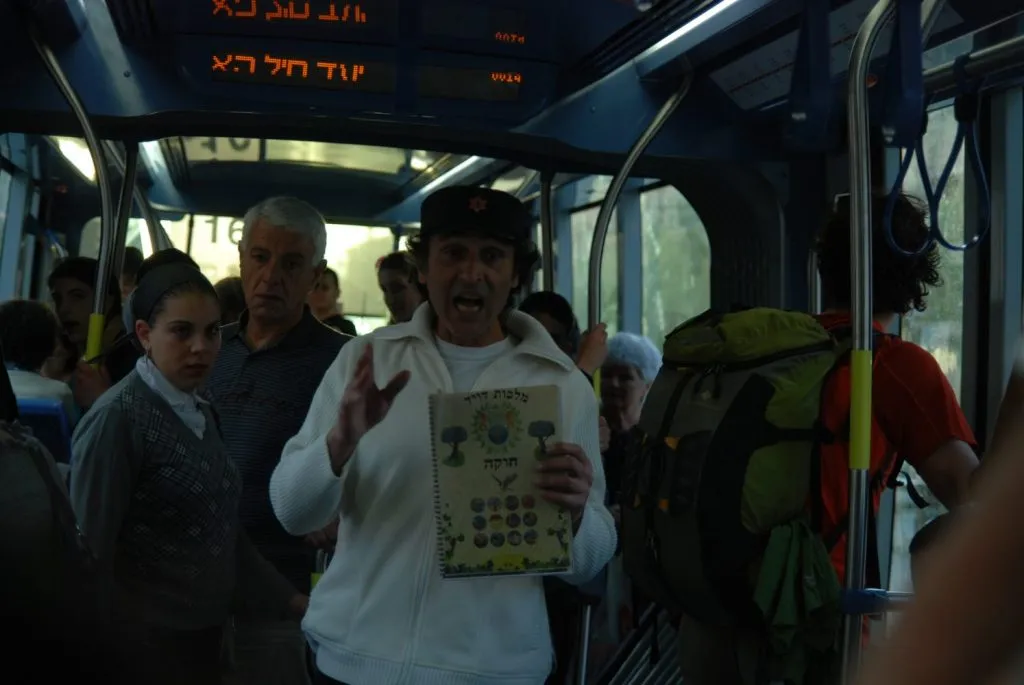
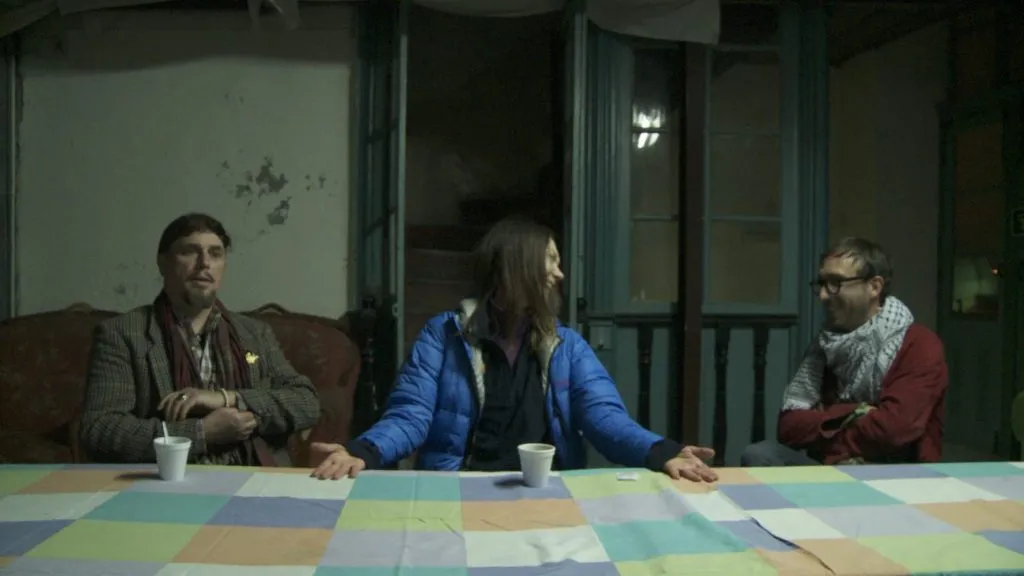
K.K.: I was holding a casting call in Tel Aviv for an autobiographical film, and I thought: why am I looking for myself?! I should find Jesus! I had been to Jerusalem several times. I was inspired by Jerusalem syndrome—a term in psychology for the phenomenon in which people believe they are Jesus. I still have to go back. I want to reach people while they are in the midst of the ‘illness’, and that is very difficult because they are hospitalised.
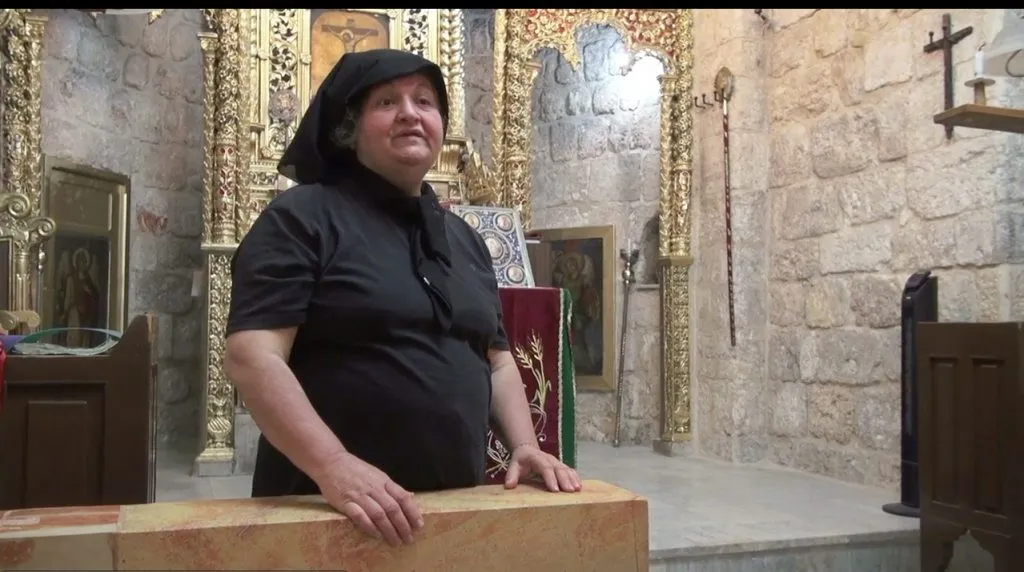
J.R.: Do they really believe they are Jesus?
K.K.: Yes, it is a psychological phenomenon. Suddenly something strikes you and you think you have a mission. You want to share it with people. You hear voices; you are in contact with ‘up above’. When I asked one of them, a Korean man, what kind of contact he had with an angel, he demonstrated—like this!—and shoved me hard. Every one of them is different. One lives in a park and heals people. He has bees. Acupuncture. I also met a man who has lived beside the Dead Sea for seven years. He eats algae, collects rainwater and has dreadlocks covering his entire face. If I managed to say something interesting, he parted them like a curtain. He wears only pants and strings, tarpaulin things on his legs—he wears them because he wants to preserve and remember his natural skin colour. He says one date and spirulina a day are all one needs to live. He stays by the sea because it is warm and his body needs no energy to keep itself warm. Another man took over an industrial chicken shed outside Jerusalem. He came from Chicago because that is the real Jerusalem—it has been archaeologically documented; the remains of a Jewish temple are there.
J.R.: Madness.
K.K.: I am not sure it is such madness. Plenty of people are mad… Madness has different colours and shades. The people I met there have a different hierarchy of values. They choose another kind of life and function on other levels. And they work to rise to those other levels.
J.R.: Do you take them seriously?
K.K.: It is an extraordinary test of oneself. Because you have great expectations about what Jesus should be like, what he should look like… You must approach it with humility. They are free; they do not belong to this system. They are completely uncombed here (Kozyra points to her head). I have never encountered such individuals, such powerful personalities—at least not in such numbers. I miss them; I would like to meet more people like that. Recently I have stopped living it quite so much because I began living this (Kozyra points to the garden).
J.R.: Be careful you do not develop schizophrenia.
K.K.: No… Though perhaps it is not the worst option. My mother cares for a man with schizophrenia. Now he is getting married in that other life. Incredible. Our reality is only one possibility. People forget there are many paths and parallel realities, and the fact that this one pushed through, was selected or evolved is probably accidental. Now you are looking at me as though I were mad. It is simple: there are masses of solutions, but people think there is only one. What you have not been taught to see, you do not see! I think artists have the best chance of brushing against it. The question is one of language—how to communicate it. That is a challenge for me: some of the Jesuses refuse to be filmed. But I prefer something imperfect and unfinished to those old formulas. It seems to me that art now consists of ready-made, safe solutions. Rusted ones. There is a format, no room for experiment. The 1990s were uncompromising. Something mattered to everyone, including institutions—they exhibited powerful, difficult works. It never occurred to me that I was making Animal Pyramid in order to sell it. Too much emotion, too many nerves. It is highly personal and authentic.
J.R.: In a sense it is anti-market: there is only one copy. At the exhibition at the Centre for Contemporary Art, it stood beside a work by Damien Hirst, who toyed with the art market through his million-dollar diamond-encrusted skull.
K.K.: Animal Pyramid beside Hirst. A devilish idea, that exhibition. It placed those British artists—financial superstars, something tabulated to the point of pain—in another context. They were used; they formed a backdrop to the Polish 1990s, when that commercial aspect did not exist. Now our field is money laundering. Those values come from nowhere. A field for speculation and scams, a sick system.
J.R.: Are the people buying it idiots?
K.K.: Nobody here is really an idiot, because everyone is pursuing their own interests. That is why it has all been cemented together, holds together and cannot be moved. Legions of people have jobs and power—because it means monstrous sums of money and networks of dependence. So many people feed off it!
J.R.: And state institutions?
K.K.: Today institutions buy from the market. Commercial galleries mediate between the artist and everybody else. Everything meshes together. Artists who are strong in the market come first. The market is a dangerous censor and acts with force, including upon institutions. The whole thing has been moulded and signed off. If artists take risks, if uncompromising works are made, they are not exhibited because they throw sand in the gears. Everything must be safe and known. It is the same with sponsors—they will not give you money because you are a great artist; they need to know exactly what you will do. You do not get money for what you want, but for whatever funding exists.
J.R.: That is how the third sector works too. State money, EU money… If there is funding from Norway, you make something…
K.K.: …about reindeer. It is the Chopin Year—you write ballets. This happens on a vast scale, with few exceptions. The space of art has collapsed. It is already an empty shell. A blown egg. If anything matters, it is leaving behind a product to put in the drawing room. Empty form, just to keep the wheels turning. This year's Venice Biennale exhibition, The Encyclopedic Palace: everything shown there could easily be replaced by something else and nothing would happen. Jung made drawings—mandalas—they are exhibited; some dental surgeon collected something—it is exhibited. Artists who once impressed me make me want to vomit in such an arrangement. And our revolutionary Artur Żmijewski enters this restaurant and has no problem with it. In that whole litany—doctor collects this, philosopher sculpts that… so a blind man can paint too—that is Żmijewski's work. So warped! Everything individual and creative has been erased there. I had not seen anything like it for a long time, nor felt such disgust and aversion. It is unprecedented. There is absolutely no justification for its functioning. Something has to happen, because it truly makes no sense. The market fucked art.
J.R.: And you?
K.K.: I think I work differently. Do I not? I do not know whether it is still possible to work differently… Jesus—what is it, actually? A film? An installation? Art or documentary? I still do not know. When I made the first instalment, one gallery had a problem with what to do with it because it was not a work for sale. They watched it and their faces fell. Had they known it was not commercial, they would not have exhibited it. Or they would have added a theory. A lot of theory is added to make things monetisable, and they tell you that you see something you fucking do not. Besides, all my projects demand an incredible amount of time. You can stop at the beginning, remain on the surface and occupy yourself with something new. Or you can deepen it and see an ocean opening before you—and you can finish at that stage too.
J.R.: Or you can jump into the ocean. Have you jumped?
K.K.: Not yet, but it would be stupid to give up now.
Warsaw, September 2013
*Joanna Ruszczyk, journalist and contributor to the weekly Newsweek Polska, graduate of the Postgraduate Curatorial Museum Studies programme at the Jagiellonian University, co-founder of the Sztuczna Foundation.