
BEYOND FORMAT
Andrzej Wajs
You must format Him before He can perform
(from a secret instruction manual for Pontius Pilate)
VICTORINE, OLYMPIA, COSIRA
The painter Victorine Meurent, familiar from Manet's celebrated canvas Olympia, is only ostensibly a model. By suspending the ideological and symbolic sanction of the boudoir, she already anticipates the age of performance, if by that term we mean the de-formatting of a distinction fundamental to the history of the visual arts—the distinction between model and artist. Victorine literally steps down from the painting, and I can easily imagine her approaching the painter, who has meanwhile turned into a camera operator, adjusting the camera angle, checking the lighting, scolding the cat and, after finishing another coffee, lazily returning to the bed. She manages the entire scene, regulating its meaning, tension and import. The portraitist is merely her instrument, listening attentively to the director on set. Olympia is not simply a trampling of convention or a local social scandal.
It is a visual passage leading out of the picture frame and into the history of new formations of representation. When, several decades later, Marcel Duchamp calls one of his most recognisable works Nude Descending a Staircase, its title is by no means accidental. It is not a naked woman, tired of the artist's whims, asking for the tedious sitting to end; it is the nude itself, as an emblem and pure form of male visual sensibility, leaving the painting's frame to de-format the universe of representation. Victorine performs. She does more than challenge and provoke the painter's gaze. She creates. She raises a red flag, although the place where she does so is not Chicago but a Paris studio. She lays the foundation for an edifice of new autonomies. Their manifestation is the art made by women during the final decades of the twentieth century.
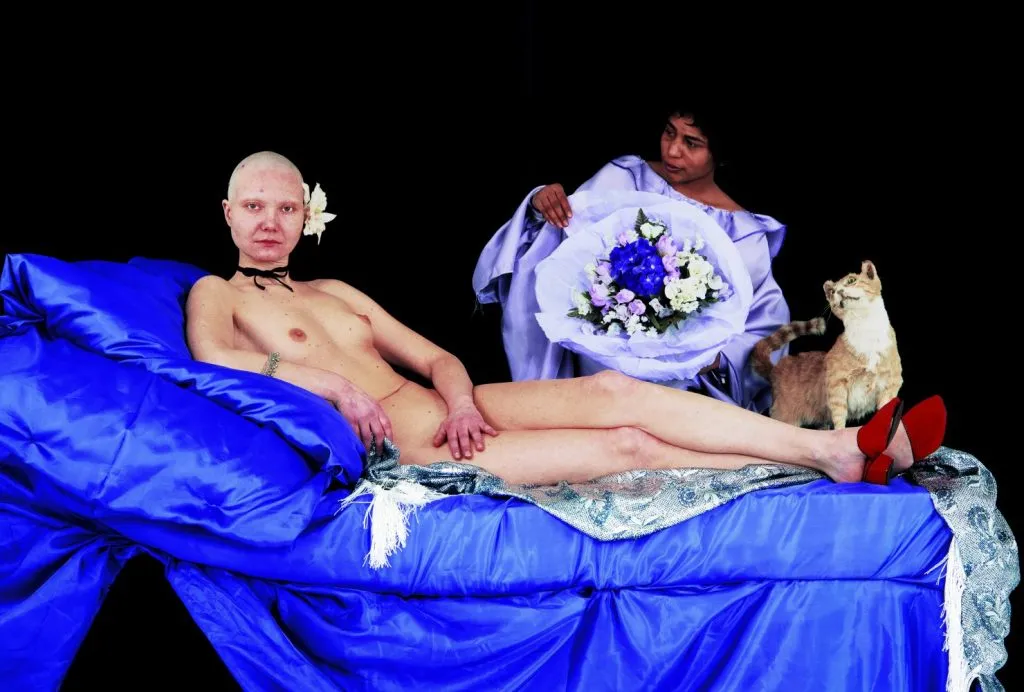
When Katarzyna Kozyra begins work on a photographic transposition of Olympia in 1996, Victorine has long since stepped down from the portrait. She has subsequently been seen in many different places: playing chess naked with an ageing bachelor against the backdrop of The Large Glass; on the streets of Vienna and New York, Amsterdam and Belgrade; in many different guises and costumes, always in another situation.
The bond holding Kozyra's photographic triptych together is the identity of artist and model, described along the boudoir–clinic axis. Nothing could really be more natural. Sooner or later, every courtesan would live out her final days in hospital. Sometimes it was even worse: when a wealthy patron failed to write a cheque in time, the patient would be moved to a poorhouse. I doubt, however, whether any celebrated portrait painter would have conceived the idea of painting her in her final decline, in a hospital bed. A breach of social convention is nothing compared with the horror inspired by ageing, illness and abandonment: the inevitable afflictions of age, the contingency of the body, pain and suffering.
When the artist-performer is ill, the only reasonable solution is to move Olympia to the clinic and cast herself in a double role, all the better to reveal the aformativity of the original work. By de-formatting the image, Kozyra dismantles the entire situation, although she still remains within the realm of visuality. Her Olympia is not a street performer; the spirit of the painted surface continues to preside over the whole installation. Although she shrugs off suggestions of painterly affiliation, the territory of the “enemy” remains her field of action. By photographing herself, she retains a connection with the idiom of representation. An away goal counts double. The absence of canvas and the smell of paint does not bother me. The camera's eye and the staging directly invoke Manet's gesture. Both works share a performative character and a mobile artist–model relationship. For not a moment do we forget that the model playing the role of Olympia is the artist herself. In each case, the play of difference and identity takes place beyond the format of the work, together with all its extra-painterly conditions, including those of medicine and the clinic.
The Olympia motif will henceforth recur throughout Katarzyna Kozyra's work: as an idiom, a trademark and an idiolect uniquely her own. We find it in later works, not only in The Bathhouse, Men's Bathhouse and The Rite of Spring, but also in the video cycle In Art Dreams Come True. It is present wherever the artist's own body, entangled in a project of crossing boundaries set by nature or social sanction, becomes the stake in the game.
Fashionable ideologies suit her no better than the dresses she once told me about. She bought them by weight and hung them in wardrobes, but never wore them. Disguises borrowed from Foucault, Derrida and Kristeva do not become her. A dress covers the body; she wants a costume that exposes it, and she will find one even in her own nakedness when, sporting a grunge goatee and a prosthetic penis, she enters the male sanctuary of a Budapest bathhouse. And again when, at a Berlin club, she offers herself as a gift to the gargantuan Gloria Viagra by performing a public striptease.
When she says in an interview, “I'm an embarrassment”, it is only now, many years later, that I understand what she means. In de-formatting the image frame, she “cuts off” one of its segments, transfers it to another module, in the process trimming away a part of herself and inserting it into an impossible role whose inevitable conclusion is failure. As in the notorious scene of butchering Mozart in the Trento theatre, after months spent training her body under the eye of the merciless Maestro, driven mad by educational mania. Only occasionally does she take revenge, as when, playing Lou Andreas-Salomé, she keeps the canine metamorphoses of Rilke and Nietzsche on a leash.
This casting of herself in different roles, a self-mystification that inevitably verges on self-demystification, could not fail to lead her to Casting (2010). At a public audition, she searches for a woman—or man, because by now we know that gender both does and does not “play a role” in her work—to play herself, inviting others to attempt the experiment. Do you think it is easy being Cosira? Then have a go. And good luck.
ANTI-FORMAT
The spectre of format has accompanied her since childhood: overprotective parents, the demons of domesticity and the phobias of growing up. When what was meant to go into the potty ends up behind the sideboard, we witness her first anti-format, aformative installation. She will repeat this motif many times as a self-aware artist, playing with the difference within her own identity and manipulating her own body in the spaces of the gallery, video and theatre. This awareness of never being who one is, and of being other than what others expect, carries over into the stratification of the medium itself. Her works are a series of tectonic faults: visual forms transferred into modules that do not suit them and led through a “mnemonic passage” into ever new ones. Each of her works remembers and recreates a segment of the one before; every previous work is an “ace up her sleeve” ready to materialise in the next. It is a system of modular dependencies, a selection based on anti-format and deformation. Like a seasoned poker player, she always plays the card that does not fit the hand.
None of her works is a structure defined through the concepts of genre and convention.
In Grzegorz Kowalski's studio, she learnt to think of sculpture as the living mass of a body in a space of movement. She blurred the boundary between object, film and text, and de-formatted the relationships between music, choreography, theatre and performance by introducing animation into The Rite of Spring. In Men's Bathhouse, she traversed the full path of bodily self-transformation, casting herself in roles that nobody but she could play and exposing herself to the threat of lynching and public judgement. In In Art Dreams Come True, she accepted the risk of training herself, disciplining the cycle of her own transformations and manipulating her body's capacity. From boudoir and salon, through slaughterhouse and clinic, she moves into the theatre, reviving the classic Baroque pattern of costume and gender reversal. Except that there everything is properly “acted”, whereas in her work she herself is always at stake. She remains Olympia. Always beyond her format: cropped, cut, on the verge of embarrassment, in the transitional zone between the performer's perfection and the possible fiasco of the role being played.
If what she does is obscene, it is so only in the sense of ob-scenity: the suspension of theatrical convention and its incorporation into a system of self-creation. It takes place offstage and beyond the performance, if by performance we understand a dialogue, characters and narrative complications prepared in advance. What distinguishes a performer from an actor is that, for the former, every role is in some sense secondary, subordinate to the project as a whole, which begins and ends beyond the format of representation. For when the word obscene is spoken in English, we know that it refers to something not only vulgar or unpalatable, but also—and perhaps above all—unfit for the stage. Kozyra the actor-performer shows herself onstage as an “obscene act”, a nude installed within the representation by force of persuasion alone. This happens in In Art Dreams Come True, but found its fullest expression in Men's Bathhouse, where the machinery of staging was thrown entirely out of alignment, thereby highlighting all the more strongly the symbolic meaning of artistic self-analysis and autobiography.
When Matejko places his Copernicus against the astronomical scenery of Frombork's tower, we see a total negation of obscenity. A lumber room full of equipment forms the backdrop to a conversation with God (Believe me, my son, it is not as you think; I was there). The format is perfect, with the enthroned astronomer at its very centre. Had Matejko placed three dwarf monkeys in the frame, playing Monopoly on Ptolemy's map of the world (I don't know whether I can afford Ganymede today), he would have anticipated the age of anti-format and ob-scenity. When Kozyra photographs her Olympia in a clinic on an intravenous drip, while preserving the spirit of the original painting, she immediately transports us to a scene beyond the performance, requiring us to infer all the stratifications already known and described. Her Olympia travels between worlds of visuality, de-formatting the original image. The literal obscenity of the boudoir becomes the ob-scenity of the photographic set: a mobile, self-transforming structure of the phenomenon of visibility, supplemented by video that tears apart the dense stitching of the static installation. It is a classic sewing together and unpicking of modules.
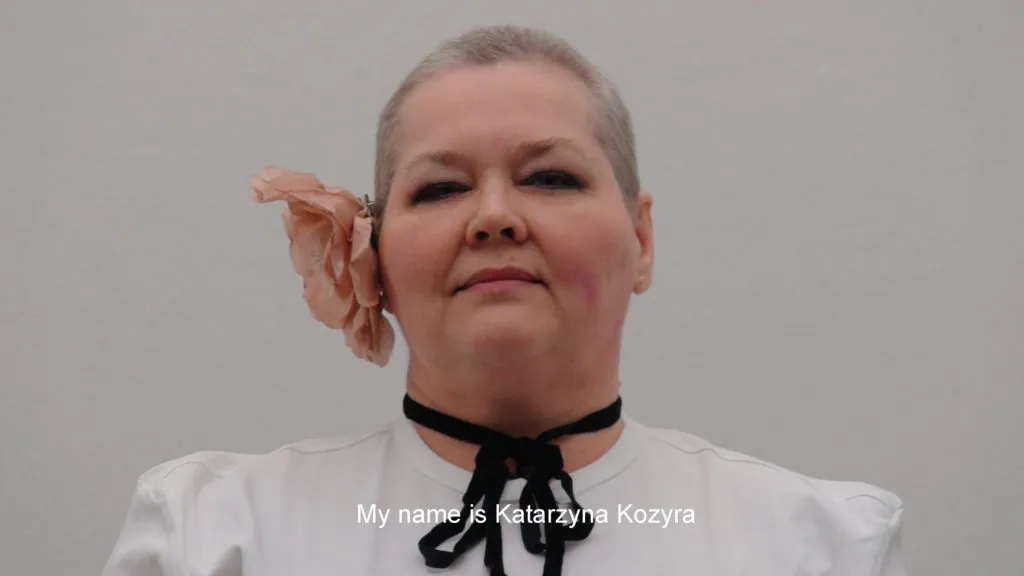
If Kozyra's work arouses the curiosity of critics from different disciplines, “philosophers”, sociologists, specialists in gender conventions and feminists, xenologists, experts in dance, music and choreography, filmmakers and specialists in opera and theatre—and in this company I shall mention prosecutors only in passing—it is precisely because her practice is a continual unpicking of formats, a mixing of aesthetic modules, a story about Olympia in the transitional zone between genres and conventions of visuality.
Into the twentieth century's play of difference and identity, she introduced the idea of a subject eroded by a wave of anti-formats: a subject occupying many places at once, unstitched and spliced. “I is another”—she subjected this Rimbaudian bon mot to her own reconstruction, showing artistic creation to mean constantly putting oneself to the test of otherness, an effort to transfer oneself into worlds beyond the domain of the ego, like an endlessly repeated casting call for oneself; a persistent listening for other voices, with all the attendant risk of losing autonomy. This is self-creation under the continual threat of substitution. For we experience the stranger most intensely precisely when they speak on our behalf, while always pleading their own case.
JESUS, WHERE ARE YOU?
I was not pleasantly surprised when I learnt that Kozyra was making a film about Jerusalem syndrome. Her? This artist, always obsessed with self-parody and never denying herself the pleasures of egotism, was going to make a film about religious crackpots? Rehash a subject of religious deviation already digested across millions of pages? Run around with a camera after imaginary Christs? Listen to psychiatrists and anthropologists prattle? Was she, who had made self-mystification her subject, finally going to enter the well-worn path, trampled by thousands of feet, of dispassionate reportage, with all its intellectual shallows and sandbanks? I consoled myself that this was merely a by-product of her search for casting candidates, which had led her quite by accident to Israel. When I saw a short fragment of the film at the Centre for Contemporary Art last winter, I knew something unique was being made.
My conviction grew stronger when she showed me sequences from the larger whole, which had not yet been fully edited. I understood then that the film would be neither a conventional documentary nor a record of any of the phenomena described above. Just as her Olympia had not been a transfer of Manet's subject from canvas.
It is a film whose principal motif and fabric is a certain mysterious absence that many find deeply moving—I hesitate to use the word “non-existence”, which is too risky and too assertive. This absence arouses hunger and a piercing sense of lack. It was filmed against the backdrop of a cultural phenomenon whose syndrome has more in common with theological doubt and mystical anguish than with the clinical pathologies through which modern medicine stigmatises inner religious conflict and ecstasy linked to the geography of worship.
When, under the influence of Neoplatonic visions, particularly those of Pseudo-Dionysius the Areopagite, ancient and early medieval Christology paved the way for the concept and images of the Holy Trinity, a certain disorder entered the celestial household. Ontic asymmetry divided the relationships between the divine persons, introducing an economy of dynamics and tension into a uniform, undisturbed order. Saint Augustine attempted to bring it all under control, initiating the systematic formation known as Imago Trinitatis. Eight centuries after Augustine, Richard of Saint Victor would openly and explicitly juxtapose the Trinitarian structure of the divine with the Trinitarian structure of the human being. In the former, a multiplicity of Persons was posited within the unity of a single substance; in the latter, a multiplicity of substances manifests itself within the unity of a single person. For if God created man in His own image and likeness, then—to paraphrase Voltaire's joke—it would have been improper for man not to return the favour. Amid the analyses and turbulent disputes, the problem of Jesus and His relationship to God the Father and the Holy Spirit also moved to the centre. From the very beginnings of Christological thought, the triune nature of the divine order posed both a difficulty and a serious threat to the autonomy of the man from Nazareth.
Three is a prime number within the natural numbers, divisible only by itself and by one; moreover, one is not a prime number in that system and, in the Aristotelian tradition, was not regarded as a number at all. This is bad news for the Galilean.
The Jesus of the Gospels is an enigmatic figure through and through. We know little about His tastes or reading. He knew Scripture from its written and oral traditions, but the distinction is irrelevant, since He was physically present “with the Father” when it came into being. The Gospel is a sequence of parables and images dominated by the Nazarene's position within the plan of divine creation, His relationship with the Father and the mission entrusted to Him. The appearance of Jesus, also called the Incarnation, is both an ontic fact—the realisation and incarnation of an eternal being—and a historical fact. Teilhard de Chardin calls this moment in the history of the world the Omega Point: the beginning of God's relation to Himself, the leaven of divine self-reflection. In evolutionary terms, it is the boundary at which entropy breaks down and something begins to form that, in terms of contemporary thought, might be called an informational order. In Teilhard's vision, this point coincides with a moment of growth and the process through which Love is reborn.
Jesus, consubstantial with the Father and the Logos, nevertheless poses a problem. Although the Gospels represent Him with a particular visual economy, accurately and succinctly, the ontology of the Holy Trinity—about which the text itself says not a single word—places Him, as it were, “outside the picture”, in a counter-format, as a coexistence within different orders; and something that exists in many places at once can perhaps be understood as a fundamental absence. This understanding of the aformativity of the Son of God originates in apophatic theology, a theory associated primarily with the writings of Pseudo-Dionysius, which generally holds that statements about God can be made only in the negative. At the end of the first millennium, John Scotus Eriugena would call Him “nothingness” outright.
“Christ teaching of the invisible” is how the influential Swiss theologian Hans Urs von Balthasar describes Jesus, also calling Him “the total otherness of God”. Yet if Father and Son are one in the divine order, it is difficult not to conclude that, in teaching of the invisible, Jesus also teaches of Himself—and also of Himself as someone else. Reading the Gospel from the perspective of reflection on the Holy Trinity, we can apply Heisenberg's uncertainty principle to the Nazarene: it is impossible to determine both the momentum and position of a particle with arbitrary precision at the same time. Jesus's spiritual energy and spatial condition are non-complementary. Energy is His word and deed, divine agency; position is a gesture frozen in a motionless pose, weariness in Gethsemane, participation in the community of disciples, the Last Supper, the Passion on the Cross and entombment. The first belongs to an unearthly, invisible order; the second, to the order of the image. Jesus is a person beyond format. In each of His essential parts, He is always “somewhere else”. The impossibility of apprehending Him in all these orders simultaneously is the greatest mystery of faith, while the “Saturday” of the descent into hell, about which theologians remain silent, is its most eloquent symbol. It is the era of His absence. The search for Jesus that forms the subject of Kozyra's film is a continual reckoning with this fact.
De-formatted Jesus regains His format and presence in the sculpture and easel painting of the late Middle Ages, Renaissance and Baroque. He returns to the canvas as an enthroned self-manifestation. This Christ is centred, always at the very middle of the picture. Painting annihilates His otherness, suspending the attributes of the divine condition and uniting spiritual energy and earthly vicissitudes, transcendence and historicism, within a single vision. If The Body of the Dead Christ in the Tomb by Hans Holbein the Younger is terrifying, this is not because it gives visual form to horror and abandonment—as though the idea of God could not accommodate the loss of glory and dignity that is, after all, an essential feature of the Incarnation—but because it is a painterly anti-format, an attempt to show the Son of God beyond the ideology of visibility and iconography that so powerfully stir the imagination of the reader of the Gospels. His dead, corporeal temporality is the historical “here and now”; His muted, extinguished energy is the ahistorical “somewhere else”. The painting manipulates these two orders, inducing the viewer to take a place in one of them. It symbolises the hidden tectonics of the divine order, whose meaning is otherness. It does not matter that the artist originally conceived it as a predella and part of something larger. In the plan of the hidden economy of the Holy Spirit, it was destined to remain precisely what it is for us today: a horizontal counter-format of painting and a dismantling of its meaning. Julia Kristeva is wrong when she writes in Black Sun that “… Holbein's Christ is an inaccessible, distant dead man, though deprived of what lies beyond”. It is not His remoteness, in extreme contrast with the naked fact of death, that inspires horror, but the mechanism within which that opposition functions. This mechanism reflects the inevitable, eternal antinomy of divine being. It is not a question of distance, but of theo-logic. Nor is Prince Myshkin right when, in this context, he speaks of the loss of faith. On the contrary: to see Him unreconciled, at the intersection of glory and doubt, is the entire meaning of faith. Against the background of the general production of painting in its period, this picture is unique—not only because of its dimensions, its suffocating aura and the anatomical precision of its details. Elsewhere, the format schema prevails: symmetrical balance and a concealed anti-Trinitarianism that presents the Trinity as the harmonious coexistence of three divine hypostases, rather than the drama of God seeing Himself in what is other. The Jesus of the Gospels, reduced to a format and visual shorthand, becomes an unwitting patron of the visual arts, with all the consequences of breaking one of the most important commandments whose corpus He had, after all, co-authored with the Father. To Him we owe the existence of our entire system of visuality.

I am absolutely convinced that Katarzyna Kozyra's latest film is not a record of any of the peculiarities associated with Jerusalem as a place, nor a description of a clinical state of ecstatic religiosity. It is a story of lack, absence and hunger: a visual treatise in negative theology, describing the phenomenon of the invisible and unnameable that excites the imagination of people condemned to a perpetual search for themselves. People for whom Jesus of Nazareth—it would be difficult to imagine a greater absurdity—is the symbol and crowning point of identity. A promise. If Kozyra has taken Him as her subject, it is precisely because He is the embodiment of non-identity, and therefore a manifestation of what has always intrigued her most. He is the anti-format of all anti-formats, its most vivid and emphatic exemplification. An artist who decodes identity so relentlessly could not fail to make such a film. The Jesus who remains silent in her image is shown against the cases and narratives of His apostles; it is they who speak and act, sometimes reluctantly and under duress, sometimes with a convert's enthusiasm, more rarely for acclaim.
Jerusalem syndrome is neither a pathology nor a manic delusion, but a fundamental error of the popular optics connected with our perception of the Son of God as Messiah. We dress in His robe, speak His words, imitate His gestures and sometimes even allow ourselves to be crucified. Popular culture seethes with religious symbols, as the history of the music video alone demonstrates. Visual kitsch runs rampant at its centre, inundated by a wave of fashionable ideologies.
The toil, hardship and effort undertaken by the figures in Kozyra's film to seize the presence of the Man from Nazareth do not result from the figure's remoteness or the impossibility of reaching Him with one's hands, heart or reason, according to preference. If He exists, He is quite close, within arm's reach. He exists as a fundamental invisibility whose cultural emblem is the idea of a spiritual journey and the geography of places, together with the inevitable idolatry and mirages of imitation. But the problem with Jesus lies elsewhere. To enter into Him, initiate a bond, observe His gestures and listen to His word is to escape into non-identity. You will not find His identity if you are searching for your own. This is precisely what Kozyra has shown so magnificently. You can only be “like Him”, never Him. And when one of her protagonists continually circles around the motif of abandoning his own ego as a condition of meeting the Messiah, I cannot reconcile this with the fact that he wants this intimacy after regaining his own identity.
What separates us from Jesus is not the dictatorship of the ego—once described more simply and accessibly as vanitas—but the illusion of identity, the obsessive persistence with which faith is associated with a return to oneself, with finding one's sources and roots. As though Jesus were a tree and religiosity a question of orchards and horticulture. The Trinitarian weave of which He is both part and whole always leaves Him outside the picture frame; He cannot be framed within it. The myth of a meeting or conversation, even if it takes the form of prayer, is a manifestation of a fundamental impossibility. If Jerusalem syndrome has any meaning at all, it is as an image of religious incapacity, an attempt to describe the phenomenon of faith in terms that do not fit it: the hopeless effort of a positive theology of the street, searching for Him at the sites of His incidental epiphanies.
Kozyra's conception begins at precisely this point in the dilemma, in the no man's land of transit where negative theology is inclined to abandon its axioms for a moment. This is the sphere of the Holy Spirit's activity—in whose honest intentions I do not entirely believe—the sphere of culture, of which Jesus is the unwitting sponsor, witness and victim. In describing its phenomenon, Hegel used the strange term Verstellung, whose meaning glints with the dialectic of rearrangement, dismantling and concealment. Culture—including, and perhaps above all, Christian culture—is a laborious dismantling of the economy of the triune divine order and a trivialisation of Christ's participation in it. The protagonists of Kozyra's film sense this, attempting their own paths at their own expense and risk. The microphone and camera render their effort with visual reverence, though not without the artist's commentary.
Looking for Jesus is not a documentary in the conventional sense. It is both a diagnosis and a travel diary kept by the artist herself, who at a certain point realises that she is also telling her own story. If she introduces the word “casting” into her vocabulary, it is not merely to issue a public call for herself—after all, she has repeatedly played herself, treating her own identity as a costume. The Jerusalem episode allows her to understand the phenomenon of self-identification more fully because she can now consider it, as it were, from the outside. The principal difference between her and her protagonists is that she has long known that her identity is administered by another—who is, of course, also herself—and that she is merely its tenant without the right of first refusal; they, meanwhile, are utterly convinced that otherness, including cultural alienation, is a blemish they must erase, and that only by finding themselves will they find the way to Jesus, the guarantor and guardian of their subjectivity. If they feel that they are merely its tenants, it is only with His permission. Like the apostles. That is what this film is about.
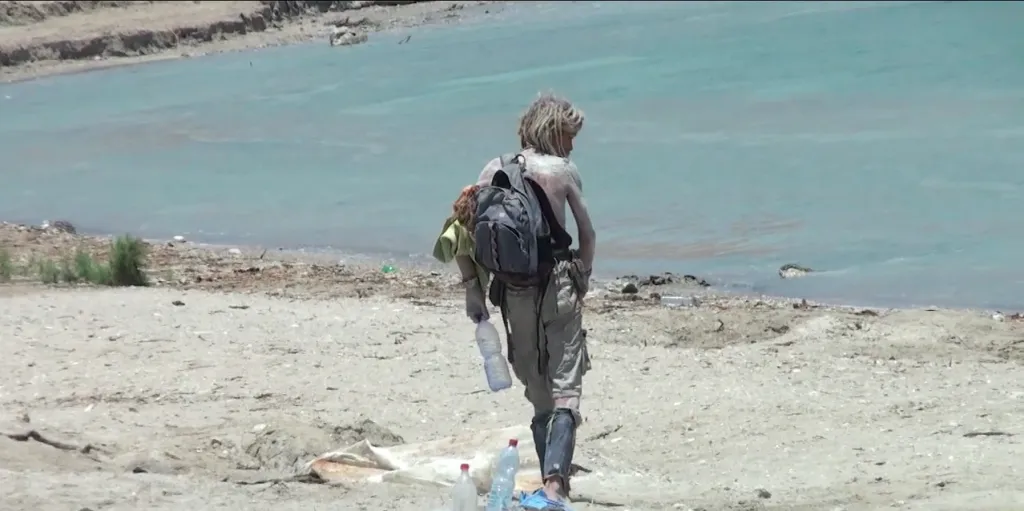
She would not be Cosira if she formatted the image. The sequences of images do not form a uniform succession of events; the outlines of the characters de-format the whole. Displaying her old claws, she effortlessly shifts from the monotony of indolent scenes to a plane of violent exaltation where words vibrate with madness and ecstasy. Her gallery is a genuine mosaic of characters, superbly arranged around motifs from the margins of religious intuition, pop history and visual shorthand. She herself probably does not fully realise how closely these images refer to the history of sacred painting and its ideological sanction. Mark, a Californian on the hot sand beside the Dead Sea, surrounded by scantily clad young women and figures of long-bearded men floating on the waves, is an almost identical copy of the image of John the Baptist transmitted by icons: the ascetic body, naked torso and dishevelled hair, although instead of animal fur he wears surplus army trousers. Covered in sun-protective clay, he resembles a pale grey extraterrestrial streak of light weaving between the suntanned female adepts. The possessed Arkady, originally from Russia, in turn invokes the image of Jesus and Mary Magdalene. A woman nestles against his hands like a faithful dog. Only the feet and oils are missing, although I suspect there may be a selection of sun creams and deodorants in the bathroom at the back.
It is precisely this diversity of characters and turbulent configuration of scenes that determine the work's anti-format. Styles and conventions mingle here: the psychiatric interview with excursions into the lexicon of art; film with installation; the moving photograph of human sculpture with a dispassionate inspection of locations. The author places herself on multiple planes, sometimes relinquishing active participation. She notes, records and manipulates, de-formatting the system and giving us food for thought. It is a film for many audiences: the viewer and lover of art, cultural anthropologists and scholars of deviance. And for herself.
When filming Jostina, the black-clad Syrian servant of the cult and custodian of a relic of the Last Supper, Kozyra doubles her figure in the edit, allowing the woman to speak through two independent channels of the mass of her living body. It is a symbolic representation of the intervention of the Holy Spirit, who commands the priestess to translate speech she does not know into a language she does. “You shall speak in the tongues of many peoples.” And when, in the next shot, still within the same scene, Kozyra shows herself speaking in the voice of the relic's custodian, everything suddenly becomes very clear. Identity is decoded.
The revolutionary Messiah at a tram stop; the hands and voice of a Korean visionary, filtered through a story about a woman who strayed into the men's prayer section—does that remind you of anything?; a hermit living in a painful yet joyful symbiosis with bees; a doctor and miracle worker; Pierre, a supposed descendant of Provençal troubadours and crusaders; a Black convert from Chicago who remembers performing with Sun Ra and in Earth, Wind & Fire—all of them search and perform, continually becoming mired in format. The artist sometimes shows them dispassionately, sometimes tenderly. In her frame, they acquire weight. They are logical and concrete. Their problem is not a fiction. The microphone and camera compel an aura of concentration, interrupted only occasionally by fits of fury.
In looking for Jesus, they are searching for their own identity, unaware that what they ought to seek is difference—as dramatic and illogical as all the experiences of the Man from Nazareth. They suffer defeat and pain. They consume themselves in futile rebellion, only to sink a moment later into the serene melancholy of rejection, literally consumed by the weight of their initiations. They believe their testimony is not of this world. This is the tribute they must pay for participating in the collective insanity of religious clichés. When they enter the path of His experience, wishing to imitate Him, they do not realise that they are landing in the prison of their own egos, from which they so badly wanted to escape.
For now, hope keeps them alive. They simply do not know what their Master knew.
That hope is the first to die.
*Andrzej Wajs is an historian of ideas, translator and essayist. He has translated works by Broch, Husserl, Ingarden and Edith Stein into Polish. He translates philosophical literature and fiction. He is the author of writings on art and numerous translations published in catalogues.